
YOUR QUESTION. A CLEARER NEXT STEP.
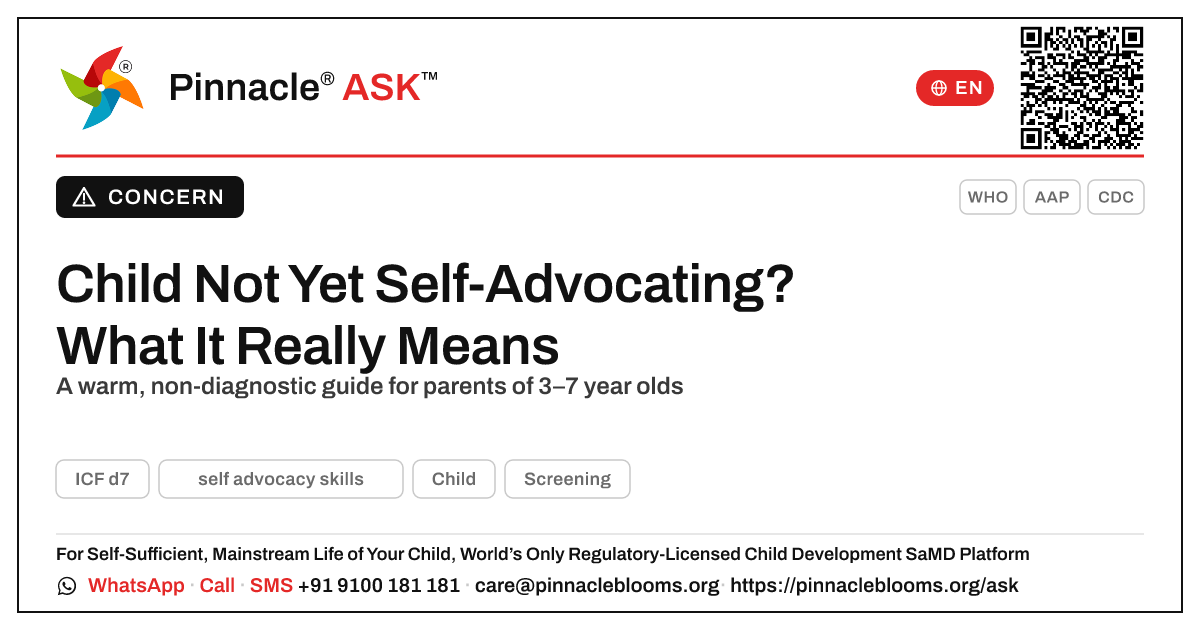
What if my child isn't showing self-advocacy skills yet?
Self-advocacy — asking for help, saying no, making choices — is a skill that only just begins emerging between 3 and 7 years and varies greatly between children. Not yet showing it is usually normal development, not a problem. It is worth a gentle developmental check when it is delayed alongside clear difficulties in talking, understanding or connecting with others.
In this answer 5 sections
If your young child isn't yet speaking up for what they need or want, take heart — for a three-to-seven-year-old, this is a skill that is still very much being built.
In short
Self-advocacy means a child can express what they need, ask for help, say "no" or "stop", and make simple choices about their own day. Between 3 and 7 years, this skill is only just emerging — it grows gradually alongside language, confidence and social understanding, and it varies hugely from child to child. Not yet showing it is usually a sign your child is still developing, not a sign of a problem. It becomes worth a gentle developmental check when self-advocacy is delayed together with clear difficulties in talking, understanding or connecting with others.
What to watch (3–7 years)
Self-advocacy is one thread in the wider weave of communication and social skills. Gentle signs worth a clinician's eye include:
- Asking & telling — rarely asks for help, food, the toilet or a favourite toy, even when clearly wanting something.
- Choices — struggles to make simple choices ("this one or that one?") well beyond age 4.
- Protest & preference — doesn't say or show "no", "more" or "mine"; goes along passively with everything.
- Naming needs — can't tell you when hurt, hungry, tired or upset, when peers the same age can.
- Any loss — stops using words or gestures they once had. This always deserves prompt review.
Remember: a shy or cautious child may simply need more time and warm encouragement. Context matters — many children advocate freely at home yet stay quiet at school.
The science
Self-advocacy (ICF chapter d7, interpersonal interactions) rests on receptive and expressive language, emotional awareness and a sense of safety. It is nurtured, not taught overnight — children who are offered real choices and whose voice is honoured build it fastest. A check looks at the whole picture, not this one skill alone.
The Pinnacle way
A clinical AbilityScore® and any diagnosis are formed only at a Pinnacle Blooms Network centre, under qualified clinician care — never from an online list. Our team looks at where self-advocacy skills sit within your child's overall communication and social development, and where words or confidence are the barrier, our speech therapy team can begin gentle, play-based support.
Trusted sources
WHO ICF framework on interpersonal interactions and relationships (chapter d7); American Academy of Pediatrics guidance (healthychildren.org) on social-emotional milestones; CDC "Learn the Signs, Act Early" developmental resources.
Next step — Trust what you've noticed. Book a developmental check with a Pinnacle clinician for a clear, reassuring picture of how your child communicates and advocates.
This is general information, not a diagnosis — individual assessment and diagnosis require an appropriately qualified healthcare professional.
CONNECT THE ANSWER TO YOUR CHILD’S DAY
Something to notice. Something to discuss.
What to notice
Between 3 and 7, seek a gentle check if your child rarely asks for help or favourite things, can't make simple choices well past age 4, never shows "no" or "mine", can't tell you when hurt or hungry like same-age peers — or loses words or gestures they once had.
In everyday life
Offer real choices every day — "apple or banana?", "red shirt or blue?" — and wait patiently for a response. Honouring even a pointed finger or a single word teaches your child that their voice matters, which is the seed of self-advocacy.
Bring your observations and questions to your child’s professional. Choose activities that suit your child’s comfort, abilities and agreed plan.
Bring your questions to a first visitQuestions families ask
At what age should a child start showing self-advocacy skills?
Early forms appear around 3–4 years as children make simple choices and say "no" or "more". It grows steadily through age 7 and well beyond. There is wide normal variation, so the absence of polished self-advocacy in a young child is rarely a concern on its own.
Is a shy child the same as one lacking self-advocacy skills?
No. Many cautious or shy children advocate freely at home but stay quiet at school. Temperament and confidence play a big part. A check becomes useful only when reluctance to express needs sits alongside delays in language or social understanding.
How can I help my child build self-advocacy at home?
Offer real, simple choices daily, name feelings out loud, and respond warmly when your child expresses a want or a "no". Honouring their voice — even gestures — builds the confidence and language that self-advocacy is made of.
FOLLOW THE SOURCE
References behind this answer.
- Organisation website · further readingWHO ICF — interpersonal interactions & relationships (chapter d7)
- Organisation website · further readingAAP — social-emotional development milestones
- Source referenceCDC — Learn the Signs, Act Early
References are supplied with this answer. An organisation homepage offers further reading; it does not establish an independent review of this page.
Content attribution: SETU Consortium · Pinnacle Blooms Network.
PEOPLE, TOPICS & DEVELOPMENT
See the connections.
Browse the wider question collections connected with this answer’s audience, developmental area and stage.
FROM UNDERSTANDING TO PURPOSEFUL SUPPORT
One question. Your child’s whole life.
Your child’s self-sufficient, mainstream-included life is the purpose from the beginning. At Pinnacle, that purpose shapes what we understand, the goals we choose, the people we bring together, everyday practice and review.
Connect this question with the right support.
Start with your child’s strengths, your observations and what you want everyday life to become.
Make the next conversation useful.
Bring the situations you notice at home or school. We’ll explain a suitable service, centre and first visit, including availability and fees, before you decide.
How PinnacleAI® connects the journeyExplore the seven stages
- 1Understand abilities
A starting picture of your child’s capabilities.
- 2Choose meaningful goals
Readiness and a plan shaped around the child.
- 3Bring the right support together
Suitable therapies and people for those goals.
- 4Carry practice into everyday life
Guidance for family, home and school.
- 5Track and correct
Use observations to adjust the plan.
- 6Reassess and review
Decide what to continue, change or do next.
- 7Grow independence and participation
The child’s life gives each step its purpose.
Explore the whole PinnacleAI® system → · Participation at school and in the community →
PINNACLE’S EVIDENCE, OPEN TO YOU
Look at the evidence behind our work.
Read our research, inspect the original regulatory documents and check what each institutional measure means.
General information supports a conversation with an appropriately qualified professional. Advice, goals and support depend on the individual child.