
YOUR QUESTION. A CLEARER NEXT STEP.
What an AbilityScore of 800-900 Means in Dysgraphia
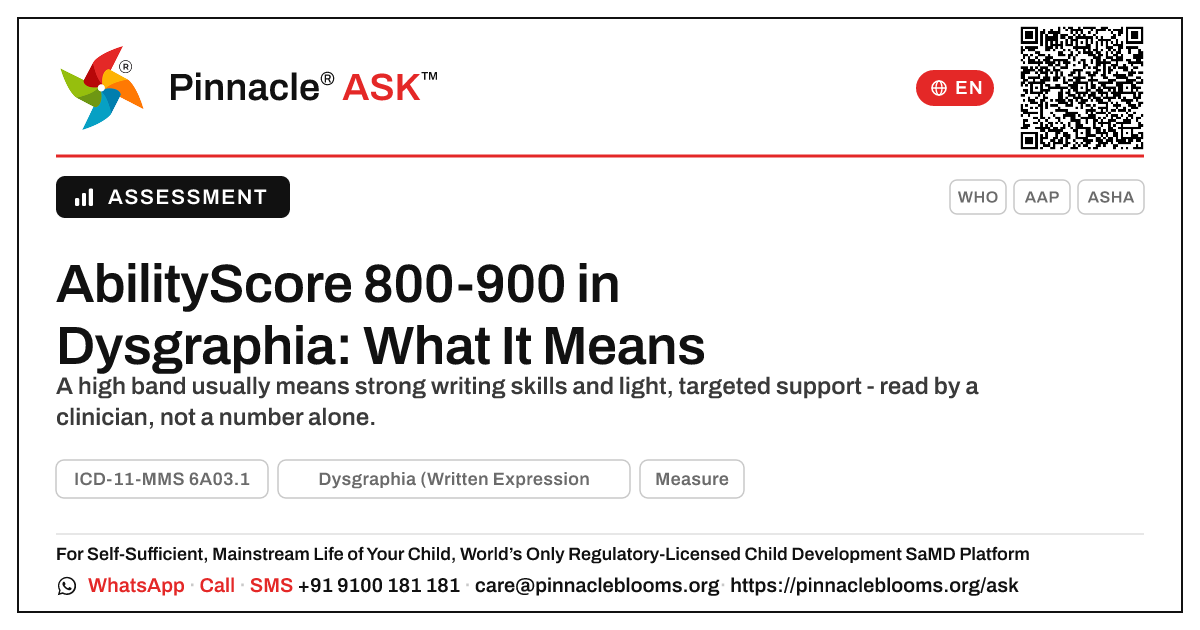
An AbilityScore in the 800-900 band usually reflects strong, well-established written-expression skills needing only light, targeted support - your child is close to age-typical ability. It is a snapshot of their own progress, read and explained by a clinician, never a number alone.
In this answer 5 sections
An AbilityScore in the 800–900 band is genuinely encouraging news — let's unpack what it tells you about your child's written-expression journey.
In short
For a child with Dysgraphia, an AbilityScore® in the 800–900 band generally reflects strong, well-established skills with only light, targeted support needed — your child is close to age-typical written-expression ability, with specific fine-tuning rather than foundational rebuilding. The score is a snapshot of their own progress, compared to their earlier baseline, not a ranking against other children. What it means precisely for your child is read and explained by their clinician — never by a number alone.
What this band usually reflects
AbilityScore® is a clinician-administered structured assessment that captures where a child stands across the skills that feed written expression — handwriting motor control, letter formation, spelling, sentence organisation and the stamina to get thoughts onto the page. A higher band such as 800–900 typically points to:
- Solid foundations — the building blocks of writing are largely in place.
- Targeted, not intensive, support — work is likely to focus on specific gaps (perhaps writing speed, neatness under pressure, or organising longer pieces) rather than starting from the basics.
- Strong momentum — children in this band often respond quickly to focused strategies and accommodations.
Remember: dysgraphia is about how writing comes out, not how clever or capable your child is. A high band confirms what you may already sense — that a bright mind is simply working around a specific writing hurdle.
Reading the band wisely
A band is a guide, not a verdict. Two children with the same score can need different plans, because the pattern behind the number matters more than the number itself. That is why your clinician interprets it alongside classroom samples, your observations at home, and how writing affects your child's confidence. Progress is then tracked by re-measuring against your child's own earlier score — so even quiet gains become visible.
The Pinnacle way
Developmental measurement supports care planning; diagnosis requires an appropriately qualified healthcare professional., under the care of a qualified clinician — never from an online figure or a band alone. Our occupational and writing-skills therapy team turns a score like this into a practical, confidence-building plan, and you can read how the measure works on our AbilityScore® explainer. Across 70+ centres, 25 million+ therapy sessions and 4.95 lakh+ families served, our aim is always the same: your child writing, learning and thriving with ease. Start anytime from our home page.
Trusted sources
WHO ICD-11 (6A03.1, developmental learning disorder with impairment in written expression); American Academy of Pediatrics guidance on learning disorders; American Speech-Language-Hearing Association resources on written-language difficulties.
Next step — Bring your child's AbilityScore® to a clinician who can turn it into a plan. Book an assessment review with a Pinnacle specialist.
This is general information, not a diagnosis — individual assessment and diagnosis require an appropriately qualified healthcare professional.
CONNECT THE ANSWER TO YOUR CHILD’S DAY
Something to notice. Something to discuss.
What to notice
Even with a high band, watch for rising frustration during longer writing tasks, avoidance of homework, or hand fatigue and pain - and share these with your clinician, as the pattern behind the score matters more than the number.
In everyday life
Let your child dictate a story aloud first, then write it - separating ideas from handwriting eases the load and builds confidence. Keep writing sessions short, frequent and praised for effort, not neatness.
Bring your observations and questions to your child’s professional. Choose activities that suit your child’s comfort, abilities and agreed plan.
Bring your questions to a first visitQuestions families ask
Is an AbilityScore of 800-900 a good result for my child with dysgraphia?
It is generally encouraging - the band typically reflects strong, well-established written-expression skills needing only light, targeted support. But the band is read by your clinician alongside writing samples and your observations, because the pattern behind the number matters more than the number itself.
Does a high band mean my child no longer needs therapy?
Not necessarily. A high band often means support can be more focused - perhaps on writing speed, stamina or organising longer pieces - rather than starting from the basics. Your clinician decides the right plan based on the full picture.
Is the AbilityScore a diagnosis of dysgraphia?
No. The AbilityScore is a clinician-administered structured assessment that maps your child's skills and progress. A diagnosis is formed only at a Pinnacle Blooms Network centre, under qualified clinician care - never from a number alone.
FOLLOW THE SOURCE
References behind this answer.
- Organisation website · further readingWHO ICD-11: developmental learning disorder with impairment in written expression
- Organisation website · further readingAmerican Academy of Pediatrics - learning disorders guidance
- Organisation website · further readingASHA - written-language disorders
References are supplied with this answer. An organisation homepage offers further reading; it does not establish an independent review of this page.
Content attribution: SETU Consortium · Pinnacle Blooms Network.
PEOPLE, TOPICS & DEVELOPMENT
See the connections.
Browse the wider question collections connected with this answer’s audience, developmental area and stage.
FROM UNDERSTANDING TO PURPOSEFUL SUPPORT
One question. Your child’s whole life.
Your child’s self-sufficient, mainstream-included life is the purpose from the beginning. At Pinnacle, that purpose shapes what we understand, the goals we choose, the people we bring together, everyday practice and review.
Connect this question with the right support.
Start with your child’s strengths, your observations and what you want everyday life to become.
Make the next conversation useful.
Bring the situations you notice at home or school. We’ll explain a suitable service, centre and first visit, including availability and fees, before you decide.
How PinnacleAI® connects the journeyExplore the seven stages
- 1Understand abilities
A starting picture of your child’s capabilities.
- 2Choose meaningful goals
Readiness and a plan shaped around the child.
- 3Bring the right support together
Suitable therapies and people for those goals.
- 4Carry practice into everyday life
Guidance for family, home and school.
- 5Track and correct
Use observations to adjust the plan.
- 6Reassess and review
Decide what to continue, change or do next.
- 7Grow independence and participation
The child’s life gives each step its purpose.
Explore the whole PinnacleAI® system → · Participation at school and in the community →
PINNACLE’S EVIDENCE, OPEN TO YOU
Look at the evidence behind our work.
Read our research, inspect the original regulatory documents and check what each institutional measure means.
General information supports a conversation with an appropriately qualified professional. Advice, goals and support depend on the individual child.