
YOUR QUESTION. A CLEARER NEXT STEP.
What an AbilityScore of 800–900 in Cognitive means
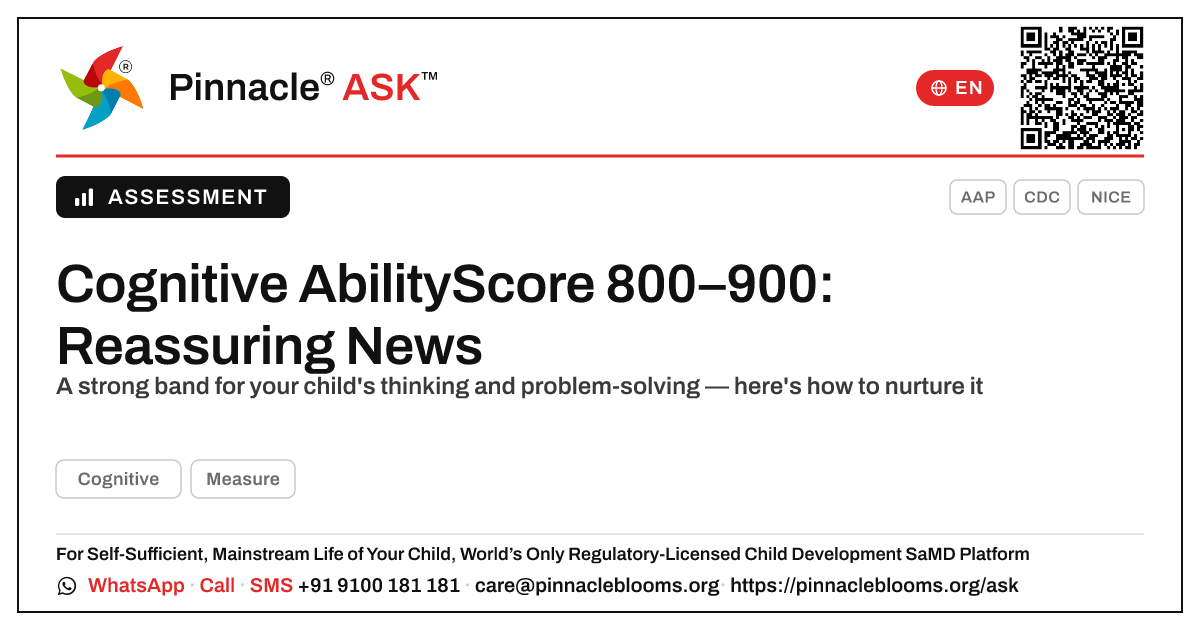
An AbilityScore of 800-900 in the Cognitive domain places your child in a strong, well-developing band - their reasoning, memory, attention and problem-solving are flourishing against their own baseline. It is reassuring news that calls for nurturing and enrichment, not worry. It is a clinician's structured read of strengths, not an IQ score or a fixed label, and any interpretation is confirmed only at a Pinnacle centre.
In this answer 5 sections
A score in this band is genuinely good news — it tells you your child's thinking, reasoning and problem-solving are tracking beautifully against their own developmental baseline.
In short
An AbilityScore® of 800–900 in the Cognitive domain places your child in a strong, well-developing band — their reasoning, attention, memory, problem-solving and early thinking skills are flourishing relative to their own baseline. This is a reassuring result that calls for nurturing and enrichment, not worry. It is a clinician's structured read of strengths, not a fixed label or an IQ figure — and it is one snapshot in your child's unfolding story.
What a score in this band actually tells you
The Cognitive domain looks at how your child takes in, holds and works with information — and a score in the 800–900 band suggests these are coming along confidently:
- Problem-solving — your child explores, experiments and works things out, often finding more than one way to reach a goal.
- Attention and memory — they can hold focus for age-appropriate stretches and recall routines, names and sequences.
- Cause and effect — they understand that actions lead to outcomes, a foundation for early reasoning and play.
- Curiosity and flexibility — they ask, imitate, pretend and adapt, which are the engines of cognitive growth.
A strong band is an invitation to keep stretching gently — offer richer play, open-ended questions and new challenges — while remembering that one domain is only part of the whole child. Cognitive strengths sit alongside language, motor and social-emotional growth, and a good clinician always reads them together.
What this is — and isn't
This band is not an IQ score, not a ceiling, and not a guarantee or a worry. Children grow in spurts and plateaus, so a score is a calm checkpoint, not a verdict. If anything in everyday life still niggles at you — a particular skill, a behaviour, a comparison — it is always worth raising it with your clinician, because your observations matter as much as any number.
The Pinnacle way
Developmental measurement supports care planning; diagnosis requires an appropriately qualified healthcare professional., under the care of a qualified clinician — never from an online figure or a single number read in isolation. The AbilityScore® is a clinician-administered structured assessment that measures your child against their own baseline across domains, turning careful observation into a warm, practical plan. Backed by 2.5 billion+ data points and 25 million+ therapy sessions across 70+ centres, we help you build on strengths. Explore how we support development, learn about cognitive and learning support, and read what the AbilityScore is and how it's calculated.
Trusted sources
CDC and HealthyChildren (AAP) milestone and developmental guidance on early thinking and learning; WHO ICD-11 framework for understanding child development; NICE guidance on children's developmental review.
Next step — Celebrate the strengths and keep them growing. Book an AbilityScore assessment with a Pinnacle clinician to understand your child's full developmental picture and plan the next enriching steps.
This is general information, not a diagnosis — individual assessment and diagnosis require an appropriately qualified healthcare professional.
CONNECT THE ANSWER TO YOUR CHILD’S DAY
Something to notice. Something to discuss.
What to notice
Keep an eye on the whole child, not just the number: if a specific everyday skill, behaviour or a noticeable gap between thinking and language or social skills still worries you, raise it with your clinician — your observations matter alongside any score.
In everyday life
Feed a curious mind with open-ended play: instead of giving answers, ask 'What do you think will happen?' and let your child experiment, predict and try again. Small daily puzzles, pretend play and 'why' conversations keep strong cognitive skills growing.
Bring your observations and questions to your child’s professional. Choose activities that suit your child’s comfort, abilities and agreed plan.
Bring your questions to a first visitQuestions families ask
Is an AbilityScore of 800–900 in Cognitive the same as an IQ score?
No. The AbilityScore is not an IQ test or a fixed intelligence figure. It is a clinician-administered structured read of how your child's thinking, attention, memory and problem-solving are developing against their own baseline, used to guide nurturing and support — never to label.
Does a high Cognitive band mean I don't need any further check?
A strong band is reassuring, but a single domain is only part of the picture. If you have any concerns about language, motor, social or emotional development, it is always worth a gentle clinical review so the whole child is understood together.
Can my child's Cognitive score change over time?
Yes. Children grow in spurts and plateaus, so a score is a calm checkpoint, not a permanent verdict. Regular, enriching play and periodic reviews help you keep building on your child's strengths.
FOLLOW THE SOURCE
References behind this answer.
- Organisation website · further readingHealthyChildren (AAP) — early thinking and learning milestones
- Source referenceCDC — developmental milestones for cognition and learning
- Organisation website · further readingNICE — guidance on children's developmental review
References are supplied with this answer. An organisation homepage offers further reading; it does not establish an independent review of this page.
Content attribution: SETU Consortium · Pinnacle Blooms Network.
PEOPLE, TOPICS & DEVELOPMENT
See the connections.
Browse the wider question collections connected with this answer’s audience, developmental area and stage.
FROM UNDERSTANDING TO PURPOSEFUL SUPPORT
One question. Your child’s whole life.
Your child’s self-sufficient, mainstream-included life is the purpose from the beginning. At Pinnacle, that purpose shapes what we understand, the goals we choose, the people we bring together, everyday practice and review.
Connect this question with the right support.
Start with your child’s strengths, your observations and what you want everyday life to become.
Make the next conversation useful.
Bring the situations you notice at home or school. We’ll explain a suitable service, centre and first visit, including availability and fees, before you decide.
How PinnacleAI® connects the journeyExplore the seven stages
- 1Understand abilities
A starting picture of your child’s capabilities.
- 2Choose meaningful goals
Readiness and a plan shaped around the child.
- 3Bring the right support together
Suitable therapies and people for those goals.
- 4Carry practice into everyday life
Guidance for family, home and school.
- 5Track and correct
Use observations to adjust the plan.
- 6Reassess and review
Decide what to continue, change or do next.
- 7Grow independence and participation
The child’s life gives each step its purpose.
Explore the whole PinnacleAI® system → · Participation at school and in the community →
PINNACLE’S EVIDENCE, OPEN TO YOU
Look at the evidence behind our work.
Read our research, inspect the original regulatory documents and check what each institutional measure means.
General information supports a conversation with an appropriately qualified professional. Advice, goals and support depend on the individual child.