
YOUR QUESTION. A CLEARER NEXT STEP.
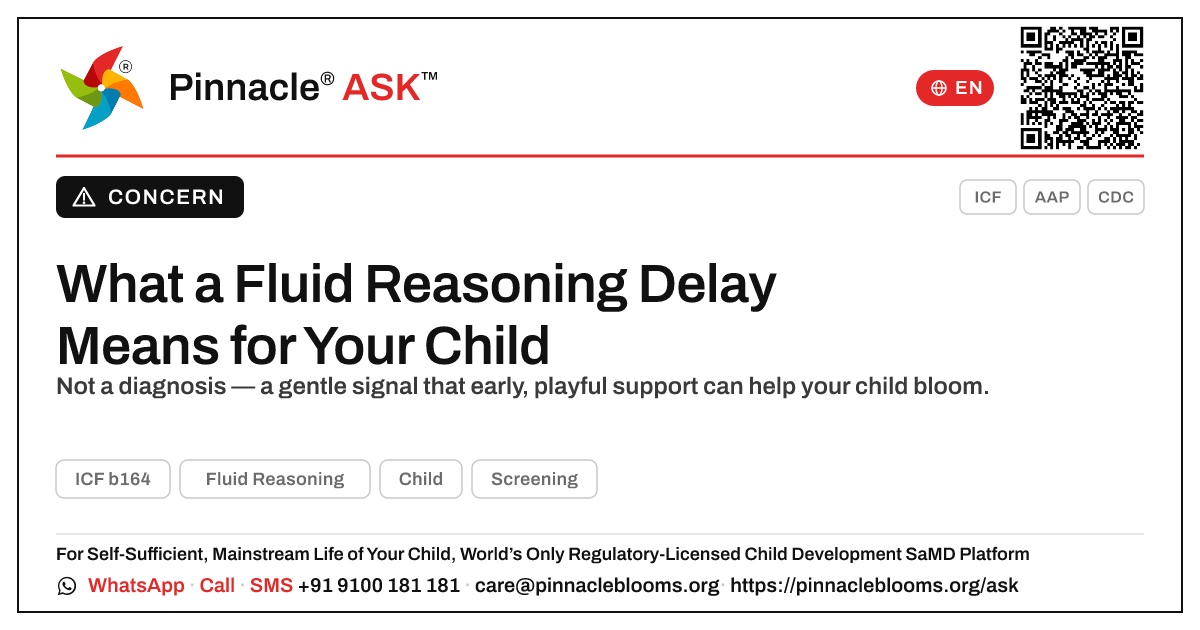
What a Delay in Fluid Reasoning Means for Your Child
A delay in fluid reasoning means your child is taking a little longer to puzzle out new problems, spot patterns and reason through unfamiliar situations — it is not a diagnosis or a fixed limit. Between 3 and 7 years, young minds are highly adaptable, so playful, early support works well. Watch for trouble grasping new game rules, sticking to one approach, or difficulty with 'what happens next' questions, and arrange a calm developmental check rather than waiting.
In this answer 5 sections
Fluid reasoning is your child's wonderful, growing power to puzzle things out — and a delay simply tells us where to gently lend a hand.
In short
Fluid reasoning is how your child works out new problems, spots patterns and reasons through situations they've never seen before — without relying on memorised facts. A delay means this skill is unfolding a little more slowly than expected for your child's age. It is not a diagnosis and not a fixed limit; it is a signal that thoughtful, playful support now can make a real difference, because young minds are beautifully adaptable between 3 and 7 years.
What this means day to day
Children use fluid reasoning when they sort shapes, finish a pattern, guess what comes next in a story, or figure out a new toy. A child who finds these harder may:
- Take longer to grasp new rules in a game, even with kind explaining.
- Stick to one approach and find it hard to try a different way when something doesn't work.
- Struggle with "what happens next" or "why" questions, or with sorting and matching.
- Lean heavily on routine and familiar steps, finding novelty unsettling.
None of these alone means anything is wrong — many bright children simply bloom on their own timeline. The aim is to notice, not to worry.
The science, gently
Fluid reasoning (ICF b164, higher-level cognitive functions) is a core thinking skill that supports problem-solving, early maths and flexible learning. It develops fastest in early childhood, which is exactly why a calm, early look is so valuable — support is most effective while these foundations are still forming. With the right play-based and educational strategies, children often make lovely gains.
The Pinnacle way
A clinical AbilityScore® and any diagnosis are formed only at a Pinnacle Blooms Network centre, under qualified clinician care — never from an online list. Our clinicians look closely at your child's fluid reasoning alongside their many strengths, then shape support through guided play and special education tailored to how your child learns best.
Trusted sources
WHO ICF framework for higher-level cognitive functions (b164); American Academy of Pediatrics guidance (healthychildren.org) on cognitive development and developmental monitoring in early childhood; CDC "Learn the Signs, Act Early" milestone resources.
Next step — Trust what you've noticed. Book a developmental assessment for a warm, clear review of your child's reasoning and learning strengths.
CONNECT THE ANSWER TO YOUR CHILD’S DAY
Something to notice. Something to discuss.
What to notice
Notice if your child takes longer to grasp new game rules even with kind explaining, sticks to one approach and resists trying another way, struggles with 'what happens next' or 'why' questions, or finds sorting, matching and novelty hard. These are reasons for a gentle developmental check between 3 and 7 years — not signs of anything fixed.
In everyday life
Play 'what comes next?' games — line up two red blocks and a blue one and ask what should follow, or pause a familiar story and ask what might happen. Keep it light and praise the trying, not just the answer; this gently strengthens reasoning.
Bring your observations and questions to your child’s professional. Choose activities that suit your child’s comfort, abilities and agreed plan.
Bring your questions to a first visitQuestions families ask
Is a fluid reasoning delay a diagnosis?
No. It is a signal that this thinking skill is unfolding a little more slowly than expected for your child's age. Developmental measurement supports care planning; diagnosis requires an appropriately qualified healthcare professional. under qualified clinician care.
Can fluid reasoning improve with support?
Yes — between 3 and 7 years children's minds are very adaptable. Play-based problem-solving, pattern games and tailored special-education strategies often help children make meaningful gains.
What age should I seek a check?
If you notice persistent difficulty with new problems, patterns or flexible thinking in the 3-to-7-year range, a calm developmental check is wise rather than waiting — early support is most effective.
FOLLOW THE SOURCE
References behind this answer.
- Source referenceICF b164
- Organisation website · further readingAAP · Cognitive development in early childhood
- Source referenceCDC · Learn the Signs, Act Early
References are supplied with this answer. An organisation homepage offers further reading; it does not establish an independent review of this page.
Content attribution: SETU Consortium · Pinnacle Blooms Network.
PEOPLE, TOPICS & DEVELOPMENT
See the connections.
Browse the wider question collections connected with this answer’s audience, developmental area and stage.
FROM UNDERSTANDING TO PURPOSEFUL SUPPORT
One question. Your child’s whole life.
Your child’s self-sufficient, mainstream-included life is the purpose from the beginning. At Pinnacle, that purpose shapes what we understand, the goals we choose, the people we bring together, everyday practice and review.
Connect this question with the right support.
Start with your child’s strengths, your observations and what you want everyday life to become.
Make the next conversation useful.
Bring the situations you notice at home or school. We’ll explain a suitable service, centre and first visit, including availability and fees, before you decide.
How PinnacleAI® connects the journeyExplore the seven stages
- 1Understand abilities
A starting picture of your child’s capabilities.
- 2Choose meaningful goals
Readiness and a plan shaped around the child.
- 3Bring the right support together
Suitable therapies and people for those goals.
- 4Carry practice into everyday life
Guidance for family, home and school.
- 5Track and correct
Use observations to adjust the plan.
- 6Reassess and review
Decide what to continue, change or do next.
- 7Grow independence and participation
The child’s life gives each step its purpose.
Explore the whole PinnacleAI® system → · Participation at school and in the community →
PINNACLE’S EVIDENCE, OPEN TO YOU
Look at the evidence behind our work.
Read our research, inspect the original regulatory documents and check what each institutional measure means.
General information supports a conversation with an appropriately qualified professional. Advice, goals and support depend on the individual child.