
YOUR QUESTION. A CLEARER NEXT STEP.
What developmental conditions can late talking point to?
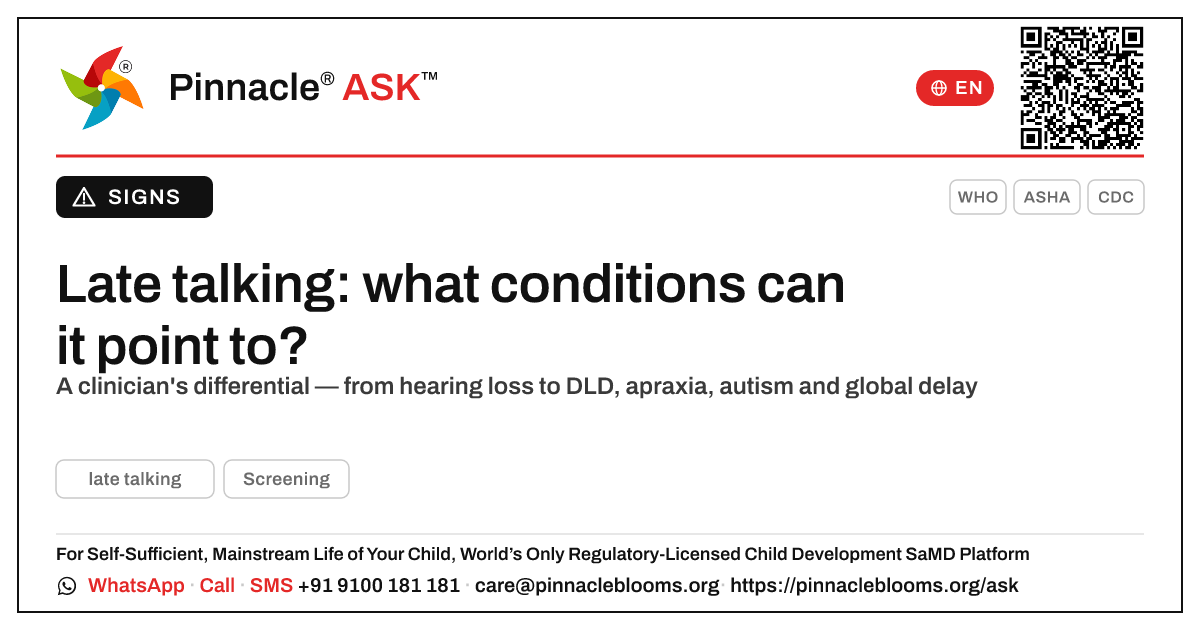
Late talking is a presenting sign, not a diagnosis. Its differential includes hearing loss (exclude first), developmental language disorder, childhood apraxia of speech, autism spectrum, and global developmental delay or intellectual disability — alongside late talkers who normalise. Refer with a parallel hearing check when there are no single words by 16 months, no two-word phrases by 24 months, or any regression.
In this answer 5 sections
A child who is slow to talk rarely arrives with a label — they arrive with a pattern worth situating. Late talking is a symptom, not a diagnosis, and the differential is what makes the next step precise.
In short
Late talking is a presenting sign, not a condition in itself. The differential spans hearing loss, developmental language disorder, autism spectrum, global developmental delay or intellectual disability, childhood apraxia of speech, and a sizeable group of late talkers who normalise — but it must never be attributed to a single cause without first excluding hearing impairment. Refer when a child has no single words by 16 months, no two-word phrases by 24 months, or any loss of acquired words at any age.
What late talking can point to
Hearing and structural causes — exclude first
- Sensorineural or conductive hearing loss, including chronic otitis media with effusion — the single most important exclusion before any language workup
- Oromotor or structural anomalies affecting feeding and articulation
Communication and language conditions
- Developmental language disorder (DLD) — language deficit out of proportion to non-verbal ability, without an associated biomedical condition
- Childhood apraxia of speech — motor speech planning difficulty, often with inconsistent errors and limited consonant inventory
- Late language emergence — expressive delay in an otherwise typically developing toddler; many catch up, but a subset persist
Broader neurodevelopmental conditions
- Autism spectrum (ICD-11 6A02) — when delay co-occurs with reduced joint attention, limited gesture, or atypical social reciprocity
- Global developmental delay or intellectual disability (ICD-11 6A00) — when language delay sits alongside delay in two or more other domains
- Selective mutism, or delay secondary to significantly reduced language exposure
When to refer
"Wait and see" is appropriate only for the isolated, gesturing, socially-engaged late talker with normal hearing and comprehension — and even then with active monitoring. Refer for a hearing assessment in parallel for every late talker. Escalate when delay is mixed receptive-expressive, when comprehension is also weak, when there is any regression, or when social-communication or motor red flags coexist. A child need not meet full criteria for any ICD-11 category to warrant onward multidisciplinary assessment and early speech therapy.
The Pinnacle way
Pinnacle Blooms Network supports the referral pathway with structured, multi-domain developmental profiling. The clinician-administered AbilityScore® gives an objective communication and cross-domain baseline that complements your clinical impression and tracks change once therapy begins. It supports — and does not replace — your judgment: Developmental measurement supports care planning; diagnosis requires an appropriately qualified healthcare professional. under qualified clinician care, never from a screen or score alone.
Trusted sources
Aligned with WHO ICD-11 (6A01 developmental speech or language disorders; 6A02 autism spectrum; 6A00 disorders of intellectual development), CDC "Learn the Signs. Act Early.", the American Speech-Language-Hearing Association, the American Academy of Pediatrics, and NICE developmental guidance.
Next step — to refer a late-talking child, or to set up a clinical referral partnership with your practice, reach the Pinnacle clinical team on WhatsApp: +91 91001 81181.
CONNECT THE ANSWER TO YOUR CHILD’S DAY
Something to notice. Something to discuss.
What to notice
Escalate to prompt referral on any regression (loss of acquired words at any age), on mixed receptive-expressive delay where comprehension is also weak, or when language delay coexists with social-communication or motor red flags — these warrant action over monitoring, and a hearing assessment in every case.
In everyday life
High-yield consult check: confirm a hearing screen has been done, then assess comprehension (does the child follow simple commands without gesture?), gesture use, and joint attention. Weak comprehension alongside delayed speech raises the threshold for referral, not reassurance.
Bring your observations and questions to your child’s professional. Choose activities that suit your child’s comfort, abilities and agreed plan.
Bring your questions to a first visitQuestions families ask
Is late talking always a sign of a developmental disorder?
No. Many toddlers with isolated expressive delay — good comprehension, gesture and social engagement — catch up without intervention. The clinical task is to distinguish these late talkers from those whose delay signals hearing loss, developmental language disorder, autism or global delay. Active monitoring with a hearing check is the safe default.
What should be excluded first in a late-talking child?
Hearing impairment. Sensorineural loss and chronic otitis media with effusion are the most important and most treatable causes, and must be excluded before any language-specific workup or attribution to a neurodevelopmental condition.
When does late talking warrant onward referral rather than monitoring?
Refer when there are no single words by 16 months, no two-word phrases by 24 months, weak comprehension alongside delayed expression, any loss of acquired words at any age, or coexisting social-communication or motor red flags. A formal label is not needed to justify assessment and early therapy.
FOLLOW THE SOURCE
References behind this answer.
- Organisation website · further readingWHO ICD-11: developmental speech or language disorders
- Organisation website · further readingWHO ICD-11: autism spectrum disorder
- Organisation website · further readingASHA: late language emergence and speech-language disorders
- Source referenceCDC: Learn the Signs. Act Early.
References are supplied with this answer. An organisation homepage offers further reading; it does not establish an independent review of this page.
Content attribution: SETU Consortium · Pinnacle Blooms Network.
PEOPLE, TOPICS & DEVELOPMENT
See the connections.
Browse the wider question collections connected with this answer’s audience, developmental area and stage.
FROM UNDERSTANDING TO PURPOSEFUL SUPPORT
One question. Your child’s whole life.
Your child’s self-sufficient, mainstream-included life is the purpose from the beginning. At Pinnacle, that purpose shapes what we understand, the goals we choose, the people we bring together, everyday practice and review.
Connect this question with the right support.
Explore how the relevant service contributes to everyday abilities, then speak with us about your child.
Make the next conversation useful.
Bring the situations you notice at home or school. We’ll explain a suitable service, centre and first visit, including availability and fees, before you decide.
How PinnacleAI® connects the journeyExplore the seven stages
- 1Understand abilities
A starting picture of your child’s capabilities.
- 2Choose meaningful goals
Readiness and a plan shaped around the child.
- 3Bring the right support together
Suitable therapies and people for those goals.
- 4Carry practice into everyday life
Guidance for family, home and school.
- 5Track and correct
Use observations to adjust the plan.
- 6Reassess and review
Decide what to continue, change or do next.
- 7Grow independence and participation
The child’s life gives each step its purpose.
Explore the whole PinnacleAI® system → · Participation at school and in the community →
PINNACLE’S EVIDENCE, OPEN TO YOU
Look at the evidence behind our work.
Read our research, inspect the original regulatory documents and check what each institutional measure means.
General information supports a conversation with an appropriately qualified professional. Advice, goals and support depend on the individual child.