
YOUR QUESTION. A CLEARER NEXT STEP.
No therapy centre in your town? Here's what you can do
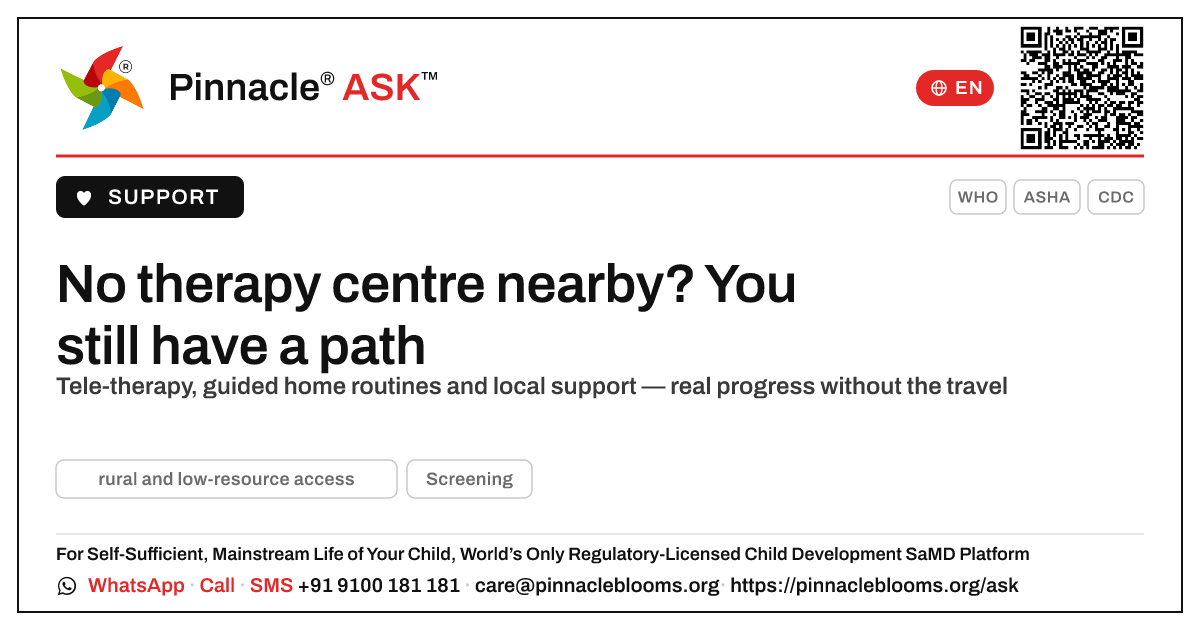
No nearby centre does not mean no progress. Begin with a clinician-led tele-therapy assessment, build a guided home routine in your own language, and use local paediatric or ASHA support between sessions. Consistent home practice, coached remotely, is often more powerful than occasional distant visits. Developmental measurement supports care planning; diagnosis requires an appropriately qualified healthcare professional.
In this answer 4 sections
No centre in your town does not mean no path forward — distance is a logistics problem, and logistics have solutions.
In short
If there's no therapy centre nearby, your child can still make real progress — many of the most powerful gains in early childhood come from what happens at home, every day, in your own language. You can begin with a remote (tele-therapy) assessment and coaching, build a simple home routine that a therapist guides you through, and stay connected for review. Early support that is consistent at home often matters more than support that is occasional and far away.
What you can do right now
Start at home, with intent. Talk through daily routines — bathing, cooking, feeding — naming what you do; this is real language therapy. Get face-to-face, follow your child's interest, pause and wait for any response (sound, look, gesture) and reward it warmly.
Use tele-therapy. A clinician-led video session can assess your child, coach you as the everyday therapist, and review progress — no travel required. This is now a well-established, evidence-backed way to reach families in rural and low-resource settings.
Build a parent-as-coach routine. Short, frequent, playful practice woven into the day beats long, rare sessions. A therapist can hand you a simple weekly plan in your home language.
Loop in local help. Your nearest paediatrician, anganwadi worker or ASHA can support screening and monitoring between remote sessions.
The Pinnacle way
Developmental measurement supports care planning; diagnosis requires an appropriately qualified healthcare professional., under qualified clinician care — but your journey can begin remotely. With 70+ centres across 4 states and tele-therapy reach, families far from a centre can still access structured assessment and speech and developmental therapy guided by our therapists, coaching you as your child's most present teacher.
Trusted sources
WHO Nurturing Care Framework on supporting development through families and communities; ASHA guidance on the effectiveness of tele-practice; CDC milestone-monitoring resources for parents.
Next step — Distance need not delay your child. Book a remote assessment with a Pinnacle clinician and start a home plan this week.
This is general information, not a diagnosis — individual assessment and diagnosis require an appropriately qualified healthcare professional.
CONNECT THE ANSWER TO YOUR CHILD’S DAY
Something to notice. Something to discuss.
What to notice
Watch whether your child responds to short, daily home practice — more sounds, looks, gestures or words over a few weeks. Note any loss of skills or persistent worry, and raise it promptly at a remote review or with your local paediatrician.
In everyday life
Turn one daily routine — say, bath time — into therapy: name each step, pause, and wait for any response from your child before continuing. Five focused minutes, every day, beats an hour once a month.
Bring your observations and questions to your child’s professional. Choose activities that suit your child’s comfort, abilities and agreed plan.
Bring your questions to a first visitQuestions families ask
Can my child really make progress with therapy at home?
Yes. In early childhood, the everyday environment is where most learning happens. A therapist can coach you to weave structured practice into daily routines in your home language, which is consistent and powerful. Home practice guided by a clinician is often more effective than occasional, distant sessions.
Is tele-therapy as good as visiting a centre in person?
Tele-therapy is a well-established, evidence-supported way to assess children and coach parents, especially in rural and low-resource settings. Some hands-on work is best in person, but a great deal — assessment, parent coaching, planning and review — can be done remotely and effectively.
How do I get an assessment if I cannot travel to a centre?
You can begin with a clinician-led remote assessment. A formal clinical AbilityScore and any diagnosis are established only at a Pinnacle Blooms Network centre under qualified clinician care, but the journey, screening and home plan can start remotely.
Who can help me locally between remote sessions?
Your nearest paediatrician, anganwadi worker or ASHA can support screening, monitoring and basic guidance between remote sessions, keeping an eye on milestones and flagging concerns promptly.
FOLLOW THE SOURCE
References behind this answer.
- Organisation website · further readingWHO Nurturing Care Framework — supporting development through families
- Organisation website · further readingASHA — evidence on tele-practice effectiveness
- Source referenceCDC — milestone monitoring for parents
References are supplied with this answer. An organisation homepage offers further reading; it does not establish an independent review of this page.
Content attribution: SETU Consortium · Pinnacle Blooms Network.
PEOPLE, TOPICS & DEVELOPMENT
See the connections.
Browse the wider question collections connected with this answer’s audience, developmental area and stage.
FROM UNDERSTANDING TO PURPOSEFUL SUPPORT
One question. Your child’s whole life.
Your child’s self-sufficient, mainstream-included life is the purpose from the beginning. At Pinnacle, that purpose shapes what we understand, the goals we choose, the people we bring together, everyday practice and review.
Connect this question with the right support.
Start with your child’s strengths, your observations and what you want everyday life to become.
Make the next conversation useful.
Bring the situations you notice at home or school. We’ll explain a suitable service, centre and first visit, including availability and fees, before you decide.
How PinnacleAI® connects the journeyExplore the seven stages
- 1Understand abilities
A starting picture of your child’s capabilities.
- 2Choose meaningful goals
Readiness and a plan shaped around the child.
- 3Bring the right support together
Suitable therapies and people for those goals.
- 4Carry practice into everyday life
Guidance for family, home and school.
- 5Track and correct
Use observations to adjust the plan.
- 6Reassess and review
Decide what to continue, change or do next.
- 7Grow independence and participation
The child’s life gives each step its purpose.
Explore the whole PinnacleAI® system → · Participation at school and in the community →
PINNACLE’S EVIDENCE, OPEN TO YOU
Look at the evidence behind our work.
Read our research, inspect the original regulatory documents and check what each institutional measure means.
General information supports a conversation with an appropriately qualified professional. Advice, goals and support depend on the individual child.