
YOUR QUESTION. A CLEARER NEXT STEP.
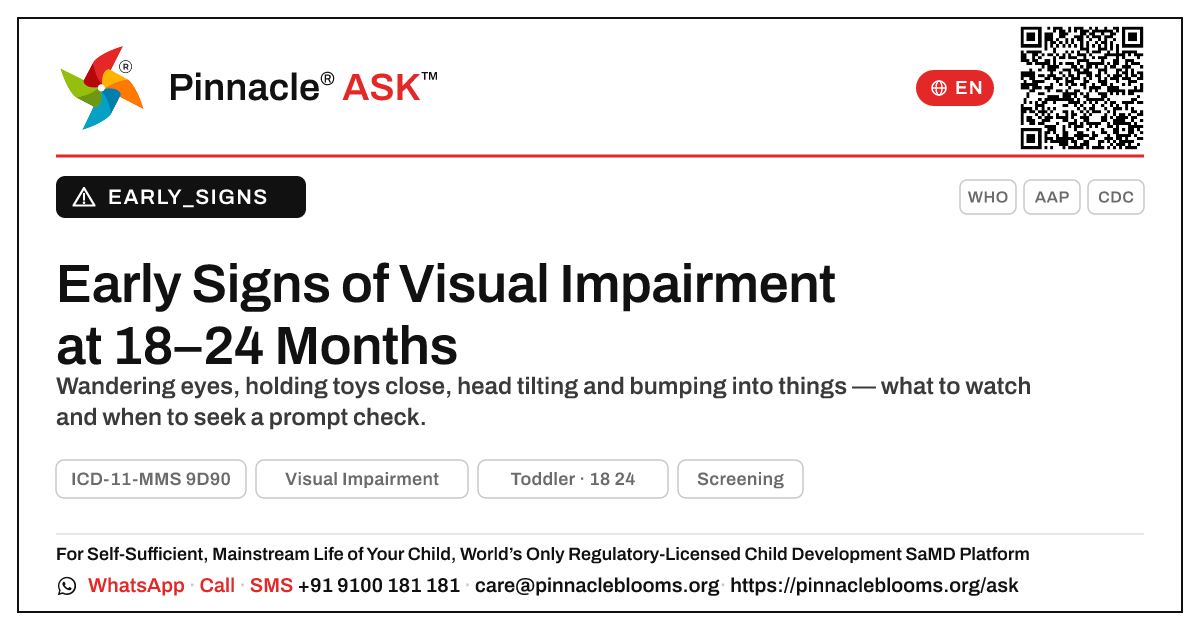
Early Signs of Visual Impairment in an 18-to-24-Month-Old
Between 18 and 24 months, early signs of visual impairment include eyes that don't follow faces or toys, wandering or jiggling eyes, a cloudy pupil, holding objects very close, head tilting, squinting, eye-rubbing, and bumping into things. A white or cloudy pupil, a wandering eye, or jiggling eyes need a prompt same-week check. These are signs to observe and have assessed — not to self-diagnose.
In this answer 5 sections
Many toddlers explore the world boldly — so how do you tell ordinary clumsiness from a child whose eyes may need a closer look?
In short
In an 18-to-24-month-old, early signs of visual impairment include eyes that don't follow your face or favourite toys smoothly, eyes that wander, cross or jiggle, holding objects very close, unusual head tilting or squinting, bumping into furniture, and not pointing at or reaching for distant things. Some children also rub their eyes a lot, dislike bright light, or show little interest in pictures and faces. These are signs to observe and have checked promptly — not to diagnose at home.
Early signs to watch at 18–24 months
How the eyes look and move
- Eyes that consistently cross, drift outward, or wander (especially after about 6 months of age)
- Rapid, repeated jiggling or wobbling of the eyes (nystagmus)
- Cloudy, hazy or unusually grey-white appearance in the pupil, or a constant droopy lid
- One eye that seems to turn while the other points straight
How your child uses their vision
- Not making steady eye contact, or not following your face and moving objects across the room
- Holding toys, books or screens very close to the eyes
- Tilting or turning the head to one side to look, or covering one eye to focus
- Squinting, frequent eye-rubbing, or strong discomfort in bright light
- Bumping into furniture, struggling on stairs, or being unusually cautious in new spaces
- Little interest in distant objects, pictures, or pointing at things across a room
Behaviour and play
- Bringing objects up to the mouth or fingers to explore rather than looking first
- Reaching past or missing toys handed to them
- Becoming upset or withdrawn in busy, visually demanding settings
What tips these from everyday toddler behaviour is consistency (it happens most days, not just when tired), both eyes or one eye repeatedly involved, and any change in how your child looks at or uses the world.
When to seek a check
Vision develops fast in the first two years, and the earlier any difficulty is found, the more can be done to support clear sight and learning. Seek a prompt check if you notice a wandering or jiggling eye, a white or cloudy pupil, eyes that don't follow you, or sudden changes in how your child looks at things — these warrant a same-week visit to your paediatrician or eye specialist. A vision concern can also affect speech, movement and play, so a whole-child view is always wise.
The Pinnacle way
At Pinnacle Blooms Network, we start by understanding how your child experiences and explores their world, and how vision shapes their play, communication and movement. Where helpful, occupational therapy supports your child to use their available vision and other senses confidently in everyday routines. A clinical AbilityScore® and any diagnosis are formed only at a Pinnacle Blooms Network centre under qualified clinician care; nothing here is a diagnosis. You can learn more about visual impairment and supportive next steps with our team. Across 70+ centres in 4 states and 4.95 lakh+ families served, our aim is steady, strengths-first progress.
Trusted sources
Aligned with WHO ICD-11 (9D90 Vision impairment), the American Academy of Pediatrics and HealthyChildren.org guidance on children's eye health and vision screening, and CDC milestone guidance on how young children use their vision.
Next step — if any of these signs sound familiar, book a developmental and vision screen with our clinical team on WhatsApp at +91 91001 81181, and let's understand your child together.
This is general information, not a diagnosis — individual assessment and diagnosis require an appropriately qualified healthcare professional.
CONNECT THE ANSWER TO YOUR CHILD’S DAY
Something to notice. Something to discuss.
What to notice
Watch for eyes that don't follow your face or toys, a wandering or jiggling eye, a cloudy or white pupil, holding objects very close, head tilting, squinting, eye-rubbing, or bumping into furniture — especially when these happen most days or involve one eye repeatedly.
In everyday life
Notice how your toddler looks at a favourite toy across the room: do both eyes find it and follow it smoothly? Gentle daily observation during play tells you more than a one-off test.
Bring your observations and questions to your child’s professional. Choose activities that suit your child’s comfort, abilities and agreed plan.
Bring your questions to a first visitQuestions families ask
Is it normal for my toddler's eyes to cross sometimes?
Occasional, brief eye-crossing can settle in early infancy, but by 18–24 months eyes that consistently cross, drift or wander warrant a prompt eye check. A constant turn in one eye should always be assessed.
My child holds books very close — should I worry?
Holding toys, books or screens very close to the eyes can be a sign of difficulty seeing clearly. If it happens most days, mention it to your paediatrician or eye specialist so vision can be checked.
Could a vision difficulty affect my child's speech and movement?
Yes — vision shapes how children learn to communicate, play and move. That is why a whole-child view is helpful, and why support such as occupational therapy can build confidence using available vision and other senses.
What should make me seek an urgent check?
A white or cloudy pupil, a wandering or jiggling eye, or eyes that don't follow you warrant a same-week visit to your paediatrician or eye specialist. Early detection makes a real difference.
FOLLOW THE SOURCE
References behind this answer.
- Organisation website · further readingWHO ICD-11 — Vision impairment
- Organisation website · further readingHealthyChildren.org — children's eye health and vision
- Organisation website · further readingCDC — developmental milestones and how children use vision
- Organisation website · further readingAmerican Academy of Pediatrics — vision screening guidance
References are supplied with this answer. An organisation homepage offers further reading; it does not establish an independent review of this page.
Content attribution: SETU Consortium · Pinnacle Blooms Network.
PEOPLE, TOPICS & DEVELOPMENT
See the connections.
Browse the wider question collections connected with this answer’s audience, developmental area and stage.
FROM UNDERSTANDING TO PURPOSEFUL SUPPORT
One question. Your child’s whole life.
Your child’s self-sufficient, mainstream-included life is the purpose from the beginning. At Pinnacle, that purpose shapes what we understand, the goals we choose, the people we bring together, everyday practice and review.
Connect this question with the right support.
Start with your child’s strengths, your observations and what you want everyday life to become.
Make the next conversation useful.
Bring the situations you notice at home or school. We’ll explain a suitable service, centre and first visit, including availability and fees, before you decide.
How PinnacleAI® connects the journeyExplore the seven stages
- 1Understand abilities
A starting picture of your child’s capabilities.
- 2Choose meaningful goals
Readiness and a plan shaped around the child.
- 3Bring the right support together
Suitable therapies and people for those goals.
- 4Carry practice into everyday life
Guidance for family, home and school.
- 5Track and correct
Use observations to adjust the plan.
- 6Reassess and review
Decide what to continue, change or do next.
- 7Grow independence and participation
The child’s life gives each step its purpose.
Explore the whole PinnacleAI® system → · Participation at school and in the community →
PINNACLE’S EVIDENCE, OPEN TO YOU
Look at the evidence behind our work.
Read our research, inspect the original regulatory documents and check what each institutional measure means.
General information supports a conversation with an appropriately qualified professional. Advice, goals and support depend on the individual child.