
YOUR QUESTION. A CLEARER NEXT STEP.
Early signs of Specific Learning Disability in a 3-year-old
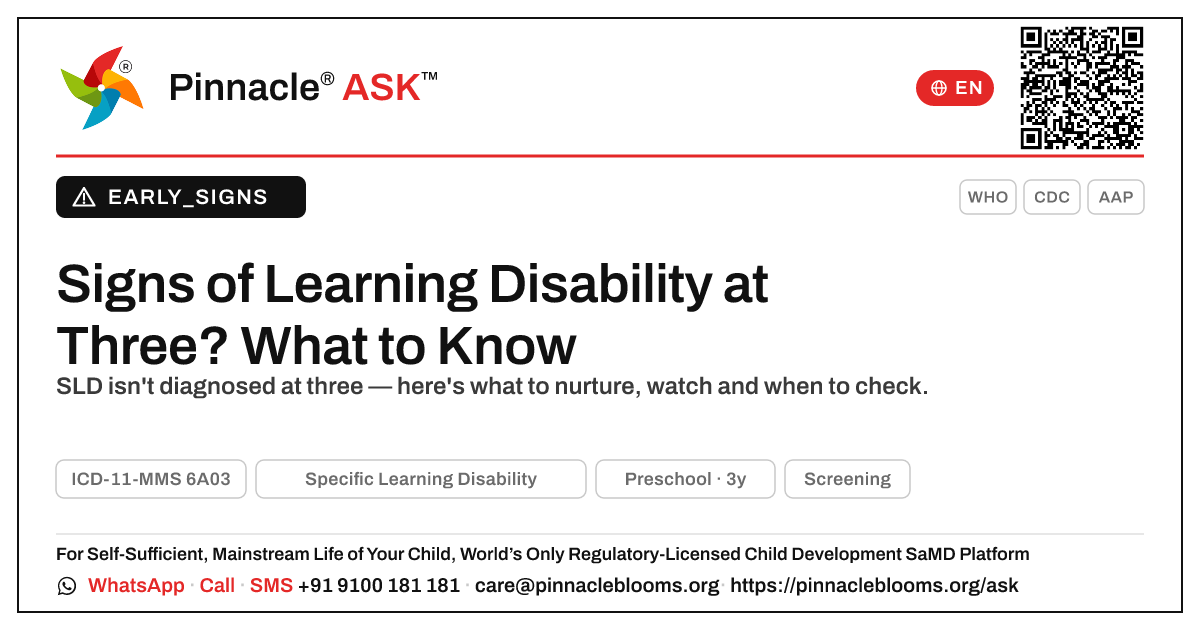
A 3-year-old cannot be diagnosed with Specific Learning Disability — the label becomes meaningful only once formal reading, writing and number work begin, around age 6-8. At three, nurture and gently watch language, attention and play foundations; if something feels off, a general developmental check is the right step, not a learning-disability label.
In this answer 5 sections
At three, a child is just beginning to play with sounds, shapes and stories — so the words "learning disability" can feel frightening before they ever truly apply.
In short
Specific Learning Disability (SLD) is a label that becomes clinically meaningful only once formal schooling and reading, writing and number work begin — usually around age 6–8. A 3-year-old cannot be diagnosed with SLD. What we can do at three is enjoy the early language, attention and play skills that lay the foundation for later learning, and gently watch a few patterns over time. If something feels off, a simple developmental check — not a learning-disability label — is the right next step.
What is appropriate to watch at three
Rather than "signs of SLD," these are the pre-literacy and pre-numeracy foundations worth nurturing and noticing:
- Enjoying being read to, and starting to recognise familiar books, rhymes and songs
- Building vocabulary — using lots of new words and short sentences
- Following simple two-step instructions ("get your shoes and bring them here")
- Playing pretend, scribbling, and showing interest in shapes, colours and counting
- Hearing well and paying attention for short, age-typical stretches
Gentle flags worth a developmental check (not a diagnosis): very few words, difficulty being understood, not following simple instructions, or persistent trouble with attention and play across home and playgroup.
When assessment becomes meaningful
A structured SLD assessment under ICD-11 6A03 becomes appropriate once a child is exposed to formal literacy and numeracy — typically school years. Before then, the priority is rich language, play and a hearing check if speech seems delayed, with watch-and-monitor over time.
The Pinnacle way
At this age we support foundations through special education and, where speech is delayed, speech therapy. A clinical AbilityScore® and any diagnosis are formed only at a Pinnacle Blooms Network centre under qualified clinician care — never from a checklist or a worried afternoon.
Trusted sources
Aligned with WHO ICD-11 (6A03 Developmental learning disorder), CDC "Learn the Signs. Act Early.", the Indian Academy of Pediatrics, and the American Academy of Pediatrics.
Next step — for reassurance and a simple developmental check, reach the Pinnacle team on WhatsApp: +91 91001 81181.
CONNECT THE ANSWER TO YOUR CHILD’S DAY
Something to notice. Something to discuss.
What to notice
Book a developmental check (not an SLD assessment) if a 3-year-old has very few words, is hard to understand, can't follow simple two-step instructions, or shows persistent attention or play difficulties across home and playgroup — and a hearing check if speech seems delayed.
In everyday life
Read aloud daily, point to pictures, sing rhymes and count everyday objects together — this playful exposure builds the very foundations later learning rests on, no flashcards needed.
Bring your observations and questions to your child’s professional. Choose activities that suit your child’s comfort, abilities and agreed plan.
Bring your questions to a first visitQuestions families ask
Can a 3-year-old be diagnosed with a learning disability?
No. Specific Learning Disability is recognised only once a child is exposed to formal reading, writing and number work, usually around age 6-8. At three we nurture language and play foundations and watch over time, rather than apply a label.
What should I watch instead at age three?
Watch the foundations: growing vocabulary and short sentences, enjoying books and rhymes, following simple two-step instructions, pretend play and interest in shapes and counting, and age-typical hearing and attention.
When should I see someone?
If your child has very few words, is hard to understand, doesn't follow simple instructions, or struggles with attention and play across settings, book a general developmental check. This is reassurance and early support — not a learning-disability diagnosis.
FOLLOW THE SOURCE
References behind this answer.
- Source referenceWHO ICD-11 6A04 · Developmental learning disorder
- Source referenceCDC — Learn the Signs. Act Early.
- Organisation website · further readingAmerican Academy of Pediatrics (HealthyChildren.org)
References are supplied with this answer. An organisation homepage offers further reading; it does not establish an independent review of this page.
Content attribution: SETU Consortium · Pinnacle Blooms Network.
PEOPLE, TOPICS & DEVELOPMENT
See the connections.
Browse the wider question collections connected with this answer’s audience, developmental area and stage.
FROM UNDERSTANDING TO PURPOSEFUL SUPPORT
One question. Your child’s whole life.
Your child’s self-sufficient, mainstream-included life is the purpose from the beginning. At Pinnacle, that purpose shapes what we understand, the goals we choose, the people we bring together, everyday practice and review.
Connect this question with the right support.
Explore how the relevant service contributes to everyday abilities, then speak with us about your child.
Make the next conversation useful.
Bring the situations you notice at home or school. We’ll explain a suitable service, centre and first visit, including availability and fees, before you decide.
How PinnacleAI® connects the journeyExplore the seven stages
- 1Understand abilities
A starting picture of your child’s capabilities.
- 2Choose meaningful goals
Readiness and a plan shaped around the child.
- 3Bring the right support together
Suitable therapies and people for those goals.
- 4Carry practice into everyday life
Guidance for family, home and school.
- 5Track and correct
Use observations to adjust the plan.
- 6Reassess and review
Decide what to continue, change or do next.
- 7Grow independence and participation
The child’s life gives each step its purpose.
Explore the whole PinnacleAI® system → · Participation at school and in the community →
PINNACLE’S EVIDENCE, OPEN TO YOU
Look at the evidence behind our work.
Read our research, inspect the original regulatory documents and check what each institutional measure means.
General information supports a conversation with an appropriately qualified professional. Advice, goals and support depend on the individual child.