
YOUR QUESTION. A CLEARER NEXT STEP.
Early Signs of Social Communication Difficulties in a 5-Year-Old
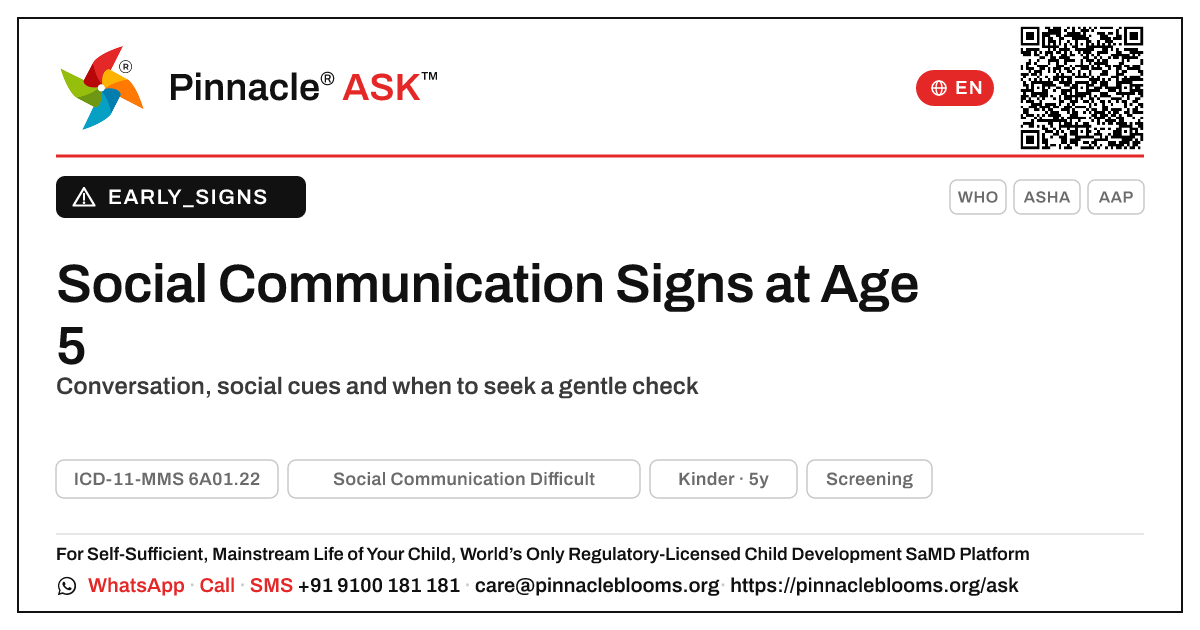
Early signs of social communication difficulties in a 5-year-old include trouble with back-and-forth conversation, not adjusting talk to different people, taking words very literally, and difficulty reading tone, expression and turn-taking. Brief wobbles are normal; persistent patterns across settings warrant a check. Only a clinician can confirm.
In this answer 5 sections
At five, the world of friendships and back-and-forth chatter opens up — so when your child finds the social side of talking tricky, you notice. Spotting it early means gentle help can begin sooner.
In short
Early signs of social communication difficulties in a 5-year-old include trouble holding a back-and-forth conversation, difficulty adjusting how they talk to different people, taking words very literally, and struggling to read social cues like tone, facial expression or turn-taking in play. Children develop these social-language skills at their own pace, so brief wobbles are normal — but when several patterns persist across home, school and play, a developmental check is wise. Only a qualified clinician can tell a passing phase from a difficulty that needs support.
Early signs to watch for
In conversation
- Difficulty keeping a to-and-fro chat going — answers feel one-sided or off-topic
- Talking at people rather than with them, or dominating with a favourite topic
- Trouble starting a conversation or greeting others appropriately
- Not adjusting how they speak with a teacher, a baby or a friend
In understanding meaning
- Taking things very literally — missing jokes, hints, sarcasm or idioms
- Difficulty understanding why someone said something, not just what
- Confusion when language depends on context ("Can you open the window?" taken as a yes/no question)
In play and social cues
- Difficulty reading facial expressions, tone of voice or body language
- Trouble taking turns in conversation or shared play
- Struggling to repair a chat when the listener looks confused
- Finding group play harder than one-to-one
These signs are about using language socially, not about how clearly your child pronounces words or how large their vocabulary is. A child can speak fluently and still find the social rules of talking hard.
When to seek a check
A brief, passing wobble as your child settles into school is common. Seek a developmental check when several of these patterns persist across weeks and across settings — home, kindergarten and play — and especially if they affect making friends, following classroom routines or your child's confidence. Persistent parental worry is itself a good enough reason to ask.
The Pinnacle way
At Pinnacle Blooms Network, support for social communication blends playful speech therapy with peer-play coaching and practical strategies you can use at home. A clinical AbilityScore® and any diagnosis are formed only at a Pinnacle Blooms Network centre under qualified clinician care — never from an online list. With 2.5 billion+ data points and 25 million+ therapy sessions behind our approach, we focus on what your child can build next, one warm step at a time.
Trusted sources
Aligned with WHO ICD-11 (6A01.22, developmental language disorder with impairment of mainly pragmatic language), American Academy of Pediatrics and HealthyChildren.org guidance on social and language development, and ASHA resources on social communication and pragmatics.
Next step — if the social side of talking feels tricky for your 5-year-old, book a gentle developmental screen with the Pinnacle team on WhatsApp: +91 91001 81181.
This is general information, not a diagnosis — individual assessment and diagnosis require an appropriately qualified healthcare professional.
CONNECT THE ANSWER TO YOUR CHILD’S DAY
Something to notice. Something to discuss.
What to notice
Watch whether several patterns — one-sided conversations, very literal understanding, missing social cues, trouble with turn-taking — persist across home, school and play for weeks and affect friendships, routines or confidence. Persistent worry is reason enough to ask for a check.
In everyday life
Build social-language skills through play: narrate feelings aloud ("He looks sad — shall we ask why?"), pause to let your child take a turn in conversation, and use simple turn-taking games like rolling a ball back and forth while chatting.
Bring your observations and questions to your child’s professional. Choose activities that suit your child’s comfort, abilities and agreed plan.
Bring your questions to a first visitQuestions families ask
Is my 5-year-old just shy, or is this a social communication difficulty?
Shyness usually settles once a child feels safe, and shy children still read social cues and chat well one-to-one. Social communication difficulties show up as ongoing trouble with the rules of conversation — turn-taking, reading tone, adjusting to the listener — across many settings, even with familiar people. A clinician can tell the difference.
Can a child speak clearly and still have a social communication difficulty?
Yes. Social communication is about using language socially — taking turns, reading cues, getting jokes and hints — not about pronunciation or vocabulary. A child can speak fluently and still find the social side of talking hard.
At what age can social communication difficulties be assessed?
By around 4 to 5 years, children are expected to manage back-and-forth conversation and adjust how they talk to different people, so this age is meaningful for assessment. A developmental screen at a Pinnacle Blooms Network centre can clarify whether support would help.
FOLLOW THE SOURCE
References behind this answer.
- Source referenceWHO ICD-11: developmental language disorder, pragmatic language
- Source referenceASHA: social communication and pragmatics
- Organisation website · further readingAAP HealthyChildren.org: language and social development
References are supplied with this answer. An organisation homepage offers further reading; it does not establish an independent review of this page.
Content attribution: SETU Consortium · Pinnacle Blooms Network.
PEOPLE, TOPICS & DEVELOPMENT
See the connections.
Browse the wider question collections connected with this answer’s audience, developmental area and stage.
FROM UNDERSTANDING TO PURPOSEFUL SUPPORT
One question. Your child’s whole life.
Your child’s self-sufficient, mainstream-included life is the purpose from the beginning. At Pinnacle, that purpose shapes what we understand, the goals we choose, the people we bring together, everyday practice and review.
Connect this question with the right support.
Explore how the relevant service contributes to everyday abilities, then speak with us about your child.
Make the next conversation useful.
Bring the situations you notice at home or school. We’ll explain a suitable service, centre and first visit, including availability and fees, before you decide.
How PinnacleAI® connects the journeyExplore the seven stages
- 1Understand abilities
A starting picture of your child’s capabilities.
- 2Choose meaningful goals
Readiness and a plan shaped around the child.
- 3Bring the right support together
Suitable therapies and people for those goals.
- 4Carry practice into everyday life
Guidance for family, home and school.
- 5Track and correct
Use observations to adjust the plan.
- 6Reassess and review
Decide what to continue, change or do next.
- 7Grow independence and participation
The child’s life gives each step its purpose.
Explore the whole PinnacleAI® system → · Participation at school and in the community →
PINNACLE’S EVIDENCE, OPEN TO YOU
Look at the evidence behind our work.
Read our research, inspect the original regulatory documents and check what each institutional measure means.
General information supports a conversation with an appropriately qualified professional. Advice, goals and support depend on the individual child.