
YOUR QUESTION. A CLEARER NEXT STEP.
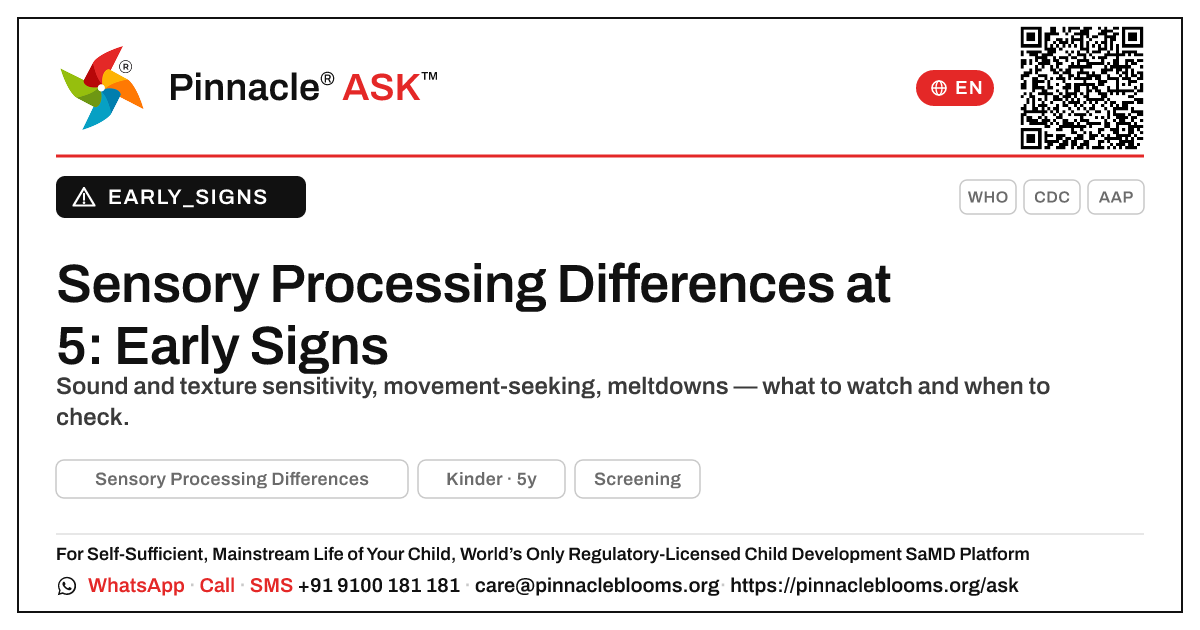
Early Signs of Sensory Processing Differences in a 5-Year-Old
In a 5-year-old, Sensory Processing Differences show as being easily overwhelmed by noise, textures or crowds, or strongly seeking movement, pressure and crashing — patterns that persist across home and school and disrupt daily routines. These are differences to support, not faults, and only a clinician can confirm.
In this answer 5 sections
Your five-year-old covers their ears at parties, refuses certain clothes, or crashes into everything — and you wonder whether it's a phase or something to understand better.
In short
Sensory Processing Differences mean a child takes in and responds to everyday sensations — sound, touch, movement, light, taste — differently from most peers their age. In a 5-year-old, this can look like being easily overwhelmed by busy or noisy places, or seeking lots of intense movement and pressure. These are differences to understand and support, not faults — and only a clinician can tell whether what you're seeing needs help.
Signs to watch in a 5-year-old
Over-responsive (sensitive)
- Covers ears at ordinary sounds — vacuum, hand-dryer, school assembly
- Strong dislike of clothing tags, seams, socks, or certain food textures
- Distressed by messy play, haircuts, nail-cutting or tooth-brushing
- Easily overwhelmed in crowded, bright or noisy places
Under-responsive or sensory-seeking
- Constantly on the move — crashing, jumping, spinning, bumping into things
- Seeks tight hugs, squeezing or rough-and-tumble more than peers
- Doesn't seem to notice mess, pain or being called
- Mouths or chews objects, clothing or pencils
Everyday impact
- Trouble settling for circle-time, meals or sleep
- Big meltdowns around transitions, dressing or grooming
- Avoids playground equipment, or seems unusually fearful of movement
Occasional quirks are normal. What matters is a pattern that appears across home and school and gets in the way of daily routines.
The science, simply
The brain constantly filters and organises sensory information so a child can respond calmly and flexibly. When that filtering works differently, ordinary sensations can feel too much or too little — which shows up as the behaviours above. A play-based occupational therapy approach helps a child's nervous system learn to regulate, building comfort and participation.
The Pinnacle way
A clinical AbilityScore® and any diagnosis are formed only at a Pinnacle Blooms Network centre under qualified clinician care — never from an online list. Our therapists map your child's unique sensory processing profile and build a warm, strengths-first plan.
Trusted sources
Aligned with WHO ICD-11, CDC "Learn the Signs. Act Early.", the Indian Academy of Pediatrics, and the American Academy of Pediatrics (HealthyChildren.org).
Next step — if these patterns feel familiar, book a developmental check with the Pinnacle clinical team on WhatsApp: +91 91001 81181.
This is general information, not a diagnosis — individual assessment and diagnosis require an appropriately qualified healthcare professional.
CONNECT THE ANSWER TO YOUR CHILD’S DAY
Something to notice. Something to discuss.
What to notice
Watch for patterns that persist across home and school and disrupt eating, sleep, dressing or learning. Seek a check sooner if meltdowns are frequent and intense, or if your child avoids most movement play or seems fearful of ordinary activity.
In everyday life
Build in regular 'heavy work' — carrying a small backpack, pushing a laundry basket, animal-walks before circle-time. This calming proprioceptive input helps many children feel more regulated and ready.
Bring your observations and questions to your child’s professional. Choose activities that suit your child’s comfort, abilities and agreed plan.
Bring your questions to a first visitQuestions families ask
Is sensory sensitivity in a 5-year-old normal?
Occasional sensitivities are very common and often part of typical development. What's worth a closer look is a consistent pattern that appears across home and school and interferes with daily routines like eating, dressing, sleep or play.
Are Sensory Processing Differences the same as autism?
No. Sensory processing differences can occur on their own, and they can also appear alongside autism, ADHD or other developmental profiles. A clinician can help understand the full picture rather than assuming one label.
What helps a child with sensory processing differences?
Play-based occupational therapy is the most common support, helping a child's nervous system learn to regulate while building comfort and participation at home and school. A clinician designs the plan around your child's unique profile.
FOLLOW THE SOURCE
References behind this answer.
- Source referenceWHO ICD-11
- Source referenceCDC — Learn the Signs. Act Early.
- Organisation website · further readingAmerican Academy of Pediatrics (HealthyChildren.org)
References are supplied with this answer. An organisation homepage offers further reading; it does not establish an independent review of this page.
Content attribution: SETU Consortium · Pinnacle Blooms Network.
PEOPLE, TOPICS & DEVELOPMENT
See the connections.
Browse the wider question collections connected with this answer’s audience, developmental area and stage.
FROM UNDERSTANDING TO PURPOSEFUL SUPPORT
One question. Your child’s whole life.
Your child’s self-sufficient, mainstream-included life is the purpose from the beginning. At Pinnacle, that purpose shapes what we understand, the goals we choose, the people we bring together, everyday practice and review.
Connect this question with the right support.
Explore how the relevant service contributes to everyday abilities, then speak with us about your child.
Make the next conversation useful.
Bring the situations you notice at home or school. We’ll explain a suitable service, centre and first visit, including availability and fees, before you decide.
How PinnacleAI® connects the journeyExplore the seven stages
- 1Understand abilities
A starting picture of your child’s capabilities.
- 2Choose meaningful goals
Readiness and a plan shaped around the child.
- 3Bring the right support together
Suitable therapies and people for those goals.
- 4Carry practice into everyday life
Guidance for family, home and school.
- 5Track and correct
Use observations to adjust the plan.
- 6Reassess and review
Decide what to continue, change or do next.
- 7Grow independence and participation
The child’s life gives each step its purpose.
Explore the whole PinnacleAI® system → · Participation at school and in the community →
PINNACLE’S EVIDENCE, OPEN TO YOU
Look at the evidence behind our work.
Read our research, inspect the original regulatory documents and check what each institutional measure means.
General information supports a conversation with an appropriately qualified professional. Advice, goals and support depend on the individual child.