
YOUR QUESTION. A CLEARER NEXT STEP.
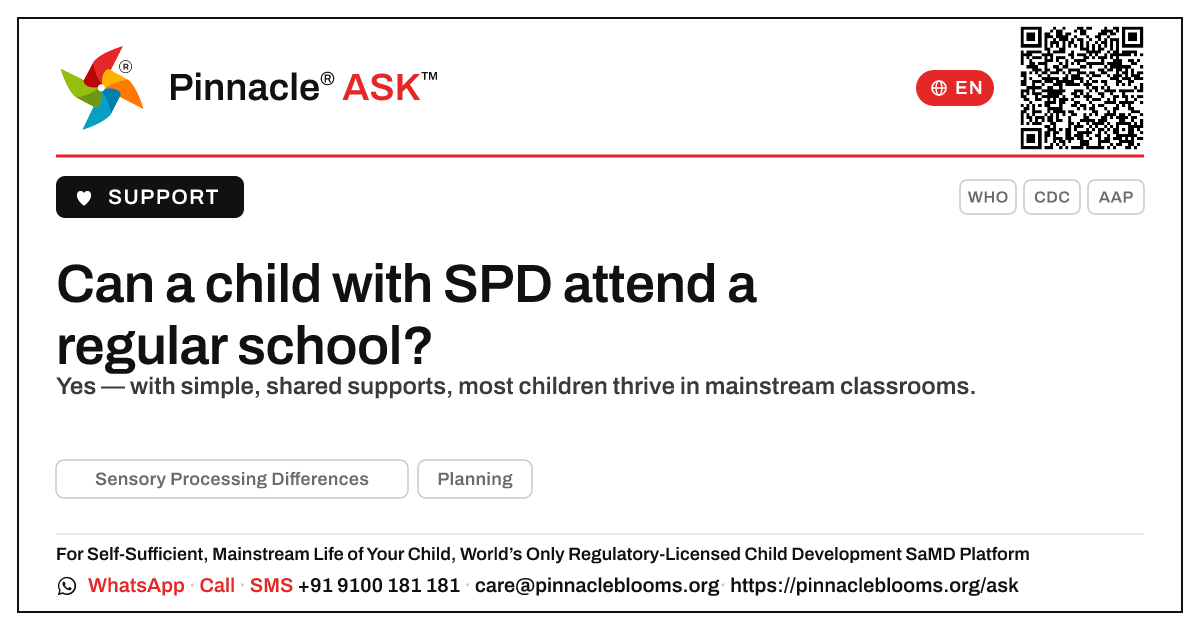
Can a child with Sensory Processing Differences attend a regular school?
Yes — children with sensory processing differences can attend regular schools and most thrive with small, shared adjustments like quiet spaces, predictable routines and sensory-friendly seating. If days are a daily struggle, an occupational therapist can build a practical school plan. Only a clinician confirms a profile.
In this answer 5 sections
Yes — with the right understanding around them, children with sensory processing differences can absolutely thrive in a regular classroom.
In short
Yes. A child with Sensory Processing Differences can attend a mainstream school, and most do beautifully with small, thoughtful supports. Sensory differences are about how a child takes in and responds to the world — bright lights, loud assemblies, scratchy uniforms, busy corridors — not about intelligence or ability to learn. The goal is to adjust the environment a little, not to hold the child back.
What helps in a regular classroom
Most children settle well when school and family share a few simple strategies:
- Sensory-friendly seating — away from the doorway, fan or noisiest corner
- A calm-down option — a quiet space or a brief movement break before a child reaches overwhelm
- Predictable routines and warnings before transitions, assemblies or fire drills
- Small tools — ear defenders for loud events, a fidget, a cushion, or flexible uniform fabric
- A shared note between teacher and parent so everyone reads the same signals
These are low-cost, everyday adjustments — and they often help the whole class, not just one child.
When to seek a little extra support
If your child is melting down daily, refusing school, exhausted by midday, or unable to focus because the room feels overwhelming, that is a signal to bring in an occupational therapist. A clinician can identify the specific triggers and build a practical school plan — often the difference between a child who copes and a child who flourishes.
The Pinnacle way
A clinical AbilityScore® and any diagnosis are formed only at a Pinnacle Blooms Network centre, under the care of a qualified clinician — never from an online form. Our occupational therapy team measures your child against their own baseline, maps their unique sensory profile, and gives you and the school a clear, doable plan. The aim is always the same: your child included, settled and learning in the mainstream.
Trusted sources
WHO ICD-11; CDC 'Learn the Signs. Act Early.'; Indian Academy of Pediatrics; American Academy of Pediatrics (HealthyChildren.org).
Next step — If school days feel like a daily struggle, let's understand why. Book a sensory assessment with a Pinnacle occupational therapist.
This is general information, not a diagnosis — individual assessment and diagnosis require an appropriately qualified healthcare professional.
CONNECT THE ANSWER TO YOUR CHILD’S DAY
Something to notice. Something to discuss.
What to notice
Watch for daily meltdowns, school refusal, exhaustion by midday, or a child who cannot focus because the room feels overwhelming — these signal it is time to involve an occupational therapist.
In everyday life
Build a tiny 'reset' habit before known triggers — a few deep pushes against a wall, a squeeze of a fidget, or two minutes in a quiet corner before assembly. Predictable, calming and easy for any teacher to allow.
Bring your observations and questions to your child’s professional. Choose activities that suit your child’s comfort, abilities and agreed plan.
Bring your questions to a first visitQuestions families ask
Does my child need a special school for sensory processing differences?
Usually no. Most children with sensory differences do well in a mainstream classroom with small adjustments such as a calmer seat, predictable routines and a quiet space to reset. A special setting is rarely needed for sensory differences alone.
What simple supports can I ask the school for?
Sensory-friendly seating away from noise and doorways, warnings before transitions and loud events, a quiet calm-down option, and small tools like ear defenders or a fidget. A shared note between you and the teacher keeps everyone reading the same signals.
When should I involve an occupational therapist?
If your child melts down daily, refuses school, is exhausted by midday, or cannot focus because the environment overwhelms them. An OT can identify triggers and build a practical, school-ready plan.
FOLLOW THE SOURCE
References behind this answer.
- Source referenceWHO ICD-11
- Source referenceCDC — Learn the Signs. Act Early.
- Organisation website · further readingAmerican Academy of Pediatrics (HealthyChildren.org)
References are supplied with this answer. An organisation homepage offers further reading; it does not establish an independent review of this page.
Content attribution: SETU Consortium · Pinnacle Blooms Network.
PEOPLE, TOPICS & DEVELOPMENT
See the connections.
Browse the wider question collections connected with this answer’s audience, developmental area and stage.
FROM UNDERSTANDING TO PURPOSEFUL SUPPORT
One question. Your child’s whole life.
Your child’s self-sufficient, mainstream-included life is the purpose from the beginning. At Pinnacle, that purpose shapes what we understand, the goals we choose, the people we bring together, everyday practice and review.
Connect this question with the right support.
Explore how the relevant service contributes to everyday abilities, then speak with us about your child.
Make the next conversation useful.
Bring the situations you notice at home or school. We’ll explain a suitable service, centre and first visit, including availability and fees, before you decide.
How PinnacleAI® connects the journeyExplore the seven stages
- 1Understand abilities
A starting picture of your child’s capabilities.
- 2Choose meaningful goals
Readiness and a plan shaped around the child.
- 3Bring the right support together
Suitable therapies and people for those goals.
- 4Carry practice into everyday life
Guidance for family, home and school.
- 5Track and correct
Use observations to adjust the plan.
- 6Reassess and review
Decide what to continue, change or do next.
- 7Grow independence and participation
The child’s life gives each step its purpose.
Explore the whole PinnacleAI® system → · Participation at school and in the community →
PINNACLE’S EVIDENCE, OPEN TO YOU
Look at the evidence behind our work.
Read our research, inspect the original regulatory documents and check what each institutional measure means.
General information supports a conversation with an appropriately qualified professional. Advice, goals and support depend on the individual child.