
YOUR QUESTION. A CLEARER NEXT STEP.
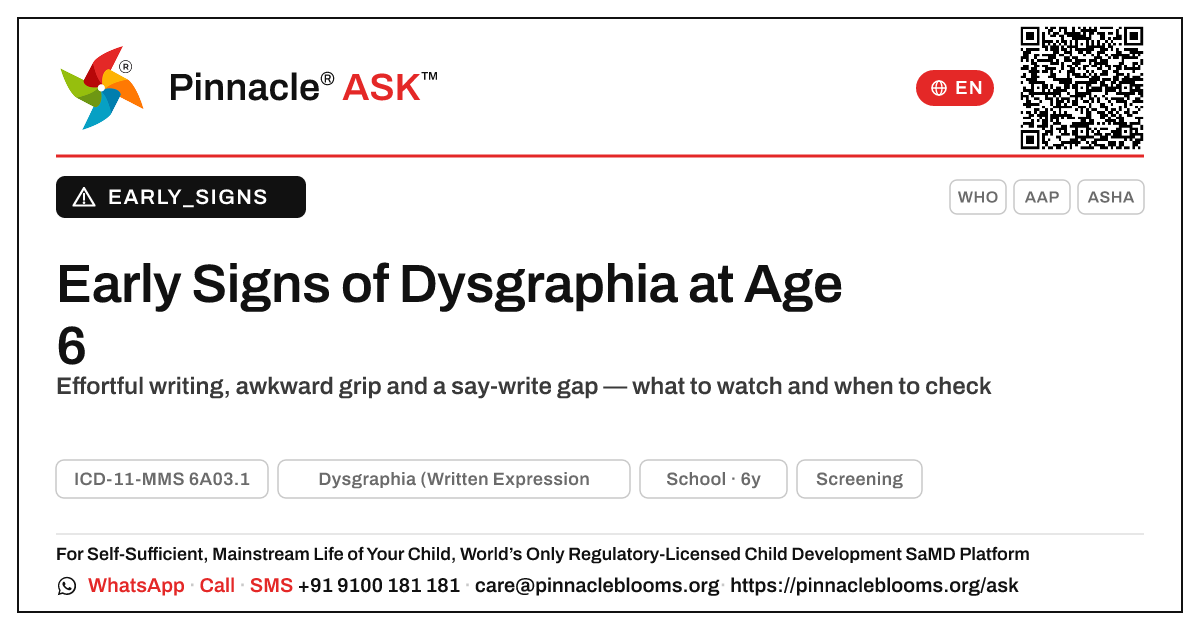
Early Signs of Dysgraphia in a 6-Year-Old
Early signs of dysgraphia in a 6-year-old include very effortful, slow or messy writing, an awkward pencil grip, reversed or uneven letters that float off the line, and a gap between spoken ideas and what reaches the page. Some struggle is normal at this new skill, but marked, persistent difficulty out of step with clear thinking warrants a check. Only a clinician can confirm.
In this answer 5 sections
The first wobbly letters are a joy — but when writing stays a daily struggle while everything else races ahead, a parent notices. Knowing the early signs helps you support your child early and gently.
In short
Early signs of dysgraphia in a 6-year-old include very effortful, slow or messy handwriting, an awkward or tight pencil grip, letters that are reversed, mixed in size or floating off the line, and a gap between what your child can say and what they can get down on paper. Some struggle at this age is normal as writing is a brand-new skill — but when difficulty is marked, persistent and out of step with your child's clear thinking and speaking, a developmental check is wise. Only a qualified clinician can tell a slow-blooming writer from a true written-expression difficulty.
Early signs to watch for
Around the hand and pencil
- An awkward, tight or unusual pencil grip; the hand tiring or hurting quickly
- Pressing too hard or too lightly; frequently breaking pencil tips
- Very slow, laboured writing that takes far longer than peers
Around letters and the page
- Letters and numbers reversed or muddled (b/d, p/q) well beyond the early settling-in stage
- Inconsistent letter size, spacing and shape; words drifting off the line
- Mixing capitals and small letters within words; trouble copying from the board
Around getting ideas onto paper
- A big gap between rich spoken ideas and what ends up written
- Avoiding or becoming upset at writing tasks; many incomplete pieces
- Frequent omitted or jumbled letters and words despite knowing them aloud
These signs are not about laziness or lack of effort — writing blends fine-motor planning, memory and language all at once, and any link in that chain can make it hard.
When to seek a check
At six, some untidiness and the odd reversal are completely normal — handwriting is still forming. "Watch and support" is reasonable for a child who is steadily improving. Seek a developmental check when the difficulty is marked, persists across the school year and home, and clearly lags behind your child's speaking, reading and thinking, or when writing brings real distress or avoidance. Persistent worry from you or your child's teacher is itself a good reason to ask.
The Pinnacle way
At Pinnacle Blooms Network, support for written expression blends fine-motor and handwriting work, occupational therapy and confidence-building strategies, tailored to how your child learns best. A clinical AbilityScore® and any diagnosis are formed only at a Pinnacle Blooms Network centre under qualified clinician care — never from an online list. With 2.5 billion+ data points and 25 million+ therapy sessions behind our approach, we focus on what your child can build next, one steady step at a time.
Trusted sources
Aligned with WHO ICD-11 (6A03.1, developmental learning disorder with impairment in written expression), American Academy of Pediatrics and HealthyChildren.org guidance on learning differences, and ASHA resources on written-language development.
Next step — if writing feels like a daily struggle for your six-year-old, book a gentle developmental screen with the Pinnacle team on WhatsApp: +91 91001 81181.
This is general information, not a diagnosis — individual assessment and diagnosis require an appropriately qualified healthcare professional.
CONNECT THE ANSWER TO YOUR CHILD’S DAY
Something to notice. Something to discuss.
What to notice
Watch for writing that stays markedly slow, laboured or distressing across the school year and clearly lags behind your child's speaking and thinking — and ask the teacher whether copying from the board and finishing written work are a struggle too.
In everyday life
Make writing playful and low-pressure: practise letters in sand, shaving foam or with chunky crayons, keep tasks short, and praise effort over neatness — building hand strength and confidence matters more than perfect letters at six.
Bring your observations and questions to your child’s professional. Choose activities that suit your child’s comfort, abilities and agreed plan.
Bring your questions to a first visitQuestions families ask
Is it normal for a 6-year-old to reverse letters like b and d?
Yes — occasional letter reversals are common and usually settle as handwriting matures over the early school years. It becomes worth a check only when reversals are frequent, persistent and paired with other writing struggles that lag behind your child's clear speaking and thinking.
Could messy handwriting just mean my child needs more practice?
Often, yes — handwriting is a new skill and improves with practice and stronger hand muscles. The difference with dysgraphia is that the difficulty stays marked and effortful despite practice, and there's a clear gap between what your child can say and what they can get onto paper. A developmental screen helps tell these apart.
Does dysgraphia mean my child is not intelligent?
Not at all. Dysgraphia affects the physical and planning side of writing, not intelligence. Many children with written-expression difficulty have rich ideas and strong thinking — the challenge is getting those ideas onto the page, which the right support can ease.
FOLLOW THE SOURCE
References behind this answer.
- Organisation website · further readingWHO ICD-11: developmental learning disorder with impairment in written expression
- Organisation website · further readingHealthyChildren.org (AAP) on learning differences
- Organisation website · further readingASHA on written-language development
References are supplied with this answer. An organisation homepage offers further reading; it does not establish an independent review of this page.
Content attribution: SETU Consortium · Pinnacle Blooms Network.
PEOPLE, TOPICS & DEVELOPMENT
See the connections.
Browse the wider question collections connected with this answer’s audience, developmental area and stage.
FROM UNDERSTANDING TO PURPOSEFUL SUPPORT
One question. Your child’s whole life.
Your child’s self-sufficient, mainstream-included life is the purpose from the beginning. At Pinnacle, that purpose shapes what we understand, the goals we choose, the people we bring together, everyday practice and review.
Connect this question with the right support.
Start with your child’s strengths, your observations and what you want everyday life to become.
Make the next conversation useful.
Bring the situations you notice at home or school. We’ll explain a suitable service, centre and first visit, including availability and fees, before you decide.
How PinnacleAI® connects the journeyExplore the seven stages
- 1Understand abilities
A starting picture of your child’s capabilities.
- 2Choose meaningful goals
Readiness and a plan shaped around the child.
- 3Bring the right support together
Suitable therapies and people for those goals.
- 4Carry practice into everyday life
Guidance for family, home and school.
- 5Track and correct
Use observations to adjust the plan.
- 6Reassess and review
Decide what to continue, change or do next.
- 7Grow independence and participation
The child’s life gives each step its purpose.
Explore the whole PinnacleAI® system → · Participation at school and in the community →
PINNACLE’S EVIDENCE, OPEN TO YOU
Look at the evidence behind our work.
Read our research, inspect the original regulatory documents and check what each institutional measure means.
General information supports a conversation with an appropriately qualified professional. Advice, goals and support depend on the individual child.