
Dysgraphia (Written Expression Impairment)
Cost-effectiveness of early therapy for dysgraphia
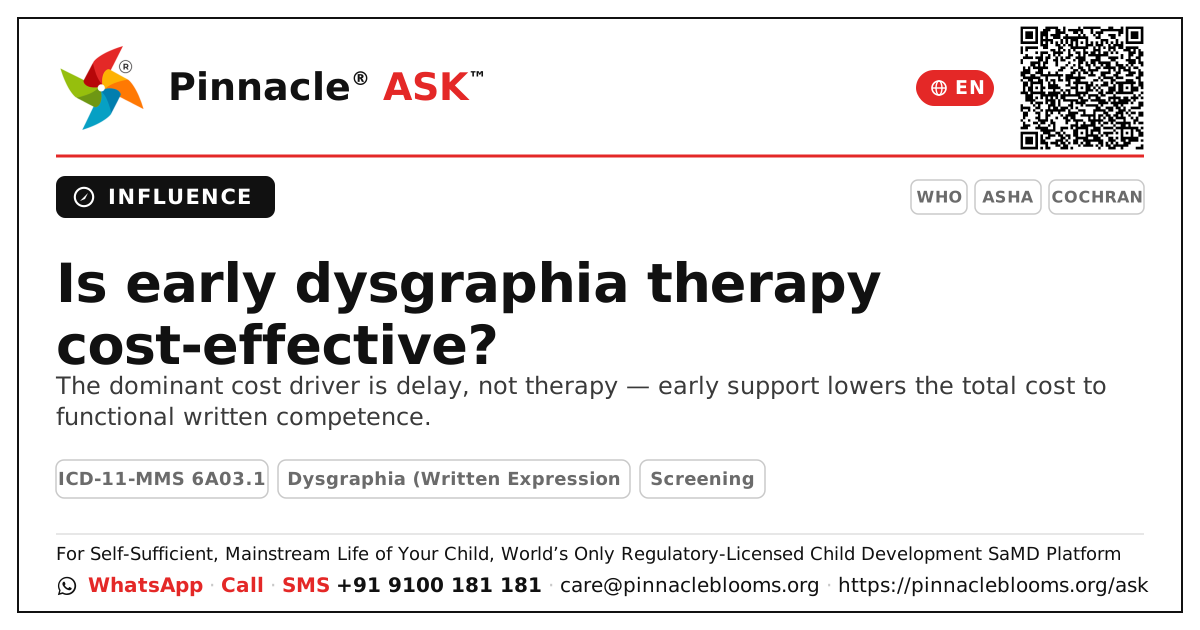
Early therapy for dysgraphia (ICD-11 6A03.1) is cost-effective because the main cost driver is delay: untreated written-expression difficulty compounds into costlier grade repetition, accommodations and secondary mental-health spend. Early, targeted intervention needs fewer therapy hours per unit of progress and lowers the total cost per child reaching functional written competence. A governed AbilityScore baseline makes that spend measurable for payers.
Payers ask a fair question: does early support for a child's written-expression difficulty actually pay back? The evidence says it does — earlier, cheaper, and with fewer downstream costs.
In short
For dysgraphia (ICD-11 6A03.1), early, targeted intervention is among the more cost-effective investments in childhood learning support — because the same skill gap costs far more to remediate later, when it has compounded into academic underachievement, lost classroom time, secondary anxiety and avoidable special-education spend. Intervening while handwriting, spelling and written-expression skills are still forming requires fewer total therapy hours per unit of progress than waiting until a child is years behind peers. The dominant cost driver is delay, not therapy.The economic case, briefly
Written-expression difficulty rarely resolves on its own; untreated, it widens the gap with peers and pulls in costlier services — repeated grade support, examination accommodations, mental-health input for the anxiety and disengagement that follow persistent academic failure. Early intervention shifts spend from these high-cost reactive pathways to lower-cost preventive ones. Three levers make the economics favourable:- Plasticity dividend — fine-motor, orthographic and language-for-writing skills are most responsive when young, so each therapy hour yields more functional gain.
- Avoided downstream cost — earlier remediation reduces years of accommodation, repetition and secondary emotional-health support.
- Targeting precision — a structured baseline directs resources to the children and skill-domains that need them, avoiding undifferentiated spend.
For a payer, the relevant metric is not the price of a session but the total cost per child reaching functional written competence — and that total falls when intervention starts early and is measured against a consistent baseline.
The Pinnacle way
A clinical AbilityScore® and any diagnosis are formed only at a Pinnacle Blooms Network centre, under qualified clinician care — never from an app or an online form. That governed baseline is what makes outcomes measurable and spend accountable for a funding partner. Across 70+ centres, 4.95 lakh+ families served and 12 validated studies, we structure dysgraphia support and occupational therapy around a single, comparable measure — see how the AbilityScore is established.Trusted sources
WHO ICD-11 classification of developmental learning disorder with impairment in written expression; AAP and ASHA guidance on early identification and intervention for learning and written-language difficulties; Cochrane reviews on intervention timing in childhood learning disorders.Next step — Payers and institutions can partner with Pinnacle to model cost-per-outcome for early dysgraphia support across a covered population.
This is general information, not a diagnosis — a clinical AbilityScore® and any diagnosis are formed only at a Pinnacle Blooms Network centre under qualified clinician care.
What to watch
Watch for a widening gap between a child's verbal ability and their written output — slow, effortful or illegible writing, avoidance of writing tasks, and rising frustration or anxiety around written work as schooling progresses.
Try this at home
For payers modelling value, compare total cost per child reaching functional written competence — not per-session price; earlier starts almost always reduce that total.
Trusted sources
Developed by SETU Consortium · Pinnacle Blooms Network · Last reviewed 2026-06-10 · reviewed every 365 days
This is general information, not a diagnosis. A clinical AbilityScore® and any diagnosis are formed only at a Pinnacle Blooms Network centre, under qualified clinician care.
Frequently asked
Is early dysgraphia therapy actually cost-effective, or just cheaper per session?
It is cost-effective on the measure that matters to a funder: total cost per child reaching functional written competence. Early intervention needs fewer therapy hours per unit of progress and avoids costly downstream spend on grade repetition, accommodations and secondary mental-health support.
What is the biggest cost driver in dysgraphia support?
Delay. Written-expression difficulty rarely resolves on its own, so waiting lets the skill gap compound — pulling in more expensive reactive services later. Early, targeted intervention shifts spend from reactive to preventive pathways.
How can a payer measure outcomes for funded dysgraphia support?
Through a consistent, clinician-administered baseline. At Pinnacle Blooms Network, a clinical AbilityScore established under clinician care gives a comparable measure of progress, so a funding partner can track cost against outcome across a covered population.