
YOUR QUESTION. A CLEARER NEXT STEP.
Cost-effectiveness of early therapy for dysgraphia
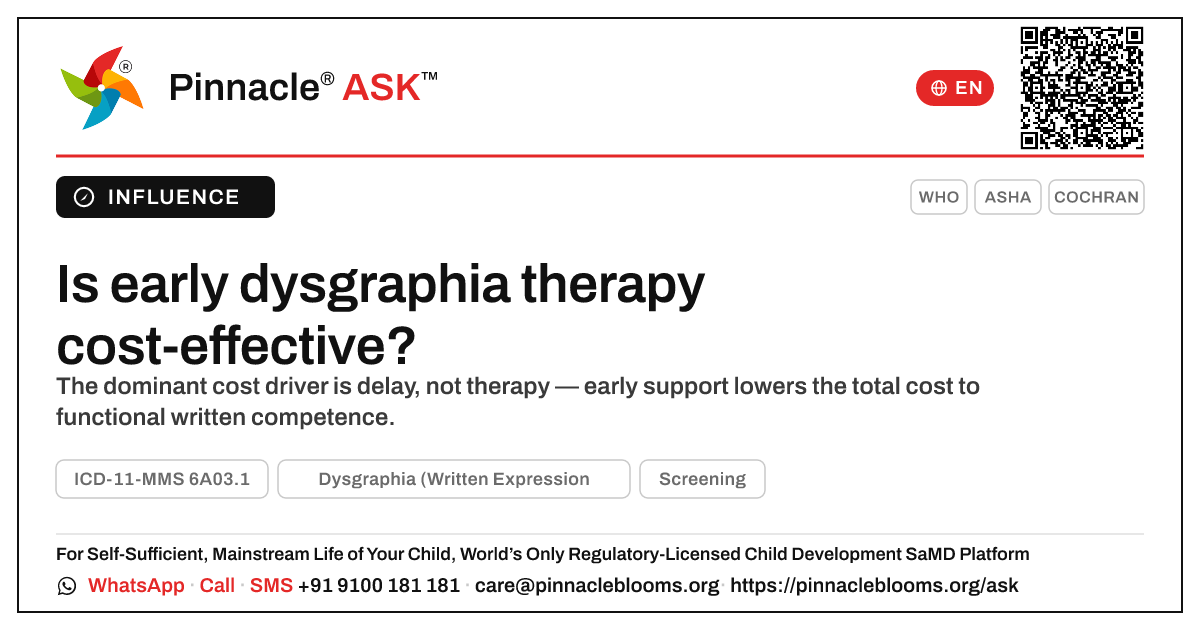
Early therapy for dysgraphia (ICD-11 6A03.1) is cost-effective because the main cost driver is delay: untreated written-expression difficulty compounds into costlier grade repetition, accommodations and secondary mental-health spend. Early, targeted intervention needs fewer therapy hours per unit of progress and lowers the total cost per child reaching functional written competence. A governed AbilityScore baseline makes that spend measurable for payers.
In this answer 4 sections
Payers ask a fair question: does early support for a child's written-expression difficulty actually pay back? The evidence says it does — earlier, cheaper, and with fewer downstream costs.
In short
For dysgraphia (ICD-11 6A03.1), early, targeted intervention is among the more cost-effective investments in childhood learning support — because the same skill gap costs far more to remediate later, when it has compounded into academic underachievement, lost classroom time, secondary anxiety and avoidable special-education spend. Intervening while handwriting, spelling and written-expression skills are still forming requires fewer total therapy hours per unit of progress than waiting until a child is years behind peers. The dominant cost driver is delay, not therapy.
The economic case, briefly
Written-expression difficulty rarely resolves on its own; untreated, it widens the gap with peers and pulls in costlier services — repeated grade support, examination accommodations, mental-health input for the anxiety and disengagement that follow persistent academic failure. Early intervention shifts spend from these high-cost reactive pathways to lower-cost preventive ones. Three levers make the economics favourable:
- Plasticity dividend — fine-motor, orthographic and language-for-writing skills are most responsive when young, so each therapy hour yields more functional gain.
- Avoided downstream cost — earlier remediation reduces years of accommodation, repetition and secondary emotional-health support.
- Targeting precision — a structured baseline directs resources to the children and skill-domains that need them, avoiding undifferentiated spend.
For a payer, the relevant metric is not the price of a session but the total cost per child reaching functional written competence — and that total falls when intervention starts early and is measured against a consistent baseline.
The Pinnacle way
AbilityScore® is part of Pinnacle’s developmental assessment. Diagnosis, where needed, requires an appropriately qualified healthcare professional — never from an app or an online form. That governed baseline is what makes outcomes measurable and spend accountable for a funding partner. Across 70+ centres, 4.95 lakh+ families served and 12 validated studies, we structure dysgraphia support and occupational therapy around a single, comparable measure — see how the AbilityScore is established.
Trusted sources
WHO ICD-11 classification of developmental learning disorder with impairment in written expression; AAP and ASHA guidance on early identification and intervention for learning and written-language difficulties; Cochrane reviews on intervention timing in childhood learning disorders.
Next step — Payers and institutions can partner with Pinnacle to model cost-per-outcome for early dysgraphia support across a covered population.
This is general information, not a diagnosis — individual assessment and diagnosis require an appropriately qualified healthcare professional.
CONNECT THE ANSWER TO YOUR CHILD’S DAY
Something to notice. Something to discuss.
What to notice
Watch for a widening gap between a child's verbal ability and their written output — slow, effortful or illegible writing, avoidance of writing tasks, and rising frustration or anxiety around written work as schooling progresses.
In everyday life
For payers modelling value, compare total cost per child reaching functional written competence — not per-session price; earlier starts almost always reduce that total.
Bring your observations and questions to your child’s professional. Choose activities that suit your child’s comfort, abilities and agreed plan.
Bring your questions to a first visitQuestions families ask
Is early dysgraphia therapy actually cost-effective, or just cheaper per session?
It is cost-effective on the measure that matters to a funder: total cost per child reaching functional written competence. Early intervention needs fewer therapy hours per unit of progress and avoids costly downstream spend on grade repetition, accommodations and secondary mental-health support.
What is the biggest cost driver in dysgraphia support?
Delay. Written-expression difficulty rarely resolves on its own, so waiting lets the skill gap compound — pulling in more expensive reactive services later. Early, targeted intervention shifts spend from reactive to preventive pathways.
How can a payer measure outcomes for funded dysgraphia support?
Through a consistent, clinician-administered baseline. At Pinnacle Blooms Network, a clinical AbilityScore established under clinician care gives a comparable measure of progress, so a funding partner can track cost against outcome across a covered population.
FOLLOW THE SOURCE
References behind this answer.
- Organisation website · further readingWHO ICD-11: developmental learning disorder with impairment in written expression
- Organisation website · further readingASHA: written-language and learning difficulties
- Organisation website · further readingCochrane: reviews on childhood learning-disorder intervention
References are supplied with this answer. An organisation homepage offers further reading; it does not establish an independent review of this page.
Content attribution: SETU Consortium · Pinnacle Blooms Network.
PEOPLE, TOPICS & DEVELOPMENT
See the connections.
Browse the wider question collections connected with this answer’s audience, developmental area and stage.
FROM UNDERSTANDING TO PURPOSEFUL SUPPORT
One question. Your child’s whole life.
Your child’s self-sufficient, mainstream-included life is the purpose from the beginning. At Pinnacle, that purpose shapes what we understand, the goals we choose, the people we bring together, everyday practice and review.
Connect this question with the right support.
Start with your child’s strengths, your observations and what you want everyday life to become.
Make the next conversation useful.
Bring the situations you notice at home or school. We’ll explain a suitable service, centre and first visit, including availability and fees, before you decide.
How PinnacleAI® connects the journeyExplore the seven stages
- 1Understand abilities
A starting picture of your child’s capabilities.
- 2Choose meaningful goals
Readiness and a plan shaped around the child.
- 3Bring the right support together
Suitable therapies and people for those goals.
- 4Carry practice into everyday life
Guidance for family, home and school.
- 5Track and correct
Use observations to adjust the plan.
- 6Reassess and review
Decide what to continue, change or do next.
- 7Grow independence and participation
The child’s life gives each step its purpose.
Explore the whole PinnacleAI® system → · Participation at school and in the community →
PINNACLE’S EVIDENCE, OPEN TO YOU
Look at the evidence behind our work.
Read our research, inspect the original regulatory documents and check what each institutional measure means.
General information supports a conversation with an appropriately qualified professional. Advice, goals and support depend on the individual child.