
sprinting ability
When to escalate a child's running and sprinting concerns
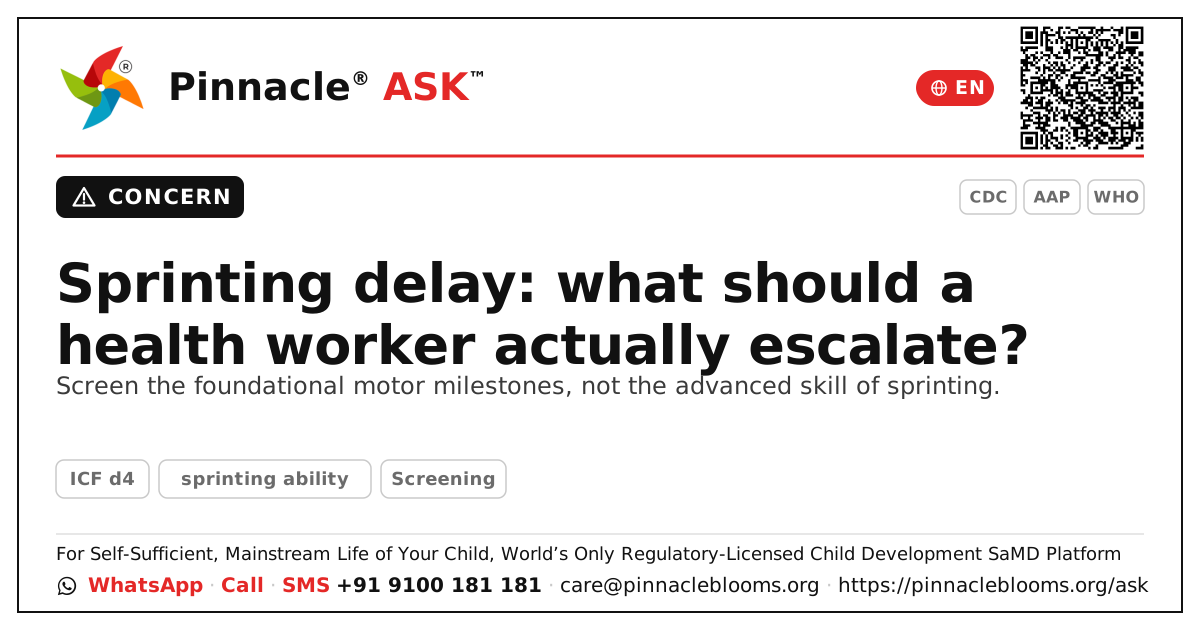
For an ASHA/PHC worker, sprinting is not a screening milestone — it sits at the top of a long motor staircase. Escalate instead on the foundational red flags: not walking by 18 months, not running steadily by ~2 years, frequent falling, asymmetry, persistent tip-toe walking, or loss of a skill once gained. These are reasons to refer for a developmental check, not a diagnosis — early support works best.
Sprinting is a late, advanced motor skill — most children only run fast and freely once the simpler steps of standing, walking and steady running are firmly in place.
In short
For a frontline health worker (ASHA/PHC), "sprinting" is not a screening milestone — it sits at the top of a long staircase of gross-motor skills. What matters first is whether the earlier, foundational milestones are on track: sitting, pulling to stand, walking by ~18 months, and running steadily by ~2 years. Escalate to a Medical Officer or developmental check when those building blocks are delayed or when a child who was running well loses that ability — not because a 3-year-old isn't yet sprinting.What to watch — the escalate triggers
Use these gross-motor flags rather than "can't sprint" alone:- Not walking independently by 18 months — a clear reason to refer.
- Not running at all (steady jog) by ~2 years, or frequent unexplained falling beyond the toddler stage.
- Cannot climb stairs, jump with both feet or kick a ball by 3 years.
- Loss of a skill — a child who walked or ran and now cannot. This always warrants prompt referral.
- Asymmetry — one side of the body weaker, stiffer, or consistently favoured.
- Tip-toe walking that persists, very floppy or very stiff limbs, or muscle weakness that worsens.
The science — why earlier markers matter
Fast running (sprinting) depends on balance, core strength, coordination and lower-limb power that mature gradually. ICF domain d4 (Mobility) frames this as a progression. A health worker's job is to catch the early deviations — because subtle motor delays can point to conditions where early support changes outcomes. Escalate on the foundational milestone, not the advanced one.The Pinnacle way
A clinical AbilityScore® and any diagnosis are formed only at a Pinnacle Blooms Network centre, under qualified clinician care — never from a checklist. Our clinicians look at the whole motor picture and how a child moves in play. Read more about sprinting and gross-motor development, and our physiotherapy team supports strength, balance and coordination.Trusted sources
WHO ICF mobility framework (domain d4); CDC developmental milestones and "Learn the Signs, Act Early"; American Academy of Pediatrics (healthychildren.org) guidance on gross-motor milestones and red flags.Next step — If a child misses the foundational walking or running milestones, or loses a skill, refer for a developmental assessment without waiting.
This is general information, not a diagnosis — a clinical AbilityScore® and any diagnosis are formed only at a Pinnacle Blooms Network centre under qualified clinician care.
What to watch
Escalate if a child is not walking independently by 18 months, not running steadily by ~2 years, falling frequently, cannot climb stairs or jump by 3 years, shows body asymmetry, persistent tip-toe walking, very floppy or stiff limbs, or has lost a motor skill once gained. Sprinting alone is too advanced to screen on.
Try this at home
When screening, watch how a child moves in free play — getting up off the floor, climbing, kicking — rather than testing a single advanced skill like sprinting. The everyday movements tell the clearer story.
Trusted sources
Developed by SETU Consortium · Pinnacle Blooms Network · Last reviewed 2026-06-10 · reviewed every 540 days
This is general information, not a diagnosis. A clinical AbilityScore® and any diagnosis are formed only at a Pinnacle Blooms Network centre, under qualified clinician care.
Frequently asked
Should I worry if my 3-year-old can't sprint yet?
Not on its own — sprinting is an advanced skill that matures later. What matters at 3 is whether your child walks, runs steadily, climbs stairs and jumps. If those are present, fast running will usually follow with practice.
When should a health worker refer a child for motor concerns?
Refer when foundational milestones are missed — not walking by 18 months, not running by ~2 years, frequent falling, body asymmetry, persistent tip-toe walking, or loss of a skill once gained.
Is a motor delay a diagnosis?
No. A missed milestone is simply a reason to seek a developmental check. A clinical AbilityScore® and any diagnosis are formed only at a Pinnacle Blooms Network centre under qualified clinician care.