
socialization
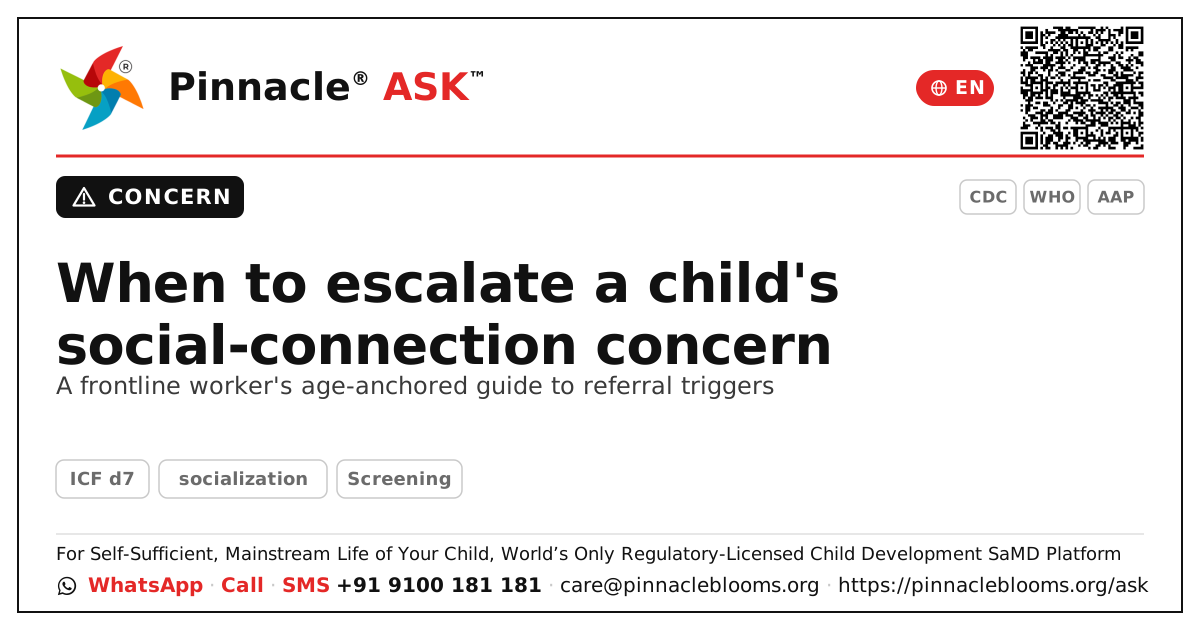
When to escalate a child's social-connection concern
A frontline health worker should escalate a child with social-connection concerns when age-anchored flags persist across more than one visit, when a previously present skill is lost, when social delay travels with speech or motor delay, or whenever the family is worried. Rough triggers: no shared smile by 6 months, no response to name by 12 months, no pointing or showing by 18 months, little pretend play or peer interest by 2–3 years. This is a referral trigger, not a diagnosis — early review opens early support.
Every child learns to connect with people at their own pace — and a frontline worker who notices and acts early is one of the most powerful protectors of that journey.
In short
Escalate when a child consistently misses the social-connection milestones for their age and the gap persists across more than one visit, or when a skill that was present is lost. As a rough guide for an ASHA or PHC worker: no shared smile by 6 months, no response to name or limited gestures by 12 months, no shared pointing or showing by 18 months, and very little pretend play or interest in other children by 2–3 years all warrant a developmental check. This is a referral trigger, not a diagnosis — early review opens early opportunity.What to watch (ICF d7 — interpersonal interactions)
Use simple, age-anchored flags during routine home visits and immunisation contacts:- By 6 months — not smiling back, little eye contact, not enjoying face-to-face play.
- By 9–12 months — not responding to their name, not babbling back-and-forth, no waving or reaching to be picked up.
- By 18 months — not pointing to show interest, not bringing things to share, little imitation.
- By 24–36 months — not interested in other children, no simple pretend play, very limited two-way interaction.
- Any age — clear loss of a social skill the child once had, or strong parental worry.
When to escalate
Escalate promptly to the medical officer or developmental clinic if a flag persists across two contacts, if a skill is lost, if social delay travels with speech or motor delay, or whenever the family is worried. Do not adopt a wait-and-watch stance for regression or for parental concern — these go forward now. Record what you saw in plain words; daily observation is valuable clinical information.The Pinnacle way
A frontline flag is a starting point — a clinical AbilityScore® and any diagnosis are formed only at a Pinnacle Blooms Network centre, under qualified clinician care, never from a checklist. Learn more about socialization and how our behaviour therapy team builds connection through play.Trusted sources
WHO ICF framework for interpersonal interactions and relationships (d7); CDC "Learn the Signs, Act Early" developmental milestones; American Academy of Pediatrics (healthychildren.org) guidance on developmental surveillance and referral.Next step — Trust what you've observed. Book a developmental assessment so a Pinnacle clinician can review the child's social milestones calmly and clearly.
What to watch
Escalate if flags persist across two contacts or a skill is lost: no shared smile by 6 months; no response to name, babble or wave by 12 months; no pointing or showing by 18 months; little pretend play or peer interest by 2–3 years. Refer promptly for any regression, social plus speech/motor delay, or strong parental worry.
Try this at home
During each home visit, ask the parent one simple question — 'Does your child look at you and smile back when you call their name?' — and note the answer. Tracking this across visits turns a single moment into a clear picture for the medical officer.
Trusted sources
Developed by SETU Consortium · Pinnacle Blooms Network · Last reviewed 2026-06-10 · reviewed every 540 days
This is general information, not a diagnosis. A clinical AbilityScore® and any diagnosis are formed only at a Pinnacle Blooms Network centre, under qualified clinician care.
Frequently asked
Should a frontline worker wait and watch if a child seems socially behind?
Wait-and-watch is reasonable for a borderline single observation in a thriving child, but not for regression, persistent flags across two visits, social delay combined with speech or motor delay, or strong parental worry — those go forward for review now.
What are the simplest social flags to check during a home visit?
Does the baby smile back by 6 months, respond to their name by 12 months, point to show interest by 18 months, and play pretend or show interest in other children by 2–3 years? Missing these consistently is worth a developmental check.
Does escalation mean the child has autism?
No. Escalation simply means a qualified clinician should take a closer, structured look. It is not a diagnosis — a clinical AbilityScore® and any diagnosis are formed only at a Pinnacle Blooms Network centre under qualified clinician care.