
YOUR QUESTION. A CLEARER NEXT STEP.
Should I worry about a 3-year-old hitting others?
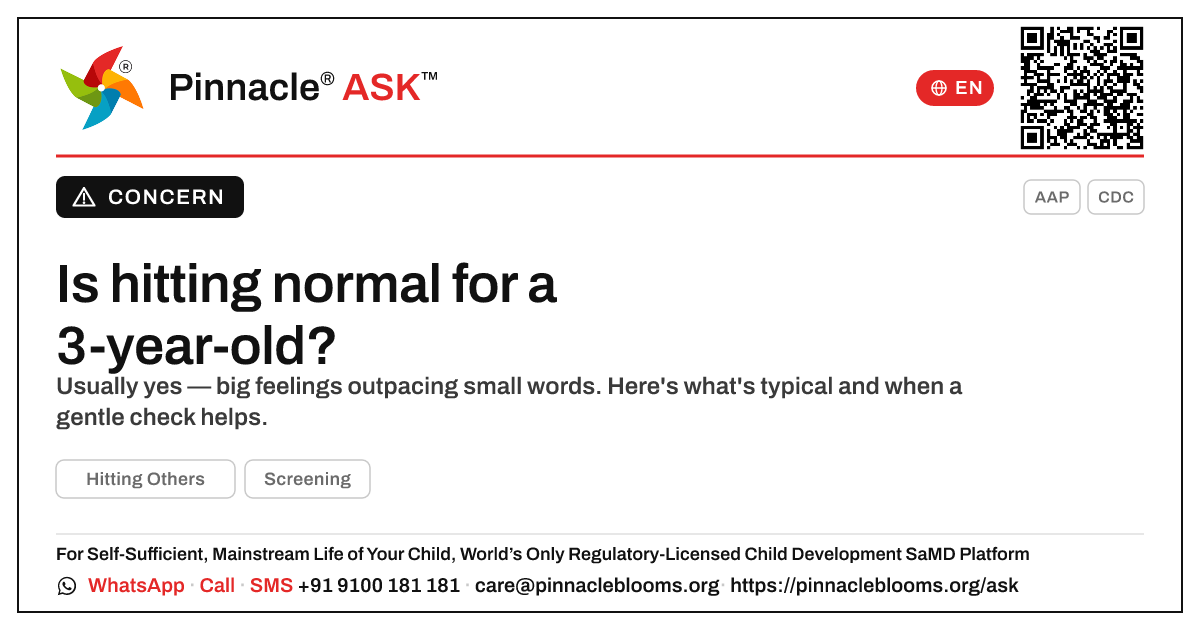
For most 3-year-olds, hitting is a normal, common part of development — a sign that big feelings have outpaced small words, not aggression or a disorder. Calm, consistent guidance and supporting communication usually ease it. Seek a developmental check if hitting is frequent, intense, hard to redirect, causes real injury, or travels with delays in talking, connecting or playing. This is a reason to observe early, not to be alarmed.
In this answer 5 sections
When a 3-year-old hits, it usually means a big feeling has outpaced the small words to express it — and that is exactly what this age is learning.
In short
For most 3-year-olds, hitting, pushing or grabbing is a normal, common part of development — not a sign of aggression or a disorder. At this age, children feel huge emotions but don't yet have the words or impulse control to manage them, so frustration spills out through their hands. The time to seek a gentle developmental check is when hitting is frequent, intense, hard to redirect, causing real injury, or travels alongside delays in talking, connecting or playing with others.
What's typical — and what deserves a closer look
At three, the thinking brain that says "stop and use words" is still very much under construction. Hitting often appears around sharing, tiredness, hunger, transitions or feeling overwhelmed. With calm, consistent guidance, most children outgrow it as language and self-regulation grow.
Gentle flags that a clinician's eye would help:
- Not easing with age or guidance — hitting that stays the same or worsens over months despite calm, consistent responses.
- Causing real harm — biting, hitting or throwing that regularly hurts others or your child.
- Very hard to redirect — explosive outbursts that are intense, long, and difficult to soothe.
- Few words to fall back on — if your child has limited speech, hitting is often the only "voice" they have, and supporting communication usually eases it.
- Travelling with other differences — little eye contact, not responding to their name, not playing alongside other children, or loss of a skill once had.
None of this is a diagnosis — it simply means an early, calm look turns small questions into early opportunities.
How you can help today
Stay calm and steady, name the feeling ("You're cross the tower fell"), set a clear gentle limit ("I won't let you hit"), and offer the words or action they could use instead. Children learn regulation by borrowing yours. If hitting is frequent and your child has few words, supporting communication is often the fastest route to calmer hands.
The Pinnacle way
A clinical AbilityScore® and any diagnosis are formed only at a Pinnacle Blooms Network centre, under qualified clinician care — never from an online list. Our clinicians watch when and why the hitting appears, look at your child's communication and emotional skills, and shape support around play. Our behaviour and emotional regulation support and speech therapy teams often work together, because giving a child words frequently softens the need to use hands. You can begin with a simple developmental review on our home page.
Trusted sources
American Academy of Pediatrics (healthychildren.org) guidance on toddler aggression, biting and discipline; CDC developmental milestones and "Learn the Signs, Act Early" resources for social-emotional development at age 3.
Next step — Trust what you've noticed. Book a developmental assessment with a Pinnacle clinician for a warm, clear look at your child's emotions, communication and play.
This is general information, not a diagnosis — individual assessment and diagnosis require an appropriately qualified healthcare professional.
CONNECT THE ANSWER TO YOUR CHILD’S DAY
Something to notice. Something to discuss.
What to notice
Seek a gentle check if hitting stays the same or worsens over months despite calm guidance, regularly causes real harm, brings intense outbursts that are very hard to soothe, or travels with few words, little eye contact, not responding to name, not playing alongside other children, or loss of a skill. Limited speech with frequent hitting is a common, very workable reason to assess communication early.
In everyday life
Keep a short phone note of when hitting happens — tired, hungry, sharing, or a sudden change? Noting the trigger and whether your child has the words to ask instead gives a clinician a clear, useful picture.
Bring your observations and questions to your child’s professional. Choose activities that suit your child’s comfort, abilities and agreed plan.
Bring your questions to a first visitQuestions families ask
Is hitting normal for a 3-year-old?
Yes, very often. At three, children feel big emotions but lack the words and impulse control to manage them, so frustration can come out through their hands. With calm, consistent guidance it usually fades as language and self-regulation grow.
How should I respond when my 3-year-old hits?
Stay calm, name the feeling ("You're cross"), set a gentle clear limit ("I won't let you hit"), and offer the words or action they could use instead. Children learn to regulate by borrowing your calm — punishment in the heat of the moment rarely helps.
When does hitting at 3 need a developmental check?
Consider a check if hitting is frequent and not easing over months, regularly causes real harm, is very hard to redirect, or comes with few words, little eye contact, or not playing with other children. This is a reason to assess early, not a diagnosis.
Could hitting mean my child has a behaviour problem?
Usually not at age three. Hitting is a common developmental stage, especially when a child has limited language to express needs. Supporting communication often eases it quickly, which is why a calm clinical review can be reassuring and practical.
FOLLOW THE SOURCE
References behind this answer.
- Organisation website · further readingAAP (healthychildren.org): toddler aggression, biting and discipline guidance
- Source referenceCDC: developmental milestones and Learn the Signs, Act Early
References are supplied with this answer. An organisation homepage offers further reading; it does not establish an independent review of this page.
Content attribution: SETU Consortium · Pinnacle Blooms Network.
PEOPLE, TOPICS & DEVELOPMENT
See the connections.
Browse the wider question collections connected with this answer’s audience, developmental area and stage.
FROM UNDERSTANDING TO PURPOSEFUL SUPPORT
One question. Your child’s whole life.
Your child’s self-sufficient, mainstream-included life is the purpose from the beginning. At Pinnacle, that purpose shapes what we understand, the goals we choose, the people we bring together, everyday practice and review.
Connect this question with the right support.
Start with your child’s strengths, your observations and what you want everyday life to become.
Make the next conversation useful.
Bring the situations you notice at home or school. We’ll explain a suitable service, centre and first visit, including availability and fees, before you decide.
How PinnacleAI® connects the journeyExplore the seven stages
- 1Understand abilities
A starting picture of your child’s capabilities.
- 2Choose meaningful goals
Readiness and a plan shaped around the child.
- 3Bring the right support together
Suitable therapies and people for those goals.
- 4Carry practice into everyday life
Guidance for family, home and school.
- 5Track and correct
Use observations to adjust the plan.
- 6Reassess and review
Decide what to continue, change or do next.
- 7Grow independence and participation
The child’s life gives each step its purpose.
Explore the whole PinnacleAI® system → · Participation at school and in the community →
PINNACLE’S EVIDENCE, OPEN TO YOU
Look at the evidence behind our work.
Read our research, inspect the original regulatory documents and check what each institutional measure means.
General information supports a conversation with an appropriately qualified professional. Advice, goals and support depend on the individual child.