
YOUR QUESTION. A CLEARER NEXT STEP.
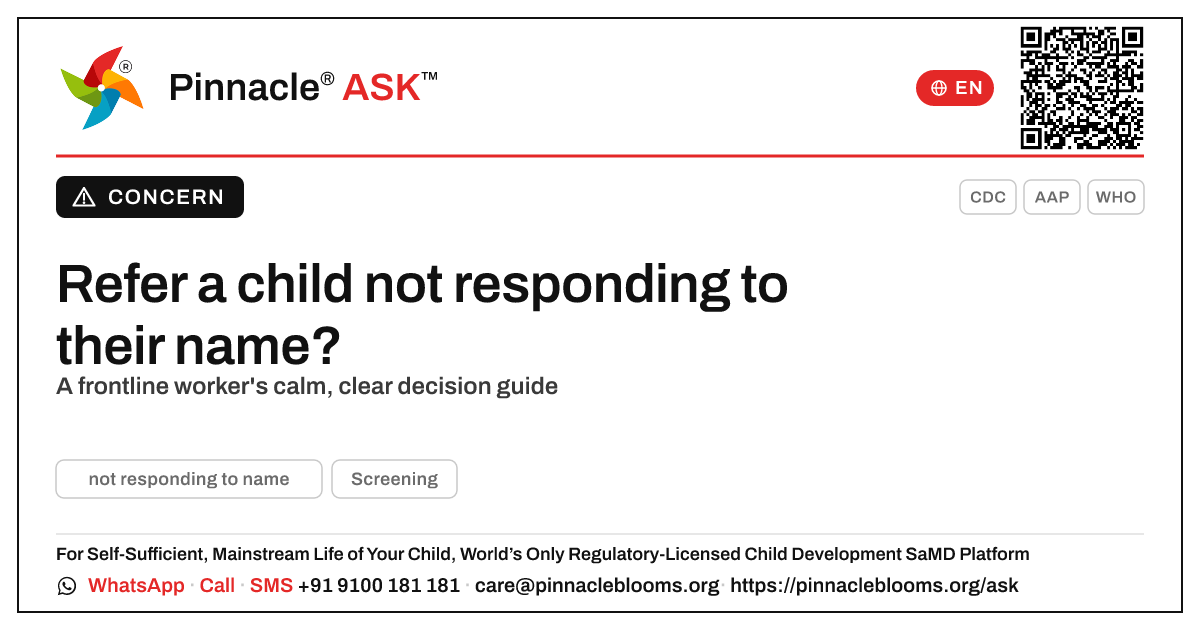
Should you refer a child not responding to their name?
Yes — a child who consistently does not respond to their name by around 12 months should be routed for a developmental and hearing check. Check hearing first, note whether the lack of response is near-constant, and watch for companions like little eye contact, no pointing or few words. This is a screening flag, not a diagnosis; when in doubt, refer, because early support works best.
In this answer 5 sections
A child who does not turn to their name is giving you a small but important signal — and a frontline worker who notices it is doing exactly the right thing.
In short
Yes — if a child consistently does not respond to their name by around 12 months, that is a recognised early flag worth acting on, and a referral for a developmental check is the correct, safe step. This is not a diagnosis and not a cause for alarm: many children with this single sign turn out to be developing typically, and others simply benefit from early support. Your job is to screen and route, not to label — observe, reassure the family, and connect them to a developmental assessment.
What this signals — and what to check
Responding to one's name is an early social-communication milestone, usually emerging by 9–12 months. A child not yet doing so reliably deserves a closer look, especially when it travels with other signs. Before you refer, gently check:
- Hearing first — does the child startle to loud sounds, turn to familiar voices or music? Inconsistent name response can simply mean a hearing concern (including glue ear after frequent colds), which needs its own check.
- Consistency — does the child respond sometimes but not when absorbed in play, or almost never even when calm and facing you? Near-never is the stronger flag.
- Travelling companions — little eye contact or shared smiling, not pointing or showing things, few or no words or babble, not following simple gestures, or loss of a skill once had.
- Age — by 12 months most children turn to their name; by 18–24 months a persistent lack of response, with other communication differences, warrants prompt routing.
When to refer
Refer for a developmental and hearing check when name-response is consistently absent at or beyond 12 months, or when it appears alongside any of the companions above at any age. When in doubt, refer — early routing costs little and early support works best. Trust the family's daily observations; what a parent notices is valuable information. There is no need to mention any specific condition to the family — frame it simply as "a check to understand how your child is hearing and communicating."
The Pinnacle way
A clinical AbilityScore® and any diagnosis are formed only at a Pinnacle Blooms Network centre, under qualified clinician care — never from a screening sign or an online list. As a frontline worker your structured observation is the first, essential link in the chain. Our clinicians then build a full picture of the child's hearing, communication and play, and our speech therapy team supports early language and connection. You can begin a routing or learn more on our home page.
Trusted sources
CDC "Learn the Signs, Act Early" developmental milestones note that turning to one's name typically emerges by around 12 months; American Academy of Pediatrics (healthychildren.org) guidance on developmental surveillance and the value of hearing checks; WHO ICD-11 framework for developmental and communication conditions.
Next step — Trust what you've observed. Route this child for a developmental and hearing check with a Pinnacle clinician for a calm, clear review.
CONNECT THE ANSWER TO YOUR CHILD’S DAY
Something to notice. Something to discuss.
What to notice
Refer for a developmental and hearing check when name-response is consistently absent at or beyond 12 months, or when it travels with little eye contact, no pointing or showing, few or no words, not following gestures, or loss of a skill. Check hearing first — inconsistent response can mean a hearing concern. When in doubt, refer; early routing is low cost and high value.
In everyday life
Try the name-call check calmly: with the child facing away but settled, say their name once in a warm voice from about a metre behind. Note whether they turn within a couple of seconds. Repeat across a few quiet moments — consistency matters more than one try.
Bring your observations and questions to your child’s professional. Choose activities that suit your child’s comfort, abilities and agreed plan.
Bring your questions to a first visitQuestions families ask
At what age should a child respond to their name?
Most children turn to their name by around 9–12 months. A child who consistently does not respond at or beyond 12 months deserves a developmental and hearing check — not as a diagnosis, but as a sensible early step.
Could not responding to name just be a hearing problem?
Yes, often. Inconsistent or absent name-response can reflect a hearing concern, including glue ear after frequent colds. That is why a hearing check is the first thing to arrange alongside developmental review.
Should I tell the family I suspect a particular condition?
No. Frame it simply as a check to understand how the child hears and communicates. Naming a condition is the role of a qualified clinician after a full assessment — your job is to observe, reassure and route.
FOLLOW THE SOURCE
References behind this answer.
- Source referenceCDC: Learn the Signs, Act Early — developmental milestones
- Organisation website · further readingAAP HealthyChildren — developmental surveillance
- Organisation website · further readingWHO ICD-11 framework
References are supplied with this answer. An organisation homepage offers further reading; it does not establish an independent review of this page.
Content attribution: SETU Consortium · Pinnacle Blooms Network.
PEOPLE, TOPICS & DEVELOPMENT
See the connections.
Browse the wider question collections connected with this answer’s audience, developmental area and stage.
FROM UNDERSTANDING TO PURPOSEFUL SUPPORT
One question. Your child’s whole life.
Your child’s self-sufficient, mainstream-included life is the purpose from the beginning. At Pinnacle, that purpose shapes what we understand, the goals we choose, the people we bring together, everyday practice and review.
Connect this question with the right support.
Start with your child’s strengths, your observations and what you want everyday life to become.
Make the next conversation useful.
Bring the situations you notice at home or school. We’ll explain a suitable service, centre and first visit, including availability and fees, before you decide.
How PinnacleAI® connects the journeyExplore the seven stages
- 1Understand abilities
A starting picture of your child’s capabilities.
- 2Choose meaningful goals
Readiness and a plan shaped around the child.
- 3Bring the right support together
Suitable therapies and people for those goals.
- 4Carry practice into everyday life
Guidance for family, home and school.
- 5Track and correct
Use observations to adjust the plan.
- 6Reassess and review
Decide what to continue, change or do next.
- 7Grow independence and participation
The child’s life gives each step its purpose.
Explore the whole PinnacleAI® system → · Participation at school and in the community →
PINNACLE’S EVIDENCE, OPEN TO YOU
Look at the evidence behind our work.
Read our research, inspect the original regulatory documents and check what each institutional measure means.
General information supports a conversation with an appropriately qualified professional. Advice, goals and support depend on the individual child.