
YOUR QUESTION. A CLEARER NEXT STEP.
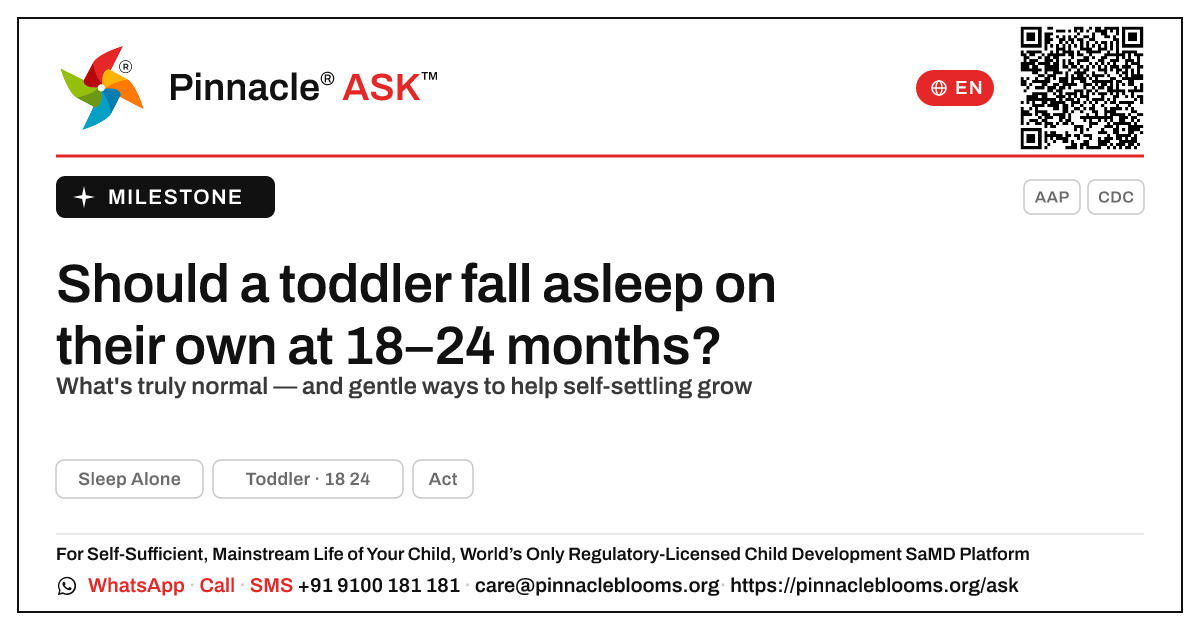
Should an 18–24-month-old fall asleep on their own?
Many 18-to-24-month-olds are starting to settle themselves but still need a parent nearby — both are normal. Independent sleep is a gradually-learned skill, not a fixed milestone; a calm, predictable routine and 11–14 hours of sleep matter most. Check with your team only for snoring, breathing pauses, or distress that affects daytime life.
In this answer 5 sections
Bedtime can feel like the longest part of the day — so it helps to know what's truly typical for a busy little toddler.
In short
Many 18-to-24-month-olds are beginning to settle themselves to sleep, but plenty still need a parent close by — and both are completely normal. Falling asleep independently is a gradually-learned skill, not a fixed milestone with a deadline. What matters more at this age is a calm, predictable bedtime routine and roughly 11–14 hours of sleep across the day and night.
What's typical at 18–24 months
At this age, toddlers are wonderfully attached and still learning to feel safe apart from you, so wanting company at bedtime is healthy, not a problem to fix. You may notice:
- Some self-settling — drifting off after you say goodnight, especially with a comfort object like a soft toy or blanket.
- Still needing presence — many toddlers fall asleep best with a parent nearby, rocking, or feeding; this is common and not harmful.
- Brief night wakings — most toddlers wake a little and may call out before resettling.
- Bedtime resistance — the new "no!", asking for one more story, or testing limits is a sign of growing independence, not a sleep disorder.
Gentle, consistent steps help the skill emerge: a short wind-down (bath, story, dim lights), the same order each night, and putting your toddler down drowsy-but-awake when you can. Progress is rarely a straight line — illness, teething, travel and big developmental leaps all temporarily upset sleep.
When to check in with your team
Most sleep settling sorts itself out with routine and time. Have a chat with your paediatric team if you notice: heavy snoring or pauses in breathing, sleep that is so disrupted it affects daytime mood, eating or play, or if bedtime distress feels extreme and unsettling for your child week after week. These point to comfort, breathing or routine factors worth a friendly look — not to anything you've done wrong.
The Pinnacle way
Sleep settles best alongside steady all-round development — language, regulation and confidence all play a part. A clinical AbilityScore® and any diagnosis are formed only at a Pinnacle Blooms Network centre under qualified clinician care; this page is for guidance and reassurance, never diagnosis. If bedtime is bound up with big feelings or communication frustration, our occupational therapy team can share simple, calming routines that fit your family.
Trusted sources
Guidance here reflects the American Academy of Pediatrics and HealthyChildren.org on toddler sleep needs and routines, and CDC developmental guidance on what to expect around 18–24 months.
Next step — if bedtime feels overwhelming or your toddler's sleep worries you, book a gentle developmental check with the Pinnacle team on WhatsApp: +91 91001 81181.
This is general information, not a diagnosis — individual assessment and diagnosis require an appropriately qualified healthcare professional.
CONNECT THE ANSWER TO YOUR CHILD’S DAY
Something to notice. Something to discuss.
What to notice
Speak to your paediatric team if you notice heavy snoring or breathing pauses in sleep, sleep disruption that affects daytime mood, feeding or play, or extreme bedtime distress that persists week after week.
In everyday life
Keep the same short wind-down each night — bath, story, dim lights — and pop your toddler down drowsy but still awake when you can, with a comfort object nearby.
Bring your observations and questions to your child’s professional. Choose activities that suit your child’s comfort, abilities and agreed plan.
Bring your questions to a first visitQuestions families ask
Is it bad if my 18-month-old still needs me to fall asleep?
Not at all. Needing a parent nearby at bedtime is very common and healthy at this age — toddlers are still learning to feel safe apart from you. Self-settling emerges gradually with a calm, consistent routine.
How much sleep does a toddler this age need?
Around 11–14 hours across a 24-hour day, usually including one daytime nap. Total amount and a predictable routine matter more than whether they drift off alone.
How can I gently help my toddler settle by themselves?
Use a short, same-order wind-down each night, keep lights dim, offer a comfort object, and try placing them down drowsy but awake. Expect a wobbly path — illness, teething and big developmental leaps temporarily upset sleep.
When should I be concerned about toddler sleep?
Check in with your paediatric team if there's heavy snoring or pauses in breathing, sleep so disrupted it affects daytime mood and play, or extreme bedtime distress that continues week after week.
FOLLOW THE SOURCE
References behind this answer.
- Organisation website · further readingAAP HealthyChildren.org — toddler sleep and routines
- Organisation website · further readingCDC — developmental milestones at 18–24 months
- Organisation website · further readingAmerican Academy of Pediatrics — healthy sleep guidance
References are supplied with this answer. An organisation homepage offers further reading; it does not establish an independent review of this page.
Content attribution: SETU Consortium · Pinnacle Blooms Network.
PEOPLE, TOPICS & DEVELOPMENT
See the connections.
Browse the wider question collections connected with this answer’s audience, developmental area and stage.
FROM UNDERSTANDING TO PURPOSEFUL SUPPORT
One question. Your child’s whole life.
Your child’s self-sufficient, mainstream-included life is the purpose from the beginning. At Pinnacle, that purpose shapes what we understand, the goals we choose, the people we bring together, everyday practice and review.
Connect this question with the right support.
Start with your child’s strengths, your observations and what you want everyday life to become.
Make the next conversation useful.
Bring the situations you notice at home or school. We’ll explain a suitable service, centre and first visit, including availability and fees, before you decide.
How PinnacleAI® connects the journeyExplore the seven stages
- 1Understand abilities
A starting picture of your child’s capabilities.
- 2Choose meaningful goals
Readiness and a plan shaped around the child.
- 3Bring the right support together
Suitable therapies and people for those goals.
- 4Carry practice into everyday life
Guidance for family, home and school.
- 5Track and correct
Use observations to adjust the plan.
- 6Reassess and review
Decide what to continue, change or do next.
- 7Grow independence and participation
The child’s life gives each step its purpose.
Explore the whole PinnacleAI® system → · Participation at school and in the community →
PINNACLE’S EVIDENCE, OPEN TO YOU
Look at the evidence behind our work.
Read our research, inspect the original regulatory documents and check what each institutional measure means.
General information supports a conversation with an appropriately qualified professional. Advice, goals and support depend on the individual child.