
YOUR QUESTION. A CLEARER NEXT STEP.
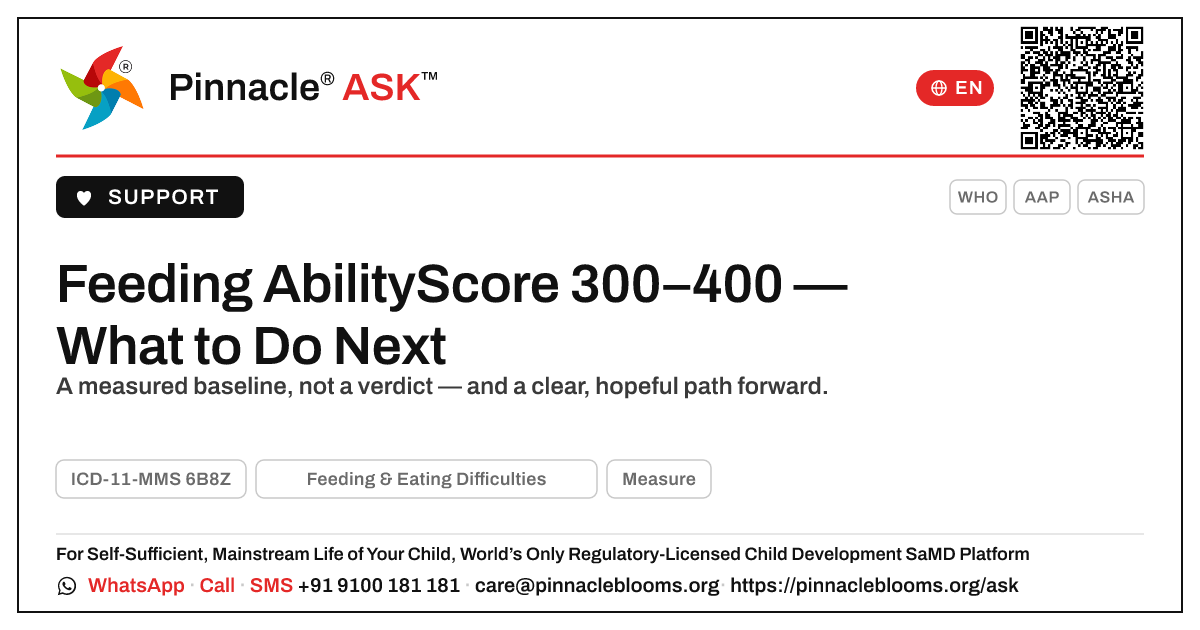
AbilityScore 300–400 for Feeding & Eating Difficulties: What to Do Next
An AbilityScore of 300–400 is a measured baseline, not a verdict. The next step is a Pinnacle clinician review to turn that number into a personalised feeding plan, rule out medical factors, and begin therapy — with progress re-measured against your child's own starting point.
In this answer 5 sections
An AbilityScore of 300–400 is not a verdict — it is a starting point, a clear baseline from which your child can grow.
In short
An AbilityScore® in the 300–400 band tells you and your clinician where your child's feeding and eating skills sit today — it is a measured baseline, not a ceiling. The next step is simple and hopeful: meet your Pinnacle clinician to turn that number into a personalised feeding plan and begin therapy. Children in this band often make meaningful gains with structured, consistent support — and progress is re-measured against your child's own starting point, never against other children.
What this band means in everyday life
Feeding & Eating Difficulties (ICD-11 6B8Z) can show up as a very limited range of foods, distress at new textures or smells, gagging or pocketing food, very slow or fraught mealtimes, or mealtimes that feel like a daily battle. A 300–400 band usually reflects clear, addressable difficulty across several of these areas. The encouraging part: feeding is highly responsive to the right approach — oral-motor support, graded texture and sensory work, positive mealtime routines and family coaching. None of this requires waiting; it benefits from starting early and staying consistent.
What to do next
- Book a clinician review so the score becomes a plan — which feeding goals come first, and how often therapy is needed.
- Rule out the medical layer — your clinician will check whether reflux, swallowing safety, allergy or other medical factors need a paediatric or ENT referral alongside therapy.
- Bring the everyday picture — a few days of notes on what your child eats, refuses, and how mealtimes feel gives the clinician rich, real-world detail.
The Pinnacle way
Developmental measurement supports care planning; diagnosis requires an appropriately qualified healthcare professional., under the care of a qualified clinician — never from an online figure alone. Backed by 25 million+ therapy sessions and 4.95 lakh+ families served across 70+ centres, our team translates your child's band into a warm, practical plan. Start with feeding therapy, understand the measure itself via how the AbilityScore is calculated, and explore your options from our home page.
Trusted sources
WHO ICD-11 (6B8Z, Feeding or eating disorders); American Academy of Pediatrics guidance on feeding and growth; American Speech-Language-Hearing Association (ASHA) on paediatric feeding and swallowing.
Next step — Turn the number into a plan. Book a feeding assessment with a Pinnacle clinician and begin your child's next chapter at mealtimes.
This is general information, not a diagnosis — individual assessment and diagnosis require an appropriately qualified healthcare professional.
CONNECT THE ANSWER TO YOUR CHILD’S DAY
Something to notice. Something to discuss.
What to notice
Seek a clinician sooner if your child is losing weight, refuses almost all foods or fluids, coughs or chokes during meals, or shows breathing changes when eating — these point to swallowing safety and need prompt medical review alongside feeding therapy.
In everyday life
Keep mealtimes calm and pressure-free: offer one tiny portion of a new food beside a food your child already trusts, and let them explore it by touch or smell with no pressure to eat. Repeated, relaxed exposure builds acceptance far better than coaxing.
Bring your observations and questions to your child’s professional. Choose activities that suit your child’s comfort, abilities and agreed plan.
Bring your questions to a first visitQuestions families ask
Is an AbilityScore of 300–400 a bad result?
No — it is a baseline, not a judgement. It simply shows where your child's feeding skills sit today so your clinician can plan the right support. Children in this band commonly make meaningful progress with consistent, tailored therapy, and gains are measured against your child's own starting point.
Do we need to start therapy straight away?
Feeding difficulties respond best to early, consistent support, so booking a clinician review soon is wise. Your clinician will confirm how often therapy is needed and whether any medical checks should happen alongside it.
Could there be a medical cause behind the feeding difficulty?
Sometimes. Reflux, swallowing safety, allergy or other medical factors can play a part, which is why your Pinnacle clinician screens for these and refers to a paediatrician or ENT when appropriate, working alongside feeding therapy.
Will the AbilityScore change as my child improves?
Yes. The score is re-measured over time so you can see progress against your child's earlier baseline, not against other children. This is how a quiet plateau can be told apart from real, steady growth.
FOLLOW THE SOURCE
References behind this answer.
- Organisation website · further readingWHO ICD-11 — Feeding or eating disorders
- Organisation website · further readingAAP HealthyChildren — feeding and growth guidance
- Organisation website · further readingASHA — paediatric feeding and swallowing
References are supplied with this answer. An organisation homepage offers further reading; it does not establish an independent review of this page.
Content attribution: SETU Consortium · Pinnacle Blooms Network.
PEOPLE, TOPICS & DEVELOPMENT
See the connections.
Browse the wider question collections connected with this answer’s audience, developmental area and stage.
FROM UNDERSTANDING TO PURPOSEFUL SUPPORT
One question. Your child’s whole life.
Your child’s self-sufficient, mainstream-included life is the purpose from the beginning. At Pinnacle, that purpose shapes what we understand, the goals we choose, the people we bring together, everyday practice and review.
Connect this question with the right support.
Explore how the relevant service contributes to everyday abilities, then speak with us about your child.
Make the next conversation useful.
Bring the situations you notice at home or school. We’ll explain a suitable service, centre and first visit, including availability and fees, before you decide.
How PinnacleAI® connects the journeyExplore the seven stages
- 1Understand abilities
A starting picture of your child’s capabilities.
- 2Choose meaningful goals
Readiness and a plan shaped around the child.
- 3Bring the right support together
Suitable therapies and people for those goals.
- 4Carry practice into everyday life
Guidance for family, home and school.
- 5Track and correct
Use observations to adjust the plan.
- 6Reassess and review
Decide what to continue, change or do next.
- 7Grow independence and participation
The child’s life gives each step its purpose.
Explore the whole PinnacleAI® system → · Participation at school and in the community →
PINNACLE’S EVIDENCE, OPEN TO YOU
Look at the evidence behind our work.
Read our research, inspect the original regulatory documents and check what each institutional measure means.
General information supports a conversation with an appropriately qualified professional. Advice, goals and support depend on the individual child.