
YOUR QUESTION. A CLEARER NEXT STEP.
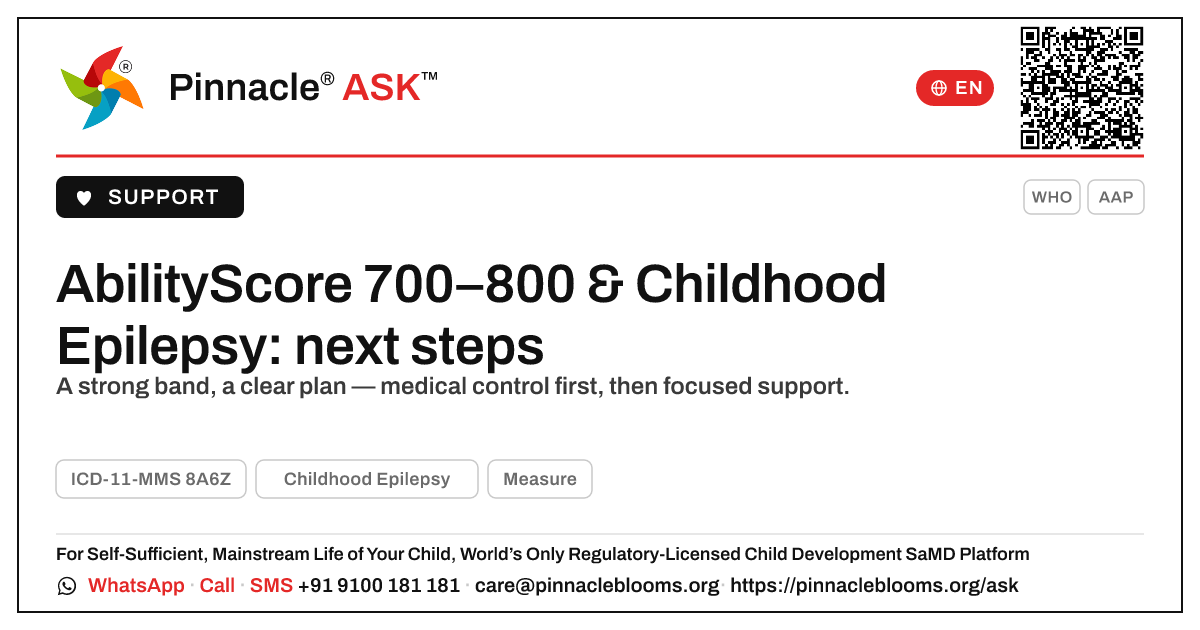
AbilityScore 700–800 with Childhood Epilepsy: what next
An AbilityScore of 700–800 is an encouraging, strengths-rich band. The first priority with Childhood Epilepsy is confirming seizure control with your neurologist; then a Pinnacle clinician uses the score to build a focused, strengths-led plan. The band guides planning — it is never a diagnosis.
In this answer 4 sections
A score in this band tells us a great deal of strength is already there — and it points clearly to your next move.
In short
An AbilityScore® of 700–800 is an encouraging band — it suggests your child is showing strong functional ability across the areas measured, with focused support likely to lift specific skills further. With Childhood Epilepsy the most important first step is medical, not therapy: ensure seizure control is well managed by your child's paediatric neurologist, because steady neurological control is the foundation everything else builds on. From there, a clinician at Pinnacle uses the same score to design a precise, strengths-led plan.
What this band means in practice
Think of the band as a map of where your child is thriving and where a little scaffolding helps most.
- Medical first — confirm with your neurologist that seizures are well controlled and medication is reviewed. Uncontrolled or frequent seizures can affect attention, language and learning, so this comes before everything else.
- Targeted, not blanket, support — a 700–800 band usually means support can be focused on a few specific skills (attention, language, fine-motor or learning readiness) rather than broad intervention.
- Re-measure to track — because epilepsy and its treatment can affect development over time, your child is compared to their own baseline at review, so progress and any change are caught early.
- School and daily life — share the plan with teachers, and keep a simple seizure-and-skills diary your clinician can use.
The Pinnacle way
Your AbilityScore® band is a planning tool, not a verdict — Developmental measurement supports care planning; diagnosis requires an appropriately qualified healthcare professional., under qualified clinician care, and always alongside your child's treating neurologist. Backed by 2.5 billion+ data points and 25 million+ therapy sessions across 70+ centres, our clinicians turn this score into a clear, strengths-led plan. Explore how the AbilityScore is calculated, see how speech therapy and allied support fit in, and start at our network.
Trusted sources
WHO ICD-11 (Childhood Epilepsy, 8A6Z); World Health Organization guidance on epilepsy in children; American Academy of Pediatrics (HealthyChildren) on managing childhood seizures; Pinnacle Blooms Network clinical studies.
Next step — Bring your score and your neurologist's latest notes to a Pinnacle clinician. Book an assessment to turn this strong band into a focused, confident plan.
This is general information, not a diagnosis — individual assessment and diagnosis require an appropriately qualified healthcare professional.
CONNECT THE ANSWER TO YOUR CHILD’S DAY
Something to notice. Something to discuss.
What to notice
Watch for any change in seizure frequency or new seizure types, increased drowsiness or attention difficulty after medication changes, or a skill your child once had slipping — each warrants a prompt call to your neurologist and Pinnacle clinician.
In everyday life
Keep a simple shared diary: one column for seizures (when, how long) and one for daily skill wins. It gives your neurologist and therapist the clearest picture and helps you see progress you might otherwise miss.
Bring your observations and questions to your child’s professional. Choose activities that suit your child’s comfort, abilities and agreed plan.
Bring your questions to a first visitQuestions families ask
Does a 700–800 AbilityScore mean my child is doing well?
It is an encouraging band that suggests strong functional ability across the areas measured, with room for focused support on specific skills. It is a planning tool reviewed by a clinician, never a diagnosis or a final verdict.
Should we start therapy before seeing the neurologist?
For Childhood Epilepsy, confirming that seizures are well controlled comes first, because steady neurological control supports attention, language and learning. Your Pinnacle clinician works alongside your treating neurologist, not instead of them.
How often should the AbilityScore be re-measured?
Your Pinnacle clinician sets the review interval based on your child's plan and any medication changes. Re-measuring against your child's own baseline helps catch progress — or any change — early.
FOLLOW THE SOURCE
References behind this answer.
- Organisation website · further readingWHO ICD-11 — Childhood Epilepsy
- Source referenceWHO — Epilepsy fact sheet
- Organisation website · further readingAAP HealthyChildren — seizures in children
References are supplied with this answer. An organisation homepage offers further reading; it does not establish an independent review of this page.
Content attribution: SETU Consortium · Pinnacle Blooms Network.
PEOPLE, TOPICS & DEVELOPMENT
See the connections.
Browse the wider question collections connected with this answer’s audience, developmental area and stage.
FROM UNDERSTANDING TO PURPOSEFUL SUPPORT
One question. Your child’s whole life.
Your child’s self-sufficient, mainstream-included life is the purpose from the beginning. At Pinnacle, that purpose shapes what we understand, the goals we choose, the people we bring together, everyday practice and review.
Connect this question with the right support.
Start with your child’s strengths, your observations and what you want everyday life to become.
Make the next conversation useful.
Bring the situations you notice at home or school. We’ll explain a suitable service, centre and first visit, including availability and fees, before you decide.
How PinnacleAI® connects the journeyExplore the seven stages
- 1Understand abilities
A starting picture of your child’s capabilities.
- 2Choose meaningful goals
Readiness and a plan shaped around the child.
- 3Bring the right support together
Suitable therapies and people for those goals.
- 4Carry practice into everyday life
Guidance for family, home and school.
- 5Track and correct
Use observations to adjust the plan.
- 6Reassess and review
Decide what to continue, change or do next.
- 7Grow independence and participation
The child’s life gives each step its purpose.
Explore the whole PinnacleAI® system → · Participation at school and in the community →
PINNACLE’S EVIDENCE, OPEN TO YOU
Look at the evidence behind our work.
Read our research, inspect the original regulatory documents and check what each institutional measure means.
General information supports a conversation with an appropriately qualified professional. Advice, goals and support depend on the individual child.