
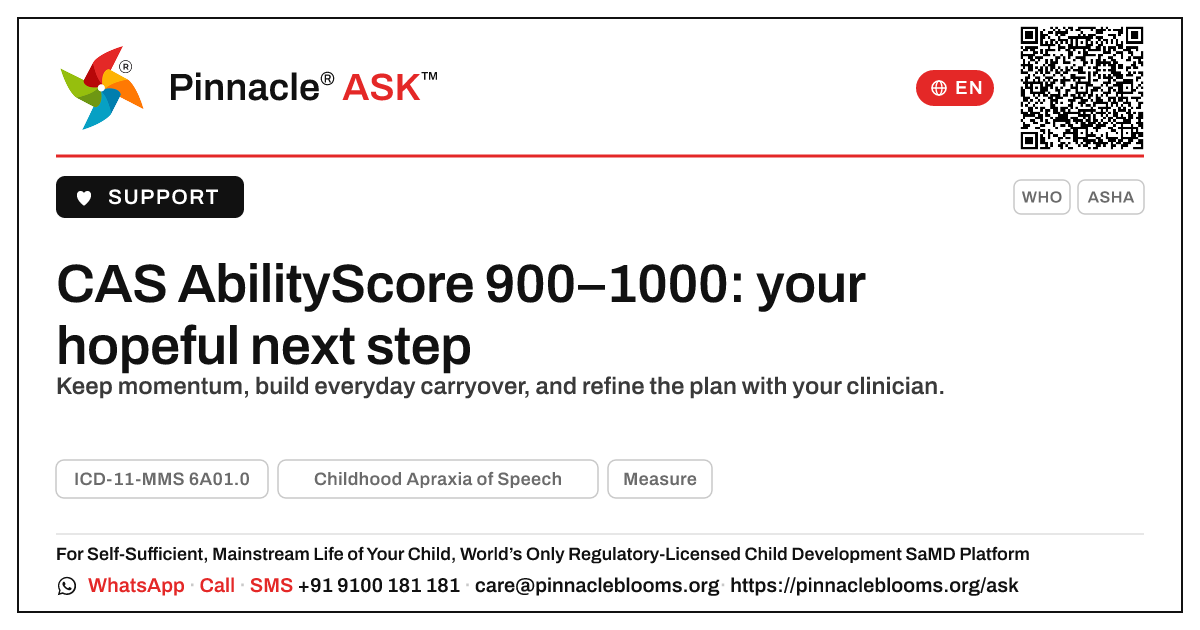
YOUR QUESTION. A CLEARER NEXT STEP.
AbilityScore 900–1000 with Childhood Apraxia of Speech: what to do next
An AbilityScore in the 900–1000 band signals strong communication readiness. For Childhood Apraxia of Speech, the next step is to keep frequent motor-speech practice going, shift targets into everyday life, and let your clinician fine-tune the plan against your child's own baseline.
In this answer 4 sections
An AbilityScore in the 900–1000 band is genuinely encouraging news — and it gives you a clear, hopeful direction for what comes next.
In short
Your child's AbilityScore® sitting in the 900–1000 band points to strong communication readiness — a foundation many families work hard to reach. With Childhood Apraxia of Speech (ICD-11 6A01.0), the next step isn't to relax the work, but to sharpen it: keep frequent, motor-focused speech practice going, consolidate the gains, and plan the move toward functional, everyday talking. Your Pinnacle clinician will use this score to fine-tune — not finish — the plan.
What this band means for your next move
CAS is a motor speech difficulty: the brain knows the words but struggles to plan and sequence the movements that produce them. Progress comes from frequent, repetitive, child-led practice of speech movements — not from waiting. With a score in this band:
- Keep the intensity steady. Apraxia responds best to little-and-often practice. A high score is a reason to maintain momentum, not to space out sessions.
- Shift toward real-life carryover. Move target words and phrases into daily routines — mealtimes, play, bedtime — so speech becomes functional, not just practised.
- Build longer sequences. As single words and short phrases steady, your clinician will layer in longer, more connected speech.
- Protect confidence. Celebrate attempts warmly; a child who feels safe trying will try more.
The Pinnacle way
Your Developmental measurement supports care planning; diagnosis requires an appropriately qualified healthcare professional., under the care of a qualified clinician — never from an online figure alone. Your speech-language therapist reads this 900–1000 band against your child's own AbilityScore baseline, then adjusts targets, intensity and home practice accordingly. The aim is always the same: clear, confident, functional speech your child can use everywhere. Start here to plan the next review with your clinician.
Trusted sources
WHO ICD-11 (6A01.0, Childhood Apraxia of Speech); American Speech-Language-Hearing Association (ASHA) guidance on CAS and principles of motor-learning practice; Pinnacle Blooms Network clinical studies.
Next step — A high score is a launchpad, not a finish line. Book a progress review with your Pinnacle speech-language pathologist to refine the plan from here.
This is general information, not a diagnosis — individual assessment and diagnosis require an appropriately qualified healthcare professional.
CONNECT THE ANSWER TO YOUR CHILD’S DAY
Something to notice. Something to discuss.
What to notice
Watch for steady carryover of practised words into real conversations, longer connected phrases, and rising confidence to attempt new words. Flag any plateau or loss of previously used words to your clinician promptly.
In everyday life
Turn target words into tiny daily rituals — say the same phrase at the same moment ("open" at the door, "more" at snack time). Short, frequent, motor-focused repetition beats long occasional sessions for apraxia.
Bring your observations and questions to your child’s professional. Choose activities that suit your child’s comfort, abilities and agreed plan.
Bring your questions to a first visitQuestions families ask
Does a 900–1000 AbilityScore mean my child's apraxia is resolved?
Not necessarily — it signals strong communication readiness and real progress, but Childhood Apraxia of Speech is a motor-speech condition that benefits from continued, frequent practice. Your clinician interprets the score against your child's own baseline and decides what the band means for the next stage of the plan.
Should we reduce therapy sessions now that the score is high?
A high score is usually a reason to maintain momentum, not to space sessions out. Apraxia responds best to little-and-often, motor-focused practice. Your speech-language pathologist will advise on the right intensity for this stage.
How was the AbilityScore calculated?
The AbilityScore® is a clinician-administered structured assessment carried out at a Pinnacle Blooms Network centre. It compares your child to their own earlier baseline so progress is measured fairly. The score and any diagnosis are formed only under qualified clinician care — never from an online form.
FOLLOW THE SOURCE
References behind this answer.
- Organisation website · further readingWHO ICD-11: Childhood Apraxia of Speech
- Organisation website · further readingASHA: Childhood Apraxia of Speech guidance
References are supplied with this answer. An organisation homepage offers further reading; it does not establish an independent review of this page.
Content attribution: SETU Consortium · Pinnacle Blooms Network.
PEOPLE, TOPICS & DEVELOPMENT
See the connections.
Browse the wider question collections connected with this answer’s audience, developmental area and stage.
FROM UNDERSTANDING TO PURPOSEFUL SUPPORT
One question. Your child’s whole life.
Your child’s self-sufficient, mainstream-included life is the purpose from the beginning. At Pinnacle, that purpose shapes what we understand, the goals we choose, the people we bring together, everyday practice and review.
Connect this question with the right support.
Explore how the relevant service contributes to everyday abilities, then speak with us about your child.
Make the next conversation useful.
Bring the situations you notice at home or school. We’ll explain a suitable service, centre and first visit, including availability and fees, before you decide.
How PinnacleAI® connects the journeyExplore the seven stages
- 1Understand abilities
A starting picture of your child’s capabilities.
- 2Choose meaningful goals
Readiness and a plan shaped around the child.
- 3Bring the right support together
Suitable therapies and people for those goals.
- 4Carry practice into everyday life
Guidance for family, home and school.
- 5Track and correct
Use observations to adjust the plan.
- 6Reassess and review
Decide what to continue, change or do next.
- 7Grow independence and participation
The child’s life gives each step its purpose.
Explore the whole PinnacleAI® system → · Participation at school and in the community →
PINNACLE’S EVIDENCE, OPEN TO YOU
Look at the evidence behind our work.
Read our research, inspect the original regulatory documents and check what each institutional measure means.
General information supports a conversation with an appropriately qualified professional. Advice, goals and support depend on the individual child.