
YOUR QUESTION. A CLEARER NEXT STEP.
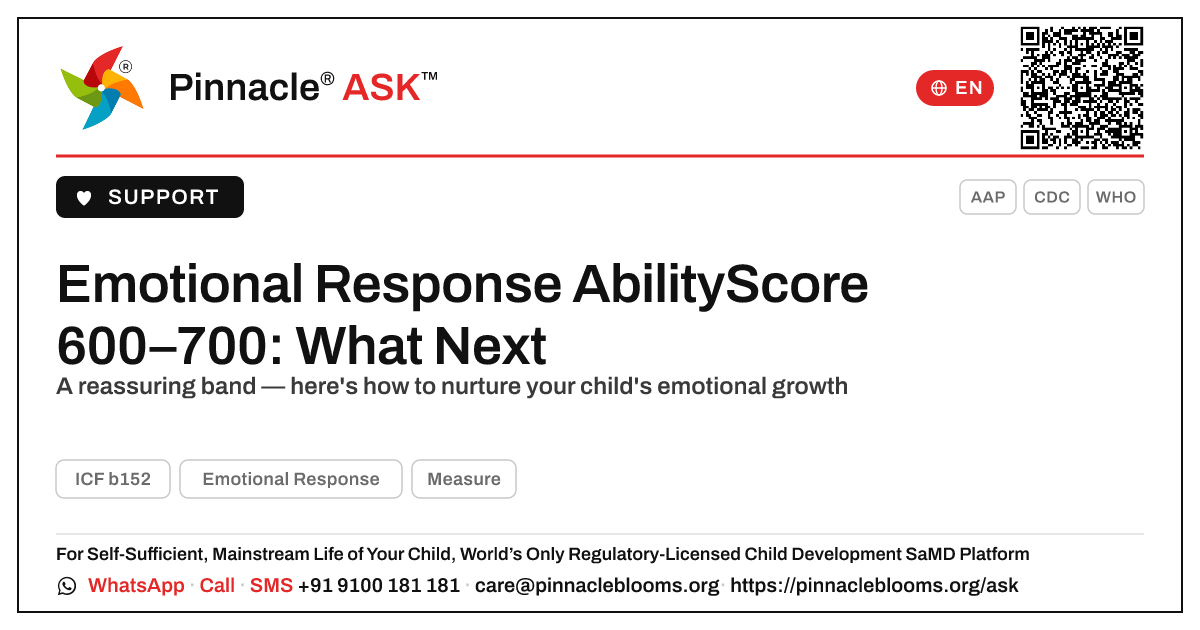
Emotional Response AbilityScore 600–700: Next Steps
An Emotional Response AbilityScore in the 600–700 band is an encouraging result, suggesting age-appropriate emotional expression and emerging self-regulation. The next steps are to read the full clinician report, keep emotional coaching part of daily life, agree a review rhythm, and consider light-touch enrichment if your clinician suggests it. AbilityScore® is part of Pinnacle’s developmental assessment. Diagnosis, where needed, requires an appropriately qualified healthcare professional.
In this answer 5 sections
A score in this band is a clear, encouraging signal — your child is building emotional skills well, and the next steps are about nurturing momentum, not fixing a problem.
In short
An Emotional Response AbilityScore in the 600–700 band is a strong, reassuring result — it suggests your child is recognising, expressing and managing feelings in a healthy, age-appropriate way. The next steps are simple: keep doing what's working, gently stretch the areas a clinician highlights, and stay connected through periodic reviews so progress continues. A score is a snapshot, not a verdict — your clinician will explain exactly what your child's profile means.
What this band tells you
Emotional Response (ICF b152) describes the appropriateness, range and regulation of a child's feelings — how they show joy, comfort themselves when upset, read others' emotions, and bounce back from frustration. A 600–700 result generally points to:
- Healthy expression — your child shows a range of feelings that fit the situation.
- Emerging self-regulation — they are learning to settle after being upset, with your support.
- Growing social awareness — they notice and respond to how others feel.
This is a band to build on. The goal now is to enrich, not intervene.
Your next steps
- Read the full clinician report, not just the number. Your Pinnacle clinician will translate the band into specific strengths and one or two gentle growth areas tailored to your child.
- Keep emotional coaching part of daily life — name feelings out loud, model calming down, and let your child practise waiting, sharing and recovering from small disappointments.
- Decide together on a review rhythm. For a child in this band, a periodic re-check is usually enough to confirm steady progress and catch any shifts early.
- Light-touch enrichment, if suggested — sometimes a short block of play-based emotional or social-skills support helps a child consolidate gains, but this is a choice you make with your clinician, not a requirement.
The Pinnacle way
AbilityScore® is part of Pinnacle’s developmental assessment. Diagnosis, where needed, requires an appropriately qualified healthcare professional — never from a number alone. Your clinician interprets this AbilityScore® band within your child's whole developmental picture and, if helpful, can introduce gentle emotional and behavioural support to build on existing strengths. Explore how Pinnacle supports children across every developmental domain at our network.
Trusted sources
WHO ICF framework (b152, Emotional functions); American Academy of Pediatrics (HealthyChildren.org) guidance on social-emotional development; CDC developmental milestones for emotional growth.
Next step — Want a clinician to walk you through your child's full profile and next steps? Book a review with a Pinnacle clinician.
This is general information, not a diagnosis — individual assessment and diagnosis require an appropriately qualified healthcare professional.
CONNECT THE ANSWER TO YOUR CHILD’S DAY
Something to notice. Something to discuss.
What to notice
Watch that your child keeps showing a range of feelings that fit the moment, settles after being upset with your help, and responds to others' emotions — and note any new, persistent changes in mood or regulation to mention at your next review.
In everyday life
Name feelings out loud as they happen — 'you look frustrated that the tower fell' — then model a calm next step. This everyday emotional coaching strengthens the very skills this score measures.
Bring your observations and questions to your child’s professional. Choose activities that suit your child’s comfort, abilities and agreed plan.
Bring your questions to a first visitQuestions families ask
Is an Emotional Response score of 600–700 good?
It is an encouraging band, generally suggesting your child is expressing and managing emotions in an age-appropriate way. The number is a snapshot — your Pinnacle clinician will explain what it means within your child's whole developmental picture.
Do we need therapy if our child is in this band?
Often not. The focus is on nurturing existing strengths through everyday emotional coaching and periodic reviews. If a clinician suggests a short block of play-based support to consolidate gains, that is a choice you make together — not a requirement.
How often should we re-check the score?
For a child in a strong band, a periodic review is usually enough to confirm steady progress and catch any shifts early. Your clinician will recommend a rhythm that suits your child.
FOLLOW THE SOURCE
References behind this answer.
- Organisation website · further readingAAP HealthyChildren.org — social-emotional development
- Organisation website · further readingCDC — developmental milestones
- Organisation website · further readingWHO ICF — Emotional functions
References are supplied with this answer. An organisation homepage offers further reading; it does not establish an independent review of this page.
Content attribution: SETU Consortium · Pinnacle Blooms Network.
PEOPLE, TOPICS & DEVELOPMENT
See the connections.
Browse the wider question collections connected with this answer’s audience, developmental area and stage.
FROM UNDERSTANDING TO PURPOSEFUL SUPPORT
One question. Your child’s whole life.
Your child’s self-sufficient, mainstream-included life is the purpose from the beginning. At Pinnacle, that purpose shapes what we understand, the goals we choose, the people we bring together, everyday practice and review.
Connect this question with the right support.
Start with your child’s strengths, your observations and what you want everyday life to become.
Make the next conversation useful.
Bring the situations you notice at home or school. We’ll explain a suitable service, centre and first visit, including availability and fees, before you decide.
How PinnacleAI® connects the journeyExplore the seven stages
- 1Understand abilities
A starting picture of your child’s capabilities.
- 2Choose meaningful goals
Readiness and a plan shaped around the child.
- 3Bring the right support together
Suitable therapies and people for those goals.
- 4Carry practice into everyday life
Guidance for family, home and school.
- 5Track and correct
Use observations to adjust the plan.
- 6Reassess and review
Decide what to continue, change or do next.
- 7Grow independence and participation
The child’s life gives each step its purpose.
Explore the whole PinnacleAI® system → · Participation at school and in the community →
PINNACLE’S EVIDENCE, OPEN TO YOU
Look at the evidence behind our work.
Read our research, inspect the original regulatory documents and check what each institutional measure means.
General information supports a conversation with an appropriately qualified professional. Advice, goals and support depend on the individual child.