
YOUR QUESTION. A CLEARER NEXT STEP.
My child isn't crawling yet — should I be worried?
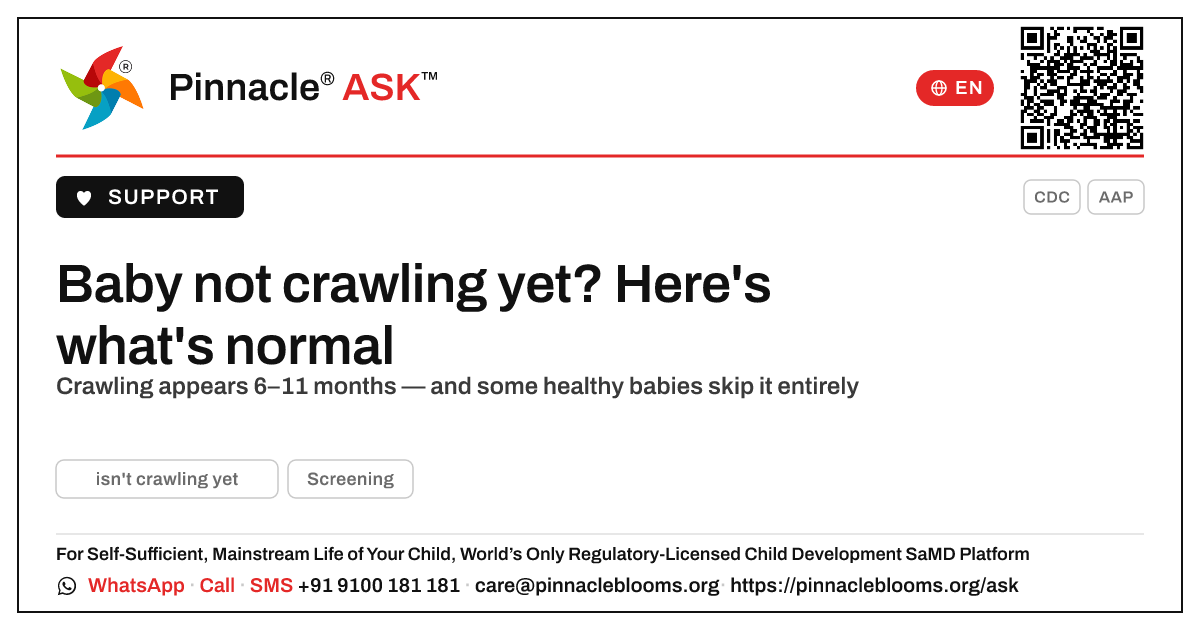
A baby who isn't crawling yet is rarely a cause for worry — crawling appears anywhere from 6 to 11 months and some healthy babies skip it entirely, bottom-shuffling or going straight to standing. What matters is steady progress in movement and curiosity, plus good head and trunk control. AbilityScore® is part of Pinnacle’s developmental assessment. Diagnosis, where needed, requires an appropriately qualified healthcare professional.
In this answer 5 sections
Some of the busiest, brightest babies skip crawling altogether — what matters most is that your little one is finding ways to move and explore.
In short
In most cases, no — a baby who isn't crawling yet is rarely a cause for worry. Crawling typically appears anywhere between 6 and 11 months, and the range of "normal" is wonderfully wide. Some babies bottom-shuffle, roll, commando-crawl or simply pull straight to standing and walk — and that's perfectly healthy. What we look for is steady forward progress in movement and curiosity, not one particular style of getting around.
What's actually normal
Crawling is just one of many ways babies learn to move, and it isn't a required milestone for healthy development. Reassuring signs that all is well include:
- Good head and trunk control when sitting, with a strong, stable back by around 8–9 months.
- Reaching, grabbing and passing toys from hand to hand — showing strength and coordination in the arms.
- Pushing up on the arms during tummy time, or rocking on hands and knees.
- Bearing weight on the legs when held in standing, and pushing back.
- Curiosity to explore — wriggling, rolling, shuffling or scooting towards a toy across the room.
Many babies who never crawl in the classic hands-and-knees way go on to walk right on time. The drive to move and reach the world matters far more than the method.
When a gentle check helps
It's worth booking a developmental check if, by around 9–12 months, your baby:
- Isn't sitting without support, or feels very floppy or very stiff to hold.
- Isn't bearing any weight on the legs or pushing up during tummy time.
- Uses only one side of the body (one hand, one leg) and ignores the other.
- Shows little interest in moving towards toys or people.
These are simply cues to look a little closer with a clinician — not signs of a problem in themselves. Early, gentle support is always easier and more playful than waiting.
The Pinnacle way
AbilityScore® is part of Pinnacle’s developmental assessment. Diagnosis, where needed, requires an appropriately qualified healthcare professional — never from an app or an online checklist. If you'd like reassurance, our clinicians offer a warm, structured developmental profile and, where helpful, playful movement-building through our occupational therapy programme. You're always welcome to start here to find your nearest centre.
Trusted sources
CDC developmental milestones guidance notes that crawling is not a required milestone and that babies move in varied ways; the American Academy of Pediatrics (HealthyChildren.org) describes the wide normal range for early motor skills and reassures that some babies skip crawling entirely.
Next step — Want simple reassurance that your baby is on track? Book a developmental check with a Pinnacle clinician.
This is general information, not a diagnosis — individual assessment and diagnosis require an appropriately qualified healthcare professional.
CONNECT THE ANSWER TO YOUR CHILD’S DAY
Something to notice. Something to discuss.
What to notice
By around 9–12 months, a gentle check helps if your baby isn't sitting without support, feels very floppy or very stiff, isn't bearing weight on the legs, consistently uses only one side of the body, or shows little interest in moving towards toys.
In everyday life
Make floor time fun — place a favourite toy just out of reach during tummy time to encourage reaching, rocking and scooting, and cheer every wriggle of effort to build strength and confidence.
Bring your observations and questions to your child’s professional. Choose activities that suit your child’s comfort, abilities and agreed plan.
Bring your questions to a first visitQuestions families ask
At what age should my baby be crawling?
Crawling typically appears anywhere between 6 and 11 months, with a very wide normal range. Some babies crawl early, some late, and some skip it altogether — all of which can be perfectly healthy.
Is it normal for a baby to skip crawling and go straight to walking?
Yes. Many healthy babies never crawl on hands and knees — they bottom-shuffle, roll, commando-crawl or pull straight to standing and walk. Crawling is not a required milestone for healthy development.
When should I seek advice about my baby not crawling?
Consider a gentle developmental check if, by around 9–12 months, your baby isn't sitting without support, feels very floppy or stiff, isn't bearing weight on the legs, uses only one side of the body, or shows little interest in moving towards toys.
FOLLOW THE SOURCE
References behind this answer.
- Source referenceCDC — Developmental milestones
- Source referenceAAP HealthyChildren.org — Baby development
References are supplied with this answer. An organisation homepage offers further reading; it does not establish an independent review of this page.
Content attribution: SETU Consortium · Pinnacle Blooms Network.
PEOPLE, TOPICS & DEVELOPMENT
See the connections.
Browse the wider question collections connected with this answer’s audience, developmental area and stage.
FROM UNDERSTANDING TO PURPOSEFUL SUPPORT
One question. Your child’s whole life.
Your child’s self-sufficient, mainstream-included life is the purpose from the beginning. At Pinnacle, that purpose shapes what we understand, the goals we choose, the people we bring together, everyday practice and review.
Connect this question with the right support.
Start with your child’s strengths, your observations and what you want everyday life to become.
Make the next conversation useful.
Bring the situations you notice at home or school. We’ll explain a suitable service, centre and first visit, including availability and fees, before you decide.
How PinnacleAI® connects the journeyExplore the seven stages
- 1Understand abilities
A starting picture of your child’s capabilities.
- 2Choose meaningful goals
Readiness and a plan shaped around the child.
- 3Bring the right support together
Suitable therapies and people for those goals.
- 4Carry practice into everyday life
Guidance for family, home and school.
- 5Track and correct
Use observations to adjust the plan.
- 6Reassess and review
Decide what to continue, change or do next.
- 7Grow independence and participation
The child’s life gives each step its purpose.
Explore the whole PinnacleAI® system → · Participation at school and in the community →
PINNACLE’S EVIDENCE, OPEN TO YOU
Look at the evidence behind our work.
Read our research, inspect the original regulatory documents and check what each institutional measure means.
General information supports a conversation with an appropriately qualified professional. Advice, goals and support depend on the individual child.