
YOUR QUESTION. A CLEARER NEXT STEP.
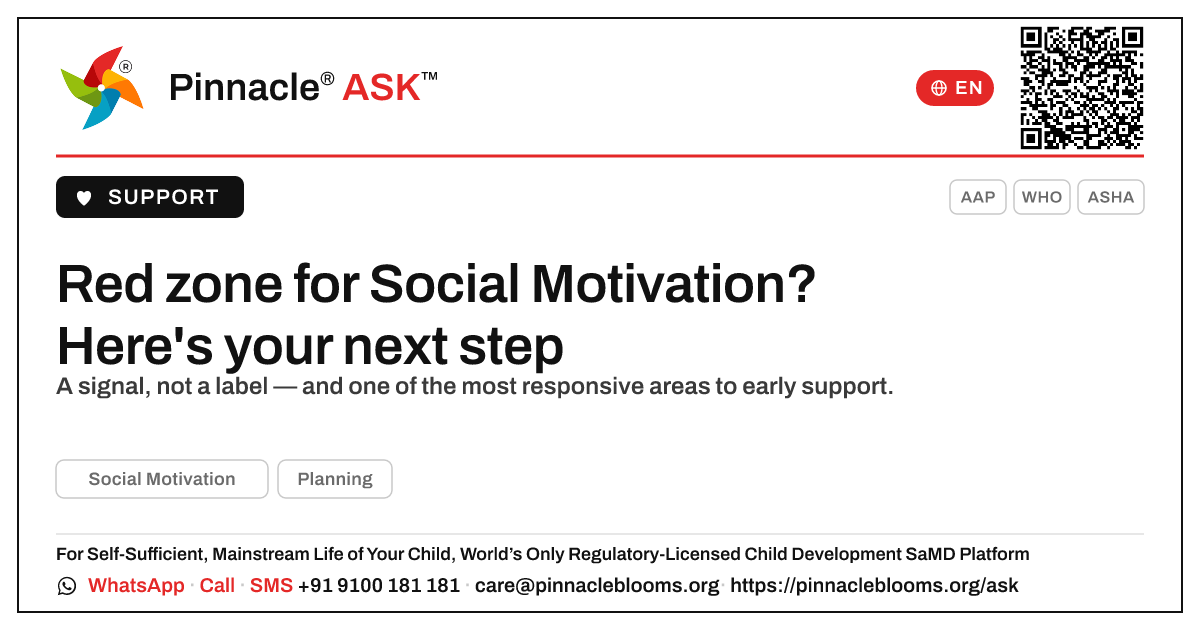
Red zone for Social Motivation: what to do next
A red zone for Social Motivation means your child's drive to seek and enjoy connection needs focused support now — it is a starting point, not a label, and one of the most responsive areas to early, play-based therapy and parent coaching. The next step is a clinician-led AbilityScore® conversation that turns the signal into a personalised plan. AbilityScore® is part of Pinnacle’s developmental assessment. Diagnosis, where needed, requires an appropriately qualified healthcare professional.
In this answer 5 sections
A red zone on one ability isn't a verdict on your child — it's a clear signal that the right support, started now, can change the story.
In short
A red zone for Social Motivation simply means your child's drive to seek out and enjoy connection with other people — sharing smiles, looking for your reaction, wanting to join in — is showing up as an area that needs focused support right now. It is a starting point, not a label, and it is one of the most responsive areas to early, playful intervention. The next step is a clinician-led conversation that turns this signal into a clear, personalised plan you can begin straight away.
What this signal means and what helps
Social Motivation is the engine behind connection — the wanting-to-be-with-you that drives a child to look at faces, share moments, point things out and seek your delight. When it sits in the red zone, support gently rebuilds that engine through:
- Play-based, child-led therapy — following your child's lead and making you the most rewarding thing in the room, so connection itself becomes something they actively seek.
- Building shared-attention moments — small back-and-forth games, peek-a-boo, turn-taking and joyful repetition that wire in the reward of "we did that together".
- Speech and language support where communication frustration is dampening the wish to connect — giving your child easier ways to reach out.
- Parent coaching — the single biggest lever. Therapists show you how to read your child's tiny bids for connection and respond in ways that make them want more.
None of this is about pressuring your child to be social — it is about making the social world feel safe, predictable and rewarding, so motivation grows from the inside.
When to act
Now is exactly the right time. Social Motivation is most responsive when support begins early, and a red-zone signal is your cue to move from watching to planning. Bring along any observations — how your child responds to their name, whether they share enjoyment with you, how they react when you join their play — as these help your clinician shape the plan. If you also notice loss of skills your child previously had, mention it promptly.
The Pinnacle way
AbilityScore® is part of Pinnacle’s developmental assessment. Diagnosis, where needed, requires an appropriately qualified healthcare professional — never from an app, a screen or this signal alone. Your red-zone result is the doorway: a clinician translates it into a precise profile and a plan built around your child. Learn how the AbilityScore® is calculated, explore play-based developmental therapy, and see how speech and language support can ease the path to connection. You can start here.
Trusted sources
American Academy of Pediatrics (HealthyChildren.org) guidance on early social-emotional development; WHO Nurturing Care Framework on responsive caregiving; ASHA guidance on social communication.
Next step — Turn this signal into a plan. Book an AbilityScore® assessment with a Pinnacle clinician.
This is general information, not a diagnosis — individual assessment and diagnosis require an appropriately qualified healthcare professional.
CONNECT THE ANSWER TO YOUR CHILD’S DAY
Something to notice. Something to discuss.
What to notice
Watch how your child responds to their name, whether they share smiles and enjoyment with you, whether they look to you for your reaction, and how they react when you join their play. Mention promptly any loss of skills your child previously had.
In everyday life
Become the most rewarding thing in the room — get down to your child's level, copy their play, and respond with big warm delight to every tiny look, sound or gesture they aim at you, so connecting with you feels worth seeking.
Bring your observations and questions to your child’s professional. Choose activities that suit your child’s comfort, abilities and agreed plan.
Bring your questions to a first visitQuestions families ask
Does a red zone for Social Motivation mean my child has autism?
No. A red zone is a signal that one area of development needs focused support — it is not a diagnosis. Many things can affect a child's drive to connect. Only a qualified clinician at a Pinnacle Blooms Network centre can interpret the full picture and form any diagnosis.
Can Social Motivation actually improve?
Yes. Social Motivation is one of the most responsive areas to early, playful intervention. Through child-led play, shared-attention games and parent coaching, children often steadily grow their wish to connect when support starts early.
What happens at the assessment?
A clinician administers a structured AbilityScore® assessment, talks through your observations, and builds a precise developmental profile. From there you receive a clear, personalised plan you can begin straight away.
What can I do at home while we wait?
Follow your child's lead in play, respond warmly to every small bid for connection, and weave in simple back-and-forth games like peek-a-boo and turn-taking. Making connection feel rewarding is the most powerful everyday step.
FOLLOW THE SOURCE
References behind this answer.
- Organisation website · further readingAAP HealthyChildren.org: early social-emotional development
- Organisation website · further readingWHO Nurturing Care Framework: responsive caregiving
- Organisation website · further readingASHA: social communication development
References are supplied with this answer. An organisation homepage offers further reading; it does not establish an independent review of this page.
Content attribution: SETU Consortium · Pinnacle Blooms Network.
PEOPLE, TOPICS & DEVELOPMENT
See the connections.
Browse the wider question collections connected with this answer’s audience, developmental area and stage.
FROM UNDERSTANDING TO PURPOSEFUL SUPPORT
One question. Your child’s whole life.
Your child’s self-sufficient, mainstream-included life is the purpose from the beginning. At Pinnacle, that purpose shapes what we understand, the goals we choose, the people we bring together, everyday practice and review.
Connect this question with the right support.
Start with your child’s strengths, your observations and what you want everyday life to become.
Make the next conversation useful.
Bring the situations you notice at home or school. We’ll explain a suitable service, centre and first visit, including availability and fees, before you decide.
How PinnacleAI® connects the journeyExplore the seven stages
- 1Understand abilities
A starting picture of your child’s capabilities.
- 2Choose meaningful goals
Readiness and a plan shaped around the child.
- 3Bring the right support together
Suitable therapies and people for those goals.
- 4Carry practice into everyday life
Guidance for family, home and school.
- 5Track and correct
Use observations to adjust the plan.
- 6Reassess and review
Decide what to continue, change or do next.
- 7Grow independence and participation
The child’s life gives each step its purpose.
Explore the whole PinnacleAI® system → · Participation at school and in the community →
PINNACLE’S EVIDENCE, OPEN TO YOU
Look at the evidence behind our work.
Read our research, inspect the original regulatory documents and check what each institutional measure means.
General information supports a conversation with an appropriately qualified professional. Advice, goals and support depend on the individual child.