
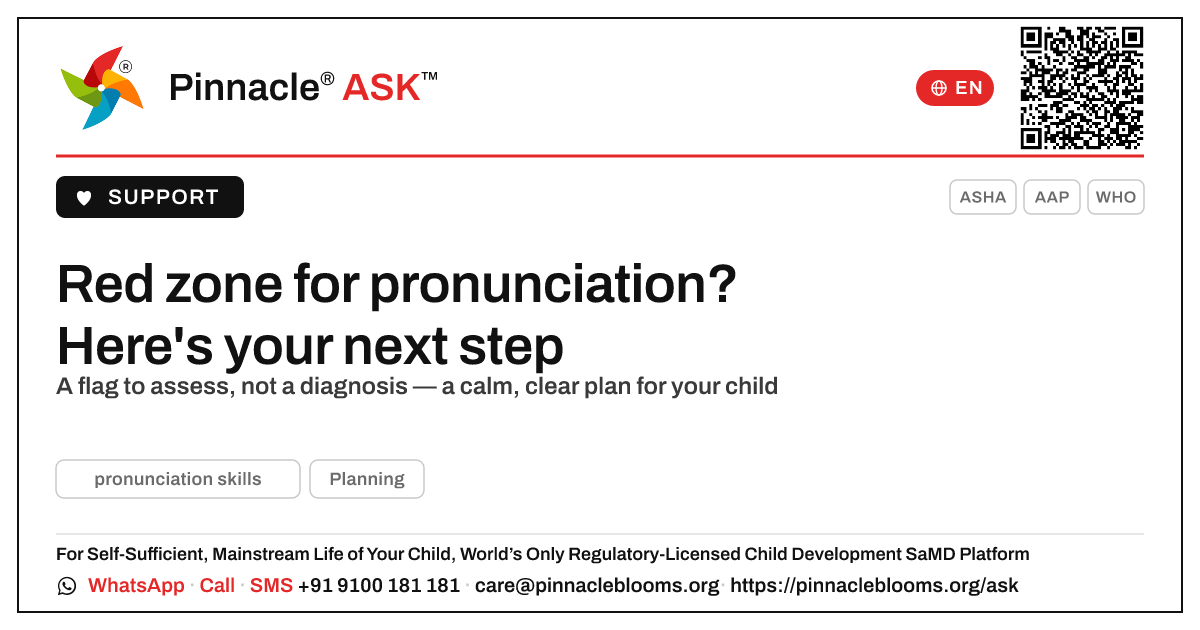
YOUR QUESTION. A CLEARER NEXT STEP.
Red zone for pronunciation skills: what to do next
A red zone for pronunciation skills is a screening flag, not a diagnosis — the next step is a clinician-led speech and language assessment, alongside a hearing check and gentle modelling at home. AbilityScore® is part of Pinnacle’s developmental assessment. Diagnosis, where needed, requires an appropriately qualified healthcare professional.
In this answer 5 sections
A red zone on pronunciation is not a verdict — it is simply a signpost showing exactly where your child needs a little focused help.
In short
A red zone for pronunciation skills means a screening tool has flagged that your child's speech sounds may need a closer look — it is a prompt to assess, not a diagnosis. The clear next step is a proper speech and language evaluation with a qualified clinician, who can tell whether this reflects a normal stage, a delay, or a speech sound difficulty that benefits from therapy. With early, playful support, most children make excellent progress and grow into clear, confident speakers.
What the red zone means — and what to do next
Pronunciation (how clearly a child produces speech sounds) develops gradually, and some sounds — like r, s, l and th — are mastered much later than others. A red flag on a screen simply means your child's pattern stands out enough to deserve a closer, clinician-led look.
Here is what helps next:
- Book a speech and language assessment. A speech-language therapist listens to which sounds are tricky, how they are produced, and whether the pattern is typical for your child's age — the foundation of any plan.
- Keep talking and listening at home. Narrate daily routines, read aloud, sing rhymes, and repeat your child's words back correctly without correcting or pressuring them — gentle modelling teaches far better than drilling.
- Rule out hearing first. Even mild or fluctuating hearing loss (often from glue ear) can blur speech sounds, so a hearing check is a sensible early step.
- Notice, don't pressure. Let your child speak freely and finish their thoughts; anxiety around talking can mask a child's real ability.
The goal is not perfect speech overnight, but to understand why sounds are tricky and to support them at the right pace.
When to seek a check sooner
Seek a check promptly if your child is very hard for family to understand beyond about age 3, frustrated or upset by not being understood, losing speech they previously had, or showing any concern with hearing. These warrant a timely professional listen rather than waiting.
The Pinnacle way
AbilityScore® is part of Pinnacle’s developmental assessment. Diagnosis, where needed, requires an appropriately qualified healthcare professional — never from an app, screen or online form. A red zone is your cue to turn a flag into a clear, kind plan: our therapists build a precise speech and developmental profile and shape playful, child-led speech therapy around exactly the sounds your child finds tricky. Explore how we support children across India at Pinnacle Blooms Network.
Trusted sources
American Speech-Language-Hearing Association guidance on children's speech sound development; American Academy of Pediatrics (HealthyChildren.org) on speech and language milestones; WHO guidance on early childhood development.
Next step — Ready to turn that red flag into a clear plan? Book a speech assessment with a Pinnacle clinician.
This is general information, not a diagnosis — individual assessment and diagnosis require an appropriately qualified healthcare professional.
CONNECT THE ANSWER TO YOUR CHILD’S DAY
Something to notice. Something to discuss.
What to notice
Watch if your child is hard for family to understand beyond about age 3, gets frustrated at not being understood, loses speech they once had, or shows any hearing concern — each warrants a timely professional listen.
In everyday life
Repeat your child's words back clearly and correctly without making them 'say it again' — gentle modelling during play and reading teaches sounds far better than drilling.
Bring your observations and questions to your child’s professional. Choose activities that suit your child’s comfort, abilities and agreed plan.
Bring your questions to a first visitQuestions families ask
Does a red zone mean my child has a speech disorder?
No. A red zone is a screening flag that says your child's speech sounds deserve a closer, clinician-led look. Many children flagged this way are simply at a normal developmental stage; an assessment tells you which is the case.
Should I correct my child's pronunciation at home?
Rather than correcting or asking them to repeat, gently model the correct word back in conversation. This teaches sounds without pressure and keeps your child confident and willing to talk.
Could hearing affect pronunciation?
Yes. Even mild or fluctuating hearing loss, often from glue ear, can blur the sounds a child hears and produces. A hearing check is a sensible early step alongside a speech assessment.
When does pronunciation usually become clear?
Children master sounds gradually, with some like r, s, l and th arriving much later. Generally a child should be mostly understandable to family by around age 3 — if not, a professional listen is wise.
FOLLOW THE SOURCE
References behind this answer.
- Source referenceASHA: speech sound development in children
- Source referenceAAP HealthyChildren: speech and language milestones
- Source referenceWHO: early childhood development
References are supplied with this answer. An organisation homepage offers further reading; it does not establish an independent review of this page.
Content attribution: SETU Consortium · Pinnacle Blooms Network.
PEOPLE, TOPICS & DEVELOPMENT
See the connections.
Browse the wider question collections connected with this answer’s audience, developmental area and stage.
FROM UNDERSTANDING TO PURPOSEFUL SUPPORT
One question. Your child’s whole life.
Your child’s self-sufficient, mainstream-included life is the purpose from the beginning. At Pinnacle, that purpose shapes what we understand, the goals we choose, the people we bring together, everyday practice and review.
Connect this question with the right support.
Start with your child’s strengths, your observations and what you want everyday life to become.
Make the next conversation useful.
Bring the situations you notice at home or school. We’ll explain a suitable service, centre and first visit, including availability and fees, before you decide.
How PinnacleAI® connects the journeyExplore the seven stages
- 1Understand abilities
A starting picture of your child’s capabilities.
- 2Choose meaningful goals
Readiness and a plan shaped around the child.
- 3Bring the right support together
Suitable therapies and people for those goals.
- 4Carry practice into everyday life
Guidance for family, home and school.
- 5Track and correct
Use observations to adjust the plan.
- 6Reassess and review
Decide what to continue, change or do next.
- 7Grow independence and participation
The child’s life gives each step its purpose.
Explore the whole PinnacleAI® system → · Participation at school and in the community →
PINNACLE’S EVIDENCE, OPEN TO YOU
Look at the evidence behind our work.
Read our research, inspect the original regulatory documents and check what each institutional measure means.
General information supports a conversation with an appropriately qualified professional. Advice, goals and support depend on the individual child.