
YOUR QUESTION. A CLEARER NEXT STEP.
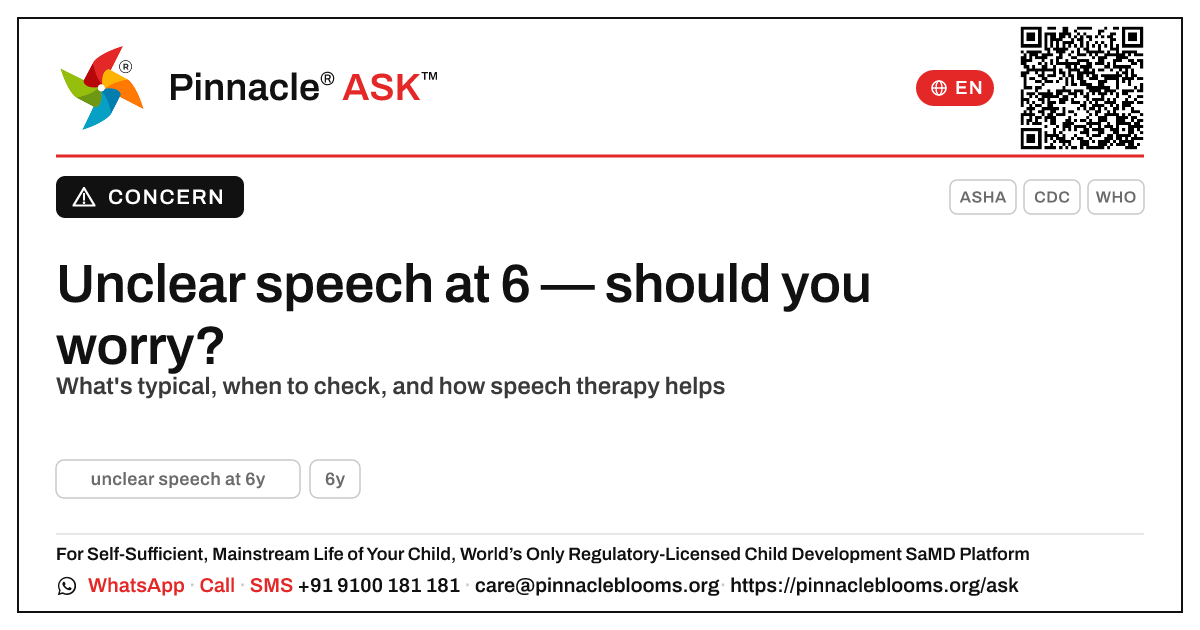
Hard to understand at 6: should you worry?
By age 6 a child's speech should be understood by almost everyone. Persistent difficulty being understood is worth a proper check — often it's a treatable speech-sound difficulty that responds well to therapy. Worry is a reason to assess, not a diagnosis; only a Pinnacle clinician can confirm what's happening.
In this answer 5 sections
If most people struggle to understand your six-year-old, your instinct to ask is a good one — and the news here is mostly hopeful.
In short
By age 6, a child's speech should be understood by almost everyone, including people outside the family — roughly fully clear by this age. If your child is hard to understand much of the time, it is worth a proper check, but it does not mean something is wrong with them or with you. Many children with unclear speech at 6 have a treatable speech-sound difficulty that responds very well to therapy. The most useful next step is a structured assessment, not worry on its own.
What clear speech looks like at 6
A helpful guide is how much a stranger can understand:
- By age 4 — most of what your child says should be clear to people outside the home
- By age 5–6 — speech should be understood by almost everyone, even when the topic is new
- At 6 — a few tricky sounds (like r, th, or s clusters) may still be settling, and that alone is usually fine
What earns a closer look at this age is persistent difficulty — when many sounds are unclear, words are left incomplete, or your child is frustrated because people keep asking them to repeat. It is also worth ruling out simple causes first, such as hearing (including glue ear after frequent colds).
When to check
Book a developmental and speech check now if, at 6, your child is:
- Hard for unfamiliar people to understand most of the time
- Dropping or swapping many sounds, not just one or two
- Getting upset, avoiding talking, or being teased about their speech
- Showing any sign of hearing trouble
Early help at this age works with the school years ahead, supporting reading, spelling and confidence — so checking sooner is genuinely the kind, practical choice.
The Pinnacle way
AbilityScore® is part of Pinnacle’s developmental assessment. Diagnosis, where needed, requires an appropriately qualified healthcare professional — never from an online form. Our clinicians can tell the difference between a few maturing sounds and a speech-sound difficulty that needs support, then build a clear plan. Start by reading more on unclear speech at 6, explore how speech therapy helps, and understand your child's starting point with the AbilityScore®.
Trusted sources
American Speech-Language-Hearing Association guidance on speech-sound development and intelligibility by age; CDC developmental milestones; WHO ICD-11 framework for speech and language disorders.
Next step — Don't sit with the worry — book a speech and developmental check with a Pinnacle clinician to get clear answers and a plan.
This is general information, not a diagnosis — individual assessment and diagnosis require an appropriately qualified healthcare professional.
CONNECT THE ANSWER TO YOUR CHILD’S DAY
Something to notice. Something to discuss.
What to notice
Whether unfamiliar people understand your child most of the time, how many sounds are unclear (not just one or two), signs of frustration or avoiding talking, and any hint of hearing trouble.
In everyday life
Instead of asking your child to 'say it again', repeat back what you did understand and gently model the full word — this keeps them talking without pressure.
Bring your observations and questions to your child’s professional. Choose activities that suit your child’s comfort, abilities and agreed plan.
Bring your questions to a first visitQuestions families ask
Is some unclear speech normal at 6?
Yes — a few tricky sounds like r, th or s-clusters may still be settling at 6 and that alone is usually fine. The concern is when many sounds are unclear and people often can't understand your child.
How clear should a 6-year-old's speech be?
By 5 to 6, a child's speech should be understood by almost everyone, including people outside the family, even on new topics. If strangers struggle most of the time, it's worth a check.
Could it be a hearing problem?
It can be. Hearing issues, including glue ear after frequent colds, can affect speech clarity. A check helps rule this out, which is why a proper assessment is the sensible first step.
Will therapy help unclear speech at this age?
Often very well. Speech-sound difficulties commonly respond to targeted speech therapy, and starting at 6 supports reading, spelling and confidence in the school years ahead.
FOLLOW THE SOURCE
References behind this answer.
- Source referenceASHA: speech-sound development and intelligibility by age
- Source referenceCDC: developmental milestones
- Organisation website · further readingWHO ICD-11: speech and language disorders
References are supplied with this answer. An organisation homepage offers further reading; it does not establish an independent review of this page.
Content attribution: SETU Consortium · Pinnacle Blooms Network.
PEOPLE, TOPICS & DEVELOPMENT
See the connections.
Browse the wider question collections connected with this answer’s audience, developmental area and stage.
FROM UNDERSTANDING TO PURPOSEFUL SUPPORT
One question. Your child’s whole life.
Your child’s self-sufficient, mainstream-included life is the purpose from the beginning. At Pinnacle, that purpose shapes what we understand, the goals we choose, the people we bring together, everyday practice and review.
Connect this question with the right support.
Explore how the relevant service contributes to everyday abilities, then speak with us about your child.
Make the next conversation useful.
Bring the situations you notice at home or school. We’ll explain a suitable service, centre and first visit, including availability and fees, before you decide.
How PinnacleAI® connects the journeyExplore the seven stages
- 1Understand abilities
A starting picture of your child’s capabilities.
- 2Choose meaningful goals
Readiness and a plan shaped around the child.
- 3Bring the right support together
Suitable therapies and people for those goals.
- 4Carry practice into everyday life
Guidance for family, home and school.
- 5Track and correct
Use observations to adjust the plan.
- 6Reassess and review
Decide what to continue, change or do next.
- 7Grow independence and participation
The child’s life gives each step its purpose.
Explore the whole PinnacleAI® system → · Participation at school and in the community →
PINNACLE’S EVIDENCE, OPEN TO YOU
Look at the evidence behind our work.
Read our research, inspect the original regulatory documents and check what each institutional measure means.
General information supports a conversation with an appropriately qualified professional. Advice, goals and support depend on the individual child.