
YOUR QUESTION. A CLEARER NEXT STEP.
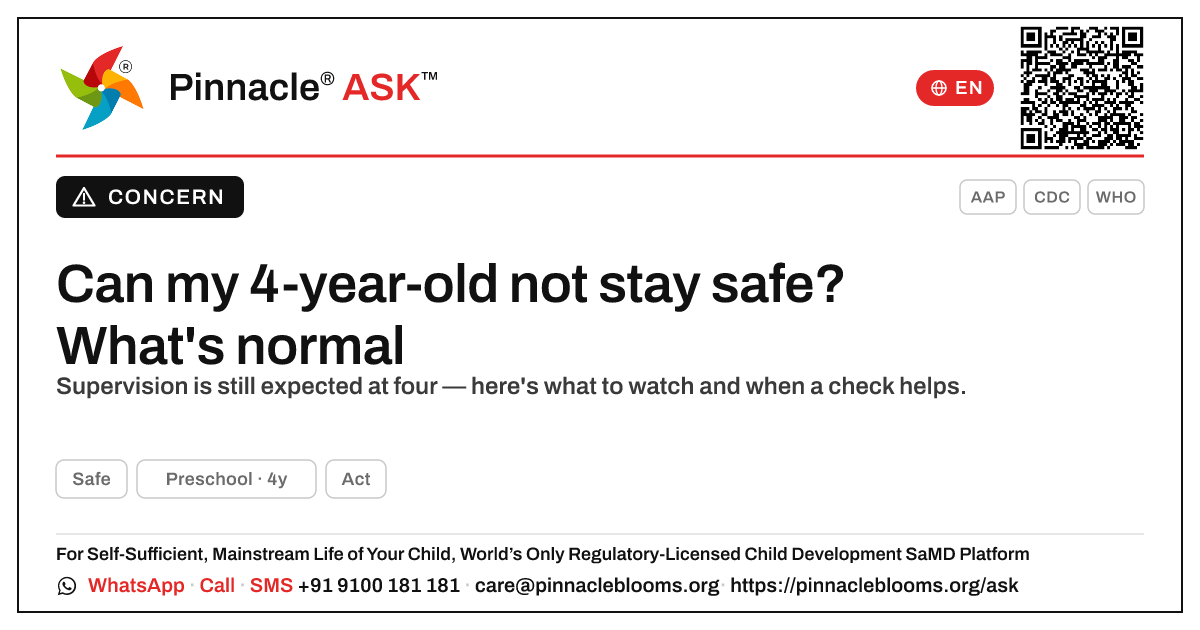
Is it a concern if my 4-year-old can't stay safe at home?
At four, children are still learning safety — they are impulsive and need adult supervision, so it is normal that your child cannot yet stay reliably safe alone. They should be beginning to follow simple rules with many gentle reminders. Seek a developmental check if your child shows no awareness of danger at all, cannot recall any rule despite repeated calm reminders, or struggles alongside delays in talking, understanding or play. This is a reason to look early, not a diagnosis.
In this answer 5 sections
Watching your four-year-old dash near stairs or grab at a hot kettle and wondering "should he know better by now?" is a very loving question to ask.
In short
At four, children are still learning safety — they are impulsive, curious and live in the moment, so it is completely normal that your child cannot yet stay reliably safe without your supervision. Most four-year-olds need an adult nearby and are only beginning to remember and follow safety rules. It becomes worth a gentle developmental check if your child shows no awareness of danger at all, cannot recall a simple rule even after many calm reminders, or struggles alongside delays in talking, understanding or play. This is a reason to look early — not a diagnosis.
What's typical at four
Safety judgement grows slowly through the preschool years. At four, expect your child to:
- Still need supervision — they cannot yet be trusted alone near roads, water, stairs, stoves or medicines.
- Be beginning to follow rules — they can learn "hot — don't touch" or "hold my hand at the road", but need many gentle repetitions and reminders.
- Act on impulse — excitement or curiosity will often override a rule they genuinely know.
- Respond to your warnings — they look to you, pause when you call out, and gradually copy careful behaviour.
What matters is the direction of travel: are they slowly learning, remembering more, and checking in with you more over the months?
When a check is wise
Arrange a calm developmental review if your child:
- Shows no sense of danger at all — runs into roads, climbs to heights or touches hot things with no hesitation, even after repeated experiences.
- Cannot retain any simple safety rule despite many gentle, consistent reminders over time.
- Does not respond to your voice or warnings, or rarely looks to you for guidance.
- Shows safety concerns alongside delays in talking, understanding instructions, play or connecting with people.
Trust your daily instinct — what you notice at home is valuable information for a clinician.
The Pinnacle way
A clinical AbilityScore® and any diagnosis are formed only at a Pinnacle Blooms Network centre, under qualified clinician care — never from an online list. Our clinicians look at the whole picture: attention, understanding, impulse control and everyday life skills, then build support around play and your home routines. Our occupational therapy team can help with body awareness, impulse regulation and learning safety step by step, and you can start here to find your nearest centre.
Trusted sources
American Academy of Pediatrics (healthychildren.org) guidance on preschooler safety and supervision; CDC developmental milestones and "Learn the Signs, Act Early" resources for four-year-olds; WHO Nurturing Care framework on safe, responsive environments for young children.
Next step — Trust what you've noticed. Book a developmental assessment for a warm, clear review of your child's safety awareness and everyday skills.
CONNECT THE ANSWER TO YOUR CHILD’S DAY
Something to notice. Something to discuss.
What to notice
Seek a check if your four-year-old shows no awareness of danger at all (runs into roads, climbs to heights, touches hot things without hesitation), cannot retain any simple safety rule despite many gentle reminders, does not respond to your warnings or look to you for guidance, or shows safety concerns alongside delays in talking, understanding or play.
In everyday life
Teach one safety rule at a time using short, calm, repeated phrases like "hot — don't touch" paired with a gentle action, and praise warmly each time your child remembers. Children this age learn safety through many small, kind repetitions, not single warnings.
Bring your observations and questions to your child’s professional. Choose activities that suit your child’s comfort, abilities and agreed plan.
Bring your questions to a first visitQuestions families ask
Should my 4-year-old be able to stay safe alone at home?
No — four-year-olds still need an adult nearby. They are impulsive and curious, and are only beginning to learn and remember safety rules. It is completely normal that your child cannot yet be left unsupervised near stairs, water, roads or hot things.
How do I teach my four-year-old to be safe?
Teach one rule at a time with short, calm, repeated phrases like "hot — don't touch" or "hold my hand at the road", paired with a gentle action. Praise each time they remember. Children this age learn through many kind repetitions, not single warnings.
When should I be concerned about my child's safety awareness?
Consider a gentle developmental check if your child shows no sense of danger at all, cannot retain any simple rule after many calm reminders, does not respond to your warnings, or shows safety concerns alongside delays in talking, understanding or play.
FOLLOW THE SOURCE
References behind this answer.
- Organisation website · further readingAAP — preschooler safety and supervision guidance
- Source referenceCDC — developmental milestones for four-year-olds
- Organisation website · further readingWHO Nurturing Care — safe, responsive environments
References are supplied with this answer. An organisation homepage offers further reading; it does not establish an independent review of this page.
Content attribution: SETU Consortium · Pinnacle Blooms Network.
PEOPLE, TOPICS & DEVELOPMENT
See the connections.
Browse the wider question collections connected with this answer’s audience, developmental area and stage.
FROM UNDERSTANDING TO PURPOSEFUL SUPPORT
One question. Your child’s whole life.
Your child’s self-sufficient, mainstream-included life is the purpose from the beginning. At Pinnacle, that purpose shapes what we understand, the goals we choose, the people we bring together, everyday practice and review.
Connect this question with the right support.
Start with your child’s strengths, your observations and what you want everyday life to become.
Make the next conversation useful.
Bring the situations you notice at home or school. We’ll explain a suitable service, centre and first visit, including availability and fees, before you decide.
How PinnacleAI® connects the journeyExplore the seven stages
- 1Understand abilities
A starting picture of your child’s capabilities.
- 2Choose meaningful goals
Readiness and a plan shaped around the child.
- 3Bring the right support together
Suitable therapies and people for those goals.
- 4Carry practice into everyday life
Guidance for family, home and school.
- 5Track and correct
Use observations to adjust the plan.
- 6Reassess and review
Decide what to continue, change or do next.
- 7Grow independence and participation
The child’s life gives each step its purpose.
Explore the whole PinnacleAI® system → · Participation at school and in the community →
PINNACLE’S EVIDENCE, OPEN TO YOU
Look at the evidence behind our work.
Read our research, inspect the original regulatory documents and check what each institutional measure means.
General information supports a conversation with an appropriately qualified professional. Advice, goals and support depend on the individual child.