
YOUR QUESTION. A CLEARER NEXT STEP.
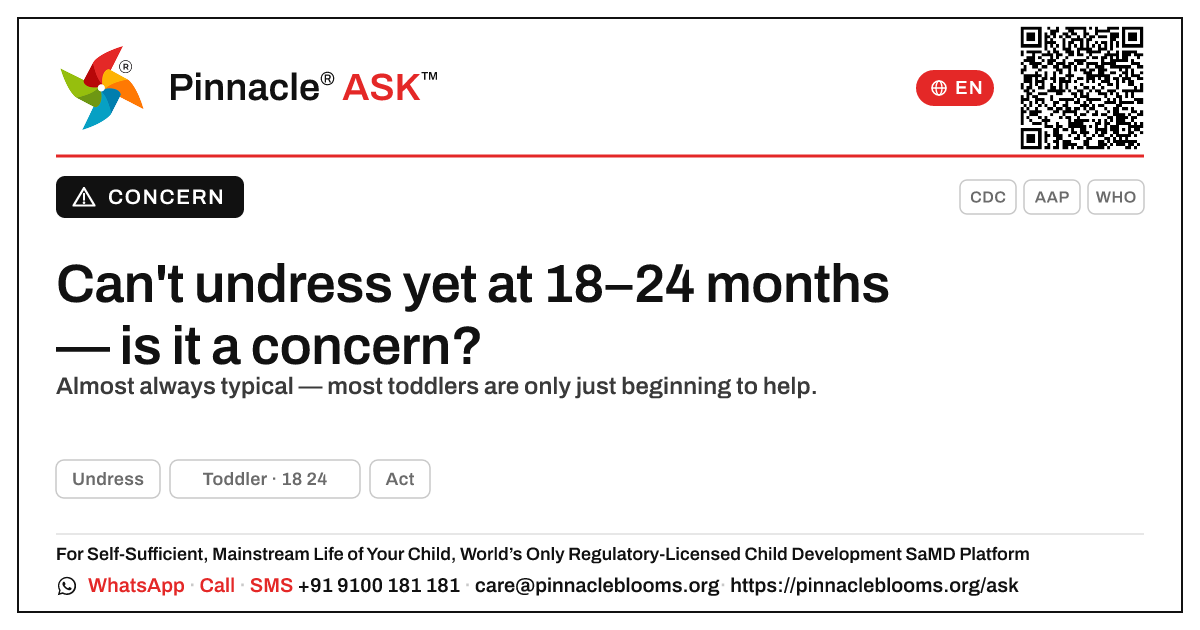
Can't undress at 18–24 months — should I worry?
At 18–24 months, most toddlers are only just beginning to help with undressing — pulling off a sock or tugging at a hat — and full independent undressing usually arrives nearer 2 to 3 years. So not yet undressing alone at this age is almost always typical. A gentle developmental check is wise only if your child shows no interest in helping at all, struggles broadly with using their hands, or this sits alongside delays in talking, walking or playing.
In this answer 5 sections
Little fingers tugging at a sock are practising big skills — and at this age, most toddlers are only just beginning.
In short
No, this is almost always perfectly typical. Most 18-to-24-month-olds are just starting to help with undressing — pulling off a sock, tugging at a hat, pushing an arm out of a sleeve. Full, independent undressing usually arrives nearer 2 to 3 years. A check is only wise if your toddler shows no interest in helping at all, struggles broadly with using their hands, or this sits alongside delays in talking, walking or playing.
What's typical at 18–24 months
Undressing is a self-help milestone built from many smaller skills — balance, hand strength, grip, body awareness and the motivation to do it themselves. At this age, expect gentle beginnings rather than independence:
- Pulls off easy items — socks, a loose hat, mittens, or untied shoes.
- Helps you — pushes an arm out of a sleeve, lifts a foot, tugs at a waistband when you've started it off.
- Shows interest — wants to "do it myself", even if the result is wobbly.
Undressing reliably comes before dressing, and full independence with both is a 3-to-4-year skill. So a child who can't yet undress alone at 18–24 months is right on track.
When a gentle check helps
There's no need to rush, but a calm developmental review is worth arranging if you notice:
- No interest in helping at all with clothing, even the easiest items, by around 2 years.
- Hands seem to struggle broadly — difficulty grasping, pulling or holding objects in everyday play, not just with clothes.
- Other differences travel alongside — few or no words, not responding to their name, little pointing or shared play, or delays in walking and balance.
- A skill once had has faded — losing the ability to do something they previously could.
The goal isn't worry — it's that an early, friendly look turns small questions into early opportunities, when support works beautifully.
The Pinnacle way
A clinical AbilityScore® and any diagnosis are formed only at a Pinnacle Blooms Network centre, under qualified clinician care — never from an online list. Our clinicians watch how your child uses their hands, balances and engages, and weave self-help skills like undressing gently into play. Our occupational therapy team can build hand strength and body awareness, and you can begin any time at our home page.
Trusted sources
CDC developmental milestones and "Learn the Signs, Act Early" guidance on self-help and motor skills in toddlers; American Academy of Pediatrics (healthychildren.org) on fostering independence and dressing skills; WHO Nurturing Care framework on early development through everyday routines.
Next step — Trust what you notice day to day. If you'd like reassurance, book a developmental assessment with a Pinnacle clinician for a calm, clear review of your child's milestones.
This is general information, not a diagnosis — individual assessment and diagnosis require an appropriately qualified healthcare professional.
CONNECT THE ANSWER TO YOUR CHILD’S DAY
Something to notice. Something to discuss.
What to notice
Most toddlers this age only help with undressing — pulling off a sock or hat — and that's typical. Seek a gentle check if your child shows no interest in helping at all by 2 years, struggles broadly to grasp and pull objects in everyday play, or this travels with few words, no pointing, no response to name, delayed walking, or loss of a skill once had.
In everyday life
Turn undressing into a playful game at bath or bedtime — start each item off (loosen the sock, lift the shirt over the shoulders) and let your toddler finish the last tug. Cheer the effort, not the result. These tiny wins build the strength and motivation behind self-help skills.
Bring your observations and questions to your child’s professional. Choose activities that suit your child’s comfort, abilities and agreed plan.
Bring your questions to a first visitQuestions families ask
At what age should my child be able to undress themselves?
Most children begin helping with undressing — pulling off socks, hats or mittens — around 18 to 24 months, and manage simple items independently nearer 2 to 3 years. Full, reliable undressing and dressing is usually a 3-to-4-year skill. So a toddler who can't undress alone at 18–24 months is right on track.
Why do children learn to undress before they can dress?
Undressing is simpler — it mostly involves pulling and tugging things off, which needs less precision and planning. Dressing requires lining up arms with sleeves and managing fasteners, so it comes later. This is the normal order of development.
When should I seek a developmental check about undressing?
A gentle check is wise if your child shows no interest in helping with any clothing by around 2 years, struggles broadly to grasp and pull objects in everyday play, or if this sits alongside delays in talking, walking or playing, or the loss of a skill once had.
FOLLOW THE SOURCE
References behind this answer.
- Source referenceCDC developmental milestones & Learn the Signs, Act Early
- Organisation website · further readingAAP HealthyChildren — fostering toddler independence
- Organisation website · further readingWHO Nurturing Care Framework
References are supplied with this answer. An organisation homepage offers further reading; it does not establish an independent review of this page.
Content attribution: SETU Consortium · Pinnacle Blooms Network.
PEOPLE, TOPICS & DEVELOPMENT
See the connections.
Browse the wider question collections connected with this answer’s audience, developmental area and stage.
FROM UNDERSTANDING TO PURPOSEFUL SUPPORT
One question. Your child’s whole life.
Your child’s self-sufficient, mainstream-included life is the purpose from the beginning. At Pinnacle, that purpose shapes what we understand, the goals we choose, the people we bring together, everyday practice and review.
Connect this question with the right support.
Start with your child’s strengths, your observations and what you want everyday life to become.
Make the next conversation useful.
Bring the situations you notice at home or school. We’ll explain a suitable service, centre and first visit, including availability and fees, before you decide.
How PinnacleAI® connects the journeyExplore the seven stages
- 1Understand abilities
A starting picture of your child’s capabilities.
- 2Choose meaningful goals
Readiness and a plan shaped around the child.
- 3Bring the right support together
Suitable therapies and people for those goals.
- 4Carry practice into everyday life
Guidance for family, home and school.
- 5Track and correct
Use observations to adjust the plan.
- 6Reassess and review
Decide what to continue, change or do next.
- 7Grow independence and participation
The child’s life gives each step its purpose.
Explore the whole PinnacleAI® system → · Participation at school and in the community →
PINNACLE’S EVIDENCE, OPEN TO YOU
Look at the evidence behind our work.
Read our research, inspect the original regulatory documents and check what each institutional measure means.
General information supports a conversation with an appropriately qualified professional. Advice, goals and support depend on the individual child.