
YOUR QUESTION. A CLEARER NEXT STEP.
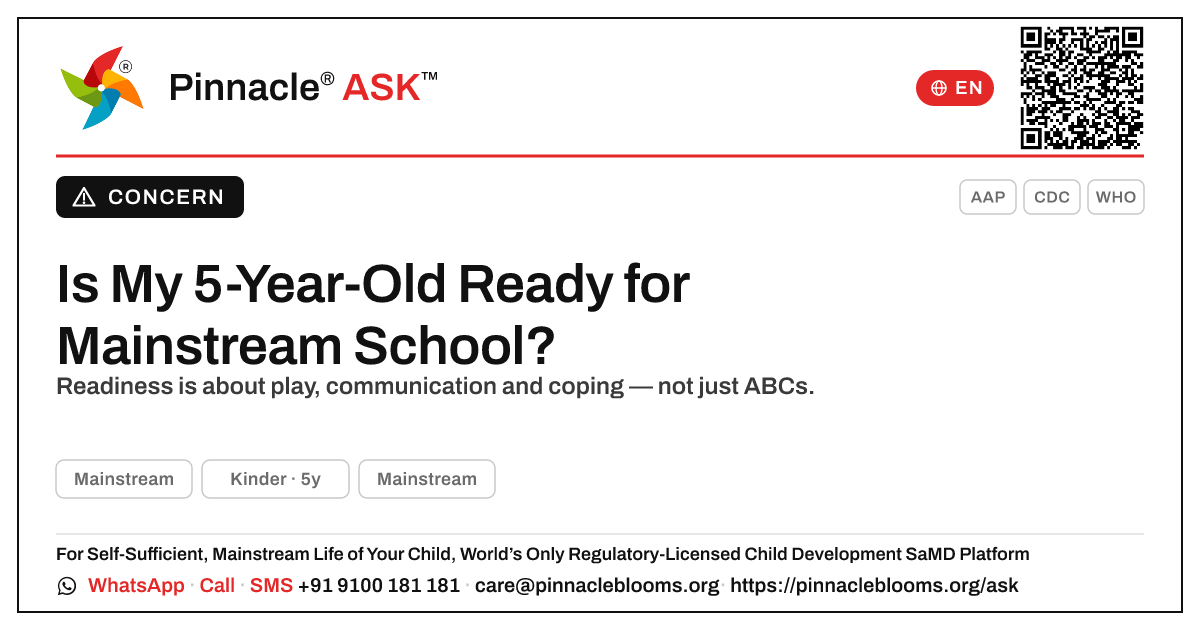
Is my 5-year-old ready for an inclusive mainstream classroom?
Most 5-year-olds are ready for an inclusive mainstream classroom, and readiness is far more about communication, social play, self-help and coping with routine than academics. A good inclusive setting is built to meet children where they are. If you have worries about talking, attention or social play, a calm developmental check now helps put the right supports in place before term begins — clarity and confidence, not a diagnosis.
In this answer 5 sections
Wondering whether your little one is ready for "big school" is one of the most loving questions a parent can ask — and readiness is about so much more than reading and writing.
In short
Most 5-year-olds are wonderfully ready for an inclusive mainstream classroom, and "readiness" is rarely about academics — it's about how your child plays, communicates, follows simple routines and copes with everyday transitions. Every child arrives at school with a different mix of strengths and emerging skills, and a good inclusive classroom is designed to meet them exactly where they are. If you have specific worries about talking, attention, social play or coping with change, a calm developmental check now helps you start school with the right supports in place — not a diagnosis, just clarity and confidence.
What "ready" really looks like at 5
Inclusive classrooms expect a range of abilities, so look at the whole picture rather than any single skill:
- Communication — can your child make their needs known (words, gestures or pictures), follow a simple two-step instruction, and enjoy back-and-forth conversation in their own way?
- Social play — does your child show interest in other children, take turns sometimes, and manage shared play with gentle adult support?
- Self-help — toileting, eating, washing hands and managing shoes and bags are often more important to a smooth school day than letters and numbers.
- Coping with routine and change — settling after a transition, separating from you, and recovering from small upsets with comfort.
- Attention and curiosity — sitting for a short story or activity, and showing interest in exploring and learning.
Gaps in any of these are not reasons to delay school — they are simply signposts for the supports a good inclusive setting can put in place: visual timetables, a buddy system, small-group time, speech or occupational therapy alongside class.
When a developmental check helps first
If your child has very few words, struggles to connect with other children, finds everyday transitions overwhelming, or you've had niggling worries you've not yet explored, a developmental check before term begins is wise. It lets the school start with strengths-first strategies in place, so your child experiences belonging from day one.
The Pinnacle way
A clinical AbilityScore® and any diagnosis are formed only at a Pinnacle Blooms Network centre, under qualified clinician care — never from an online checklist. Our clinicians map your child's communication, play, attention and self-help strengths, then translate them into practical school-readiness supports you and your child's teacher can use straight away. If talking needs a gentle boost, our speech therapy team can help, and our occupational therapy team supports self-help, attention and coping with the busy sensory world of a classroom.
Trusted sources
American Academy of Pediatrics (healthychildren.org) guidance on school readiness as a whole-child concept spanning health, social-emotional and learning skills; CDC developmental milestones for 5-year-olds and "Learn the Signs, Act Early"; WHO healthy development frameworks emphasising inclusive, nurturing learning environments.
Next step — Trust what you've noticed about your child. Book a school-readiness assessment with a Pinnacle clinician for a calm, strengths-first picture before term begins.
This is general information, not a diagnosis — individual assessment and diagnosis require an appropriately qualified healthcare professional.
CONNECT THE ANSWER TO YOUR CHILD’S DAY
Something to notice. Something to discuss.
What to notice
Look at the whole child: can they make needs known, follow a simple two-step instruction, show interest in other children and take turns with support, manage toileting and self-help, and settle after transitions? Consider a developmental check first if your child has very few words, struggles to connect with peers, finds change overwhelming, or you have unexplored worries.
In everyday life
Practise small school-like routines at home — putting on shoes, packing a bag, washing hands, and sitting for one short story. These everyday wins build confidence far more than flashcards.
Bring your observations and questions to your child’s professional. Choose activities that suit your child’s comfort, abilities and agreed plan.
Bring your questions to a first visitQuestions families ask
Does my child need to read or write before starting school?
No. Inclusive classrooms teach early literacy and numeracy from the start. Readiness is much more about communication, social play, self-help skills like toileting, and coping with routines and transitions than about academics.
My 5-year-old has very few words. Should I delay school?
Not necessarily. Delaying school is rarely the answer. A developmental check before term lets a good inclusive setting put supports like visual timetables, small-group time and speech therapy in place, so your child can belong and learn from day one.
What is an inclusive classroom?
An inclusive classroom is designed to welcome children with a range of abilities and learning styles, using supports such as visual schedules, buddy systems, flexible activities and therapy alongside class — so every child experiences belonging.
How do I know if my child needs extra support at school?
If your child struggles to connect with other children, finds transitions overwhelming, has limited communication, or you have lingering worries, a calm developmental assessment gives you and the teacher a clear, strengths-first plan before school begins.
FOLLOW THE SOURCE
References behind this answer.
- Organisation website · further readingAAP (HealthyChildren.org) — school readiness as a whole-child concept
- Source referenceCDC — developmental milestones and Learn the Signs, Act Early
- Organisation website · further readingWHO — nurturing, inclusive learning environments
References are supplied with this answer. An organisation homepage offers further reading; it does not establish an independent review of this page.
Content attribution: SETU Consortium · Pinnacle Blooms Network.
PEOPLE, TOPICS & DEVELOPMENT
See the connections.
Browse the wider question collections connected with this answer’s audience, developmental area and stage.
FROM UNDERSTANDING TO PURPOSEFUL SUPPORT
One question. Your child’s whole life.
Your child’s self-sufficient, mainstream-included life is the purpose from the beginning. At Pinnacle, that purpose shapes what we understand, the goals we choose, the people we bring together, everyday practice and review.
Connect this question with the right support.
Start with your child’s strengths, your observations and what you want everyday life to become.
Make the next conversation useful.
Bring the situations you notice at home or school. We’ll explain a suitable service, centre and first visit, including availability and fees, before you decide.
How PinnacleAI® connects the journeyExplore the seven stages
- 1Understand abilities
A starting picture of your child’s capabilities.
- 2Choose meaningful goals
Readiness and a plan shaped around the child.
- 3Bring the right support together
Suitable therapies and people for those goals.
- 4Carry practice into everyday life
Guidance for family, home and school.
- 5Track and correct
Use observations to adjust the plan.
- 6Reassess and review
Decide what to continue, change or do next.
- 7Grow independence and participation
The child’s life gives each step its purpose.
Explore the whole PinnacleAI® system → · Participation at school and in the community →
PINNACLE’S EVIDENCE, OPEN TO YOU
Look at the evidence behind our work.
Read our research, inspect the original regulatory documents and check what each institutional measure means.
General information supports a conversation with an appropriately qualified professional. Advice, goals and support depend on the individual child.