
YOUR QUESTION. A CLEARER NEXT STEP.
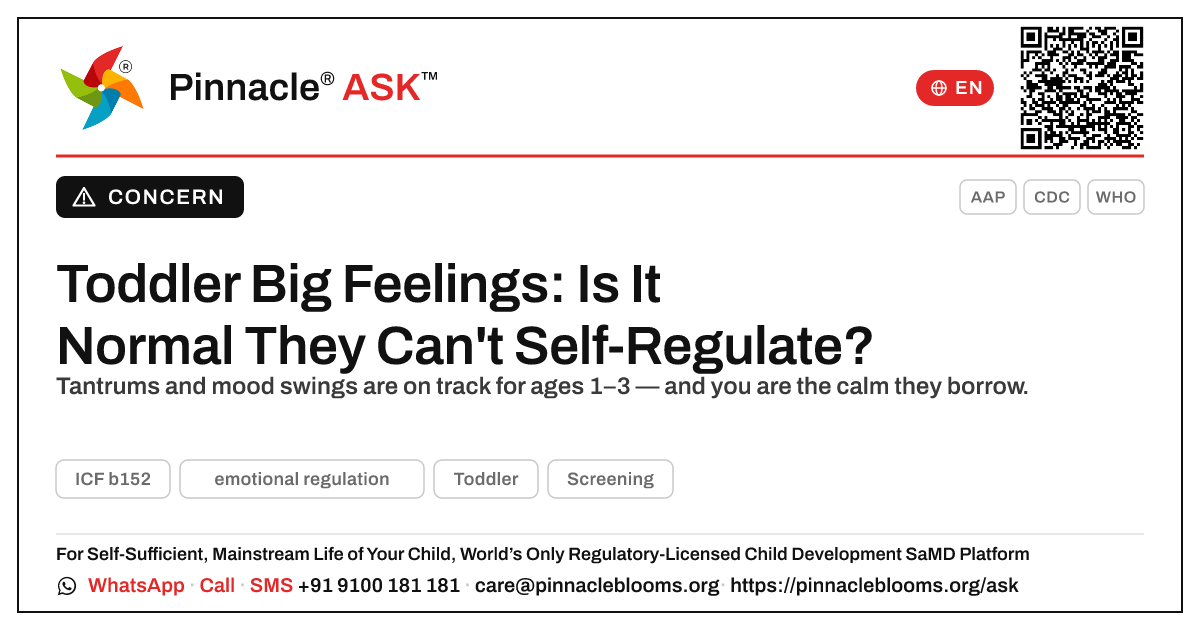
Is It Normal My Toddler Can't Self-Regulate Yet?
Not yet showing steady emotional regulation is normal and expected in toddlers aged 1–3 — the brain's calming pathways are still maturing, and children learn by borrowing a calm adult's regulation (co-regulation). Tantrums, quick mood swings and crying that settles with comfort are on track. Seek a developmental check only if distress is extreme, constant, hard to soothe, involves frequent self-injury, or comes with delays in talking, play or connection. Early support is reassurance, not diagnosis.
In this answer 5 sections
Big feelings, big meltdowns, and a tiny person still learning to steer them — this is exactly what toddlerhood looks like.
In short
Yes — for a toddler aged roughly 1 to 3 years, not yet showing steady emotional regulation is completely normal and expected. The part of the brain that calms big feelings is still being built, so tantrums, sudden tears and quick mood swings are developmentally on track. Your child borrows your calm to learn their own — this is called co-regulation. A gentle developmental check is wise only if distress is extreme, constant, or comes alongside delays in talking, play or connecting with others.
What to watch at 12–36 months
Most toddlers cannot self-soothe alone yet — they need a calm adult beside them. Typical and healthy at this age:
- Frequent tantrums, especially when tired, hungry or overwhelmed
- Crying that settles with a cuddle, words or a familiar routine
- Slowly recovering a little faster as language grows
Gentle flags worth a clinician's eye include:
- Meltdowns that are extreme, very long, or almost impossible to soothe, day after day
- Frequent self-injury during distress (head-banging, biting self)
- Little eye contact, few words, or not seeking comfort from you
- A child who seems flat, withdrawn, or rarely shows joy
The science
Emotional regulation (ICF b152, mental functions of emotion) develops gradually across the early years as the brain's calming pathways mature. Toddlers regulate through a trusted adult before they can do it alone — every soothed meltdown is a rehearsal. Naming feelings, predictable routines and calm responses are the strongest supports.
The Pinnacle way
A clinical AbilityScore® and any diagnosis are formed only at a Pinnacle Blooms Network centre, under qualified clinician care — never from an online list. Learn more about emotional regulation and how our behavioural therapy team supports families with calm, play-based co-regulation strategies.
Trusted sources
WHO ICF framework (function b152, emotion); American Academy of Pediatrics (healthychildren.org) guidance on toddler tantrums and self-regulation; CDC developmental milestones and "Learn the Signs, Act Early" resources.
Next step — Trust your instinct. Book a developmental check with a Pinnacle clinician for a warm, clear review of your toddler's milestones.
This is general information, not a diagnosis — individual assessment and diagnosis require an appropriately qualified healthcare professional.
CONNECT THE ANSWER TO YOUR CHILD’S DAY
Something to notice. Something to discuss.
What to notice
Typical: frequent tantrums when tired or overwhelmed, crying that settles with a cuddle or routine, slowly faster recovery as language grows. Seek a check if meltdowns are extreme, very long or almost impossible to soothe day after day, if there is frequent self-injury during distress, or if your toddler shows little eye contact, few words, doesn't seek comfort, or seems flat and rarely joyful.
In everyday life
During a meltdown, get low, stay calm and name the feeling out loud — 'You're so cross the play stopped.' Your steady voice lends your child the calm they can't yet make alone; this co-regulation is how self-regulation is slowly built.
Bring your observations and questions to your child’s professional. Choose activities that suit your child’s comfort, abilities and agreed plan.
Bring your questions to a first visitQuestions families ask
At what age do children start to self-regulate emotions?
It's gradual. Toddlers aged 1–3 mostly regulate through a calm adult (co-regulation), and many children only begin managing big feelings more independently in the preschool and early school years. Frequent tantrums in toddlerhood are normal and not a sign of a problem.
Are tantrums a sign something is wrong with my toddler?
Usually not. Tantrums are a typical part of toddler development, especially when a child is tired, hungry or overwhelmed and doesn't yet have words for big feelings. A gentle check is only worth arranging if meltdowns are extreme, near-impossible to soothe daily, involve self-injury, or come with delays in talking, play or connecting.
How can I help my toddler manage big feelings?
Stay calm, get to their level, name the feeling, and keep routines predictable. Your steady presence — co-regulation — is the strongest tool. Over time, naming emotions and offering comfort help your child build their own calming skills.
FOLLOW THE SOURCE
References behind this answer.
- Organisation website · further readingAAP HealthyChildren: toddler tantrums and self-regulation
- Source referenceCDC developmental milestones and Learn the Signs, Act Early
- Organisation website · further readingWHO ICF: emotion functions
References are supplied with this answer. An organisation homepage offers further reading; it does not establish an independent review of this page.
Content attribution: SETU Consortium · Pinnacle Blooms Network.
PEOPLE, TOPICS & DEVELOPMENT
See the connections.
Browse the wider question collections connected with this answer’s audience, developmental area and stage.
FROM UNDERSTANDING TO PURPOSEFUL SUPPORT
One question. Your child’s whole life.
Your child’s self-sufficient, mainstream-included life is the purpose from the beginning. At Pinnacle, that purpose shapes what we understand, the goals we choose, the people we bring together, everyday practice and review.
Connect this question with the right support.
Start with your child’s strengths, your observations and what you want everyday life to become.
Make the next conversation useful.
Bring the situations you notice at home or school. We’ll explain a suitable service, centre and first visit, including availability and fees, before you decide.
How PinnacleAI® connects the journeyExplore the seven stages
- 1Understand abilities
A starting picture of your child’s capabilities.
- 2Choose meaningful goals
Readiness and a plan shaped around the child.
- 3Bring the right support together
Suitable therapies and people for those goals.
- 4Carry practice into everyday life
Guidance for family, home and school.
- 5Track and correct
Use observations to adjust the plan.
- 6Reassess and review
Decide what to continue, change or do next.
- 7Grow independence and participation
The child’s life gives each step its purpose.
Explore the whole PinnacleAI® system → · Participation at school and in the community →
PINNACLE’S EVIDENCE, OPEN TO YOU
Look at the evidence behind our work.
Read our research, inspect the original regulatory documents and check what each institutional measure means.
General information supports a conversation with an appropriately qualified professional. Advice, goals and support depend on the individual child.