
YOUR QUESTION. A CLEARER NEXT STEP.
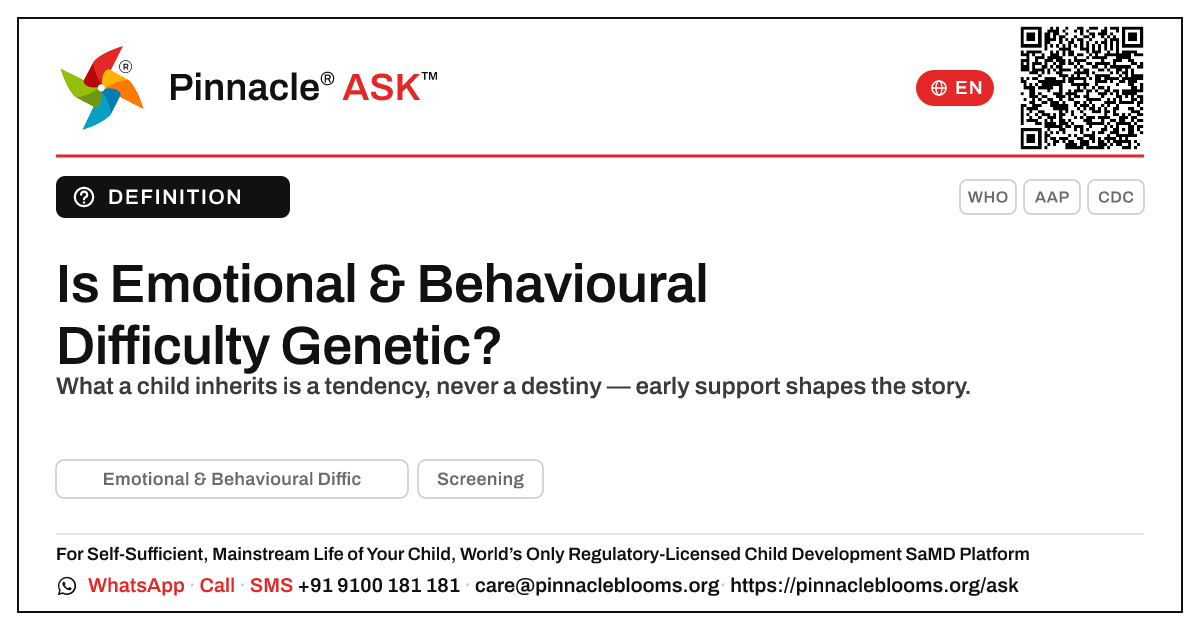
Is Emotional & Behavioural Difficulties Genetic or Hereditary?
Emotional and behavioural difficulties are partly influenced by genetics, but never determined by them. A child may inherit a temperament that is more sensitive or reactive, yet environment, relationships and early support strongly shape how that unfolds. Developmental measurement supports care planning; diagnosis requires an appropriately qualified healthcare professional., under clinician care.
In this answer 5 sections
Many parents quietly wonder, "Did my child inherit this from us?" — the honest answer is gentler and more hopeful than you might fear.
In short
Emotional and behavioural difficulties are partly influenced by genetics, but they are never fixed by them. What a child inherits is a tendency — a temperament that may be more sensitive, more intense or more reactive — not a destiny. How that tendency unfolds depends enormously on environment, relationships, sleep, stress, learning and the support a child receives. This is good news: the most powerful levers are the ones families and therapists can actually move.
The science, gently explained
Research consistently shows that emotional and behavioural patterns run in families to some degree — children share both genes and home environments with their parents, and both shape how feelings are felt and expressed. But genes work like dimmer switches, not on-off switches. A child may be born more easily overwhelmed or more impulsive, yet warm responsive parenting, predictable routines, good sleep, and early skill-building can turn that volume down considerably.
This is what scientists mean by gene–environment interaction: the same inherited sensitivity can lead to very different outcomes depending on what surrounds the child. So even where there is a clear family history, a child's path is far from written. Early, consistent support changes the story.
When to seek a developmental check
Family history is a reason to observe and support early, not to worry. Consider a developmental conversation with a clinician if your child shows persistent difficulty managing big feelings, frequent meltdowns well beyond what peers show, ongoing trouble with friendships, or changes that disrupt home, play or learning across several weeks and settings.
The Pinnacle way
AbilityScore® is part of Pinnacle’s developmental assessment. Diagnosis, where needed, requires an appropriately qualified healthcare professional — never from an online form, an app or a family-history guess. We map your child's emotional regulation, social and communication strengths as they are today, then build a plan that works with their temperament. Explore how we support emotional and behavioural difficulties, how behavioural therapy builds regulation skills, and what the AbilityScore is and how it is calculated.
Trusted sources
World Health Organization guidance on child mental health and nurturing care; American Academy of Pediatrics resources on emotional and behavioural development; CDC child development materials. These agree that emotional and behavioural traits reflect both inherited tendencies and environment, with early support strongly shaping outcomes.
Next step — Curious where your child stands today? A Pinnacle clinician can establish a clear starting point.
This is general information, not a diagnosis — individual assessment and diagnosis require an appropriately qualified healthcare professional.
CONNECT THE ANSWER TO YOUR CHILD’S DAY
Something to notice. Something to discuss.
What to notice
Persistent difficulty managing big feelings, frequent intense meltdowns beyond peers, ongoing friendship struggles, or changes disrupting home, play and learning across several weeks and settings.
In everyday life
Predictable routines and calm, consistent responses to big emotions turn down an inherited sensitivity far more than any worry about family history ever could.
Bring your observations and questions to your child’s professional. Choose activities that suit your child’s comfort, abilities and agreed plan.
Bring your questions to a first visitQuestions families ask
If it runs in our family, will my child definitely have difficulties?
No. Children may inherit a tendency — such as a more sensitive or intense temperament — but not a fixed outcome. Warm routines, good sleep and early support strongly shape how that tendency unfolds.
Can early support really change things if it is genetic?
Yes. Genes act more like dimmer switches than on-off switches. Even where there is a clear family history, responsive parenting and early skill-building can meaningfully reduce difficulties.
Should family history alone make me seek an assessment?
Family history is a reason to observe and support early, not to worry. Seek a developmental check if difficulties persist across several weeks and settings and disrupt everyday life.
FOLLOW THE SOURCE
References behind this answer.
- Organisation website · further readingWHO — child mental health and nurturing care
- Organisation website · further readingAAP — emotional and behavioural development
- Organisation website · further readingCDC — child development resources
References are supplied with this answer. An organisation homepage offers further reading; it does not establish an independent review of this page.
Content attribution: SETU Consortium · Pinnacle Blooms Network.
PEOPLE, TOPICS & DEVELOPMENT
See the connections.
Browse the wider question collections connected with this answer’s audience, developmental area and stage.
FROM UNDERSTANDING TO PURPOSEFUL SUPPORT
One question. Your child’s whole life.
Your child’s self-sufficient, mainstream-included life is the purpose from the beginning. At Pinnacle, that purpose shapes what we understand, the goals we choose, the people we bring together, everyday practice and review.
Connect this question with the right support.
Explore how the relevant service contributes to everyday abilities, then speak with us about your child.
Make the next conversation useful.
Bring the situations you notice at home or school. We’ll explain a suitable service, centre and first visit, including availability and fees, before you decide.
How PinnacleAI® connects the journeyExplore the seven stages
- 1Understand abilities
A starting picture of your child’s capabilities.
- 2Choose meaningful goals
Readiness and a plan shaped around the child.
- 3Bring the right support together
Suitable therapies and people for those goals.
- 4Carry practice into everyday life
Guidance for family, home and school.
- 5Track and correct
Use observations to adjust the plan.
- 6Reassess and review
Decide what to continue, change or do next.
- 7Grow independence and participation
The child’s life gives each step its purpose.
Explore the whole PinnacleAI® system → · Participation at school and in the community →
PINNACLE’S EVIDENCE, OPEN TO YOU
Look at the evidence behind our work.
Read our research, inspect the original regulatory documents and check what each institutional measure means.
General information supports a conversation with an appropriately qualified professional. Advice, goals and support depend on the individual child.