
YOUR QUESTION. A CLEARER NEXT STEP.
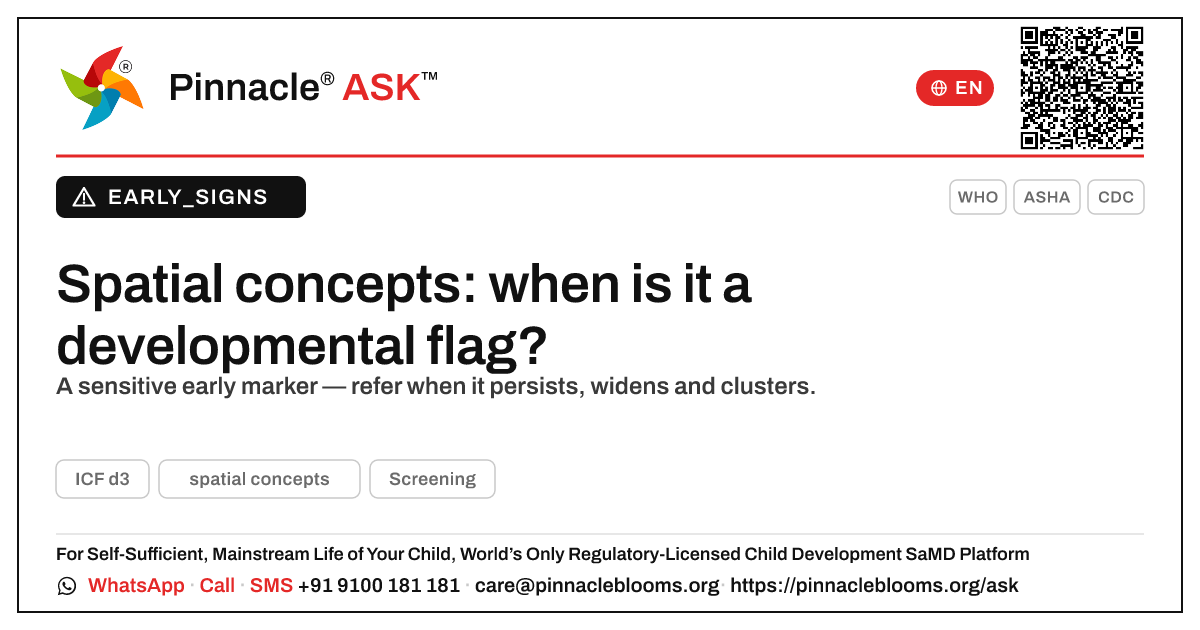
Are spatial-concept difficulties a developmental red flag?
Difficulty learning spatial concepts is rarely a red flag in isolation, but warrants developmental referral when persistent, age-inappropriate, and clustered with receptive language delay, poor multi-step direction-following, motor-planning difficulty, or early numeracy struggles. As an ICF d3 marker it is a sensitive but non-specific early signal — useful to prompt structured assessment, not to diagnose. A hearing screen should accompany any language-based referral, and concern rises when the gap persists or widens across domains.
In this answer 5 sections
Spatial language is a quiet scaffold for maths, motor planning and narrative — so when a child struggles to grasp in, under, behind, between, is that a flag worth acting on?
In short
Isolated difficulty acquiring spatial concepts is rarely a red flag on its own, but it warrants a developmental referral when it is persistent, age-inappropriate, and clusters with other concerns — receptive language delay, weak following of multi-step directions, motor-planning difficulty, or emerging numeracy struggles. Spatial concepts (ICF d3, communication/cognitive interface) are an early, observable marker; a focused screen is appropriate when the gap widens or generalises rather than resolving.
Signs that elevate concern
Spatial concepts (positional, directional, dimensional language) typically consolidate across the preschool years. Refer when you see a pattern, not a single lag:
- Difficulty comprehending positional terms (in/on/under, in front/behind, next to, between) well beyond peers
- Trouble following spatially-loaded multi-step instructions despite adequate hearing
- Co-occurring receptive or expressive language delay
- Weak body-in-space awareness, clumsiness or motor-planning difficulty (dyspraxic profile)
- Early difficulty with quantity, sequencing or pre-numeracy concepts
- Limited use of spatial language in spontaneous play and narrative
Red-flag amplifiers: the gap persists or widens over months, affects more than one domain, or sits against a history of prematurity, hearing concern, or a flagged screen.
The science
Spatial language draws on integrated visuospatial cognition, working memory and receptive language. Because these terms are linguistically frame-dependent and cognitively loaded, delayed acquisition is a sensitive (though non-specific) early signal — clinically useful as a prompt for structured assessment, not as a standalone diagnosis. A hearing screen should precede or accompany any language-based referral.
The Pinnacle way
A clinical AbilityScore® and any diagnosis are formed only at a Pinnacle Blooms Network centre under qualified clinician care — nothing here is diagnostic. We profile spatial concepts within a broader receptive-language and cognitive picture, then build targeted goals through play-based speech therapy. Across 70+ centres in 4 states, 700+ therapists and 4.95 lakh+ families, our approach is strengths-first and parent-coached.
Trusted sources
Consistent with WHO ICF activity-and-participation framing (d3 communication), ASHA guidance on receptive language and concept development, and CDC/AAP developmental-monitoring resources.
Next step — if a child shows a persistent, clustering pattern, refer for a structured developmental screen on WhatsApp at +91 91001 81181, and we'll profile language, cognition and spatial reasoning together.
This is general information, not a diagnosis — individual assessment and diagnosis require an appropriately qualified healthcare professional.
CONNECT THE ANSWER TO YOUR CHILD’S DAY
Something to notice. Something to discuss.
What to notice
A persistent, age-inappropriate gap in understanding positional/directional terms that clusters with receptive language delay, weak multi-step direction-following, motor-planning difficulty or early numeracy struggles — and that widens rather than resolves over months.
In everyday life
During play, narrate spatial relationships explicitly — 'the car is under the chair, now behind the box' — and note whether the child can act on these terms without gestural cues.
Bring your observations and questions to your child’s professional. Choose activities that suit your child’s comfort, abilities and agreed plan.
Bring your questions to a first visitQuestions families ask
Is delayed spatial-concept learning enough on its own to refer?
Usually not. It becomes referral-worthy when it is persistent, age-inappropriate and clusters with other concerns such as receptive language delay, poor multi-step direction-following or motor-planning difficulty. A single lag that resolves is generally observation, not referral.
What should accompany a language-based referral for this?
A hearing screen, since undetected hearing loss commonly masquerades as receptive-language and concept delay. Vision and a broader developmental review are also appropriate.
At what age do spatial concepts normally consolidate?
Positional and directional terms emerge and consolidate progressively across the preschool years. Acquisition that lags peers consistently, especially with spontaneous play and narrative, is the pattern to watch rather than any single age cut-off.
FOLLOW THE SOURCE
References behind this answer.
- Organisation website · further readingWHO ICF — communication & cognitive functions (d3)
- Organisation website · further readingASHA — receptive language and concept development
- Organisation website · further readingCDC — developmental monitoring resources
References are supplied with this answer. An organisation homepage offers further reading; it does not establish an independent review of this page.
Content attribution: SETU Consortium · Pinnacle Blooms Network.
PEOPLE, TOPICS & DEVELOPMENT
See the connections.
Browse the wider question collections connected with this answer’s audience, developmental area and stage.
FROM UNDERSTANDING TO PURPOSEFUL SUPPORT
One question. Your child’s whole life.
Your child’s self-sufficient, mainstream-included life is the purpose from the beginning. At Pinnacle, that purpose shapes what we understand, the goals we choose, the people we bring together, everyday practice and review.
Connect this question with the right support.
Explore how the relevant service contributes to everyday abilities, then speak with us about your child.
Make the next conversation useful.
Bring the situations you notice at home or school. We’ll explain a suitable service, centre and first visit, including availability and fees, before you decide.
How PinnacleAI® connects the journeyExplore the seven stages
- 1Understand abilities
A starting picture of your child’s capabilities.
- 2Choose meaningful goals
Readiness and a plan shaped around the child.
- 3Bring the right support together
Suitable therapies and people for those goals.
- 4Carry practice into everyday life
Guidance for family, home and school.
- 5Track and correct
Use observations to adjust the plan.
- 6Reassess and review
Decide what to continue, change or do next.
- 7Grow independence and participation
The child’s life gives each step its purpose.
Explore the whole PinnacleAI® system → · Participation at school and in the community →
PINNACLE’S EVIDENCE, OPEN TO YOU
Look at the evidence behind our work.
Read our research, inspect the original regulatory documents and check what each institutional measure means.
General information supports a conversation with an appropriately qualified professional. Advice, goals and support depend on the individual child.