
YOUR QUESTION. A CLEARER NEXT STEP.
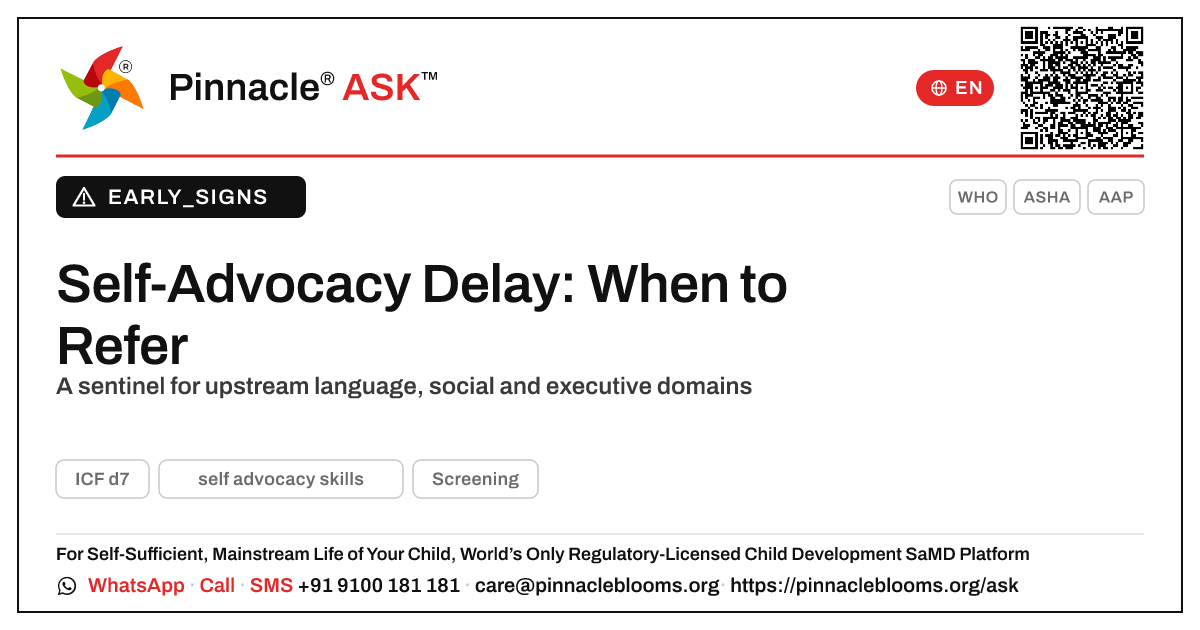
Self-Advocacy Difficulty: Is It a Developmental Red Flag?
Difficulty learning self-advocacy skills is not in itself a discrete clinical red flag — these are late-emerging composite skills built on language, executive function and social cognition. A developmental referral is warranted when self-advocacy difficulty co-occurs with delays in pragmatic language, social communication or self-regulation, when it is cross-context, or when it represents regression. Treat self-advocacy as a sentinel for upstream domains rather than a primary deficit, and screen those.
In this answer 5 sections
Self-advocacy is a higher-order skill that emerges late — so the clinical question is rarely "is it delayed?" but "what underlying domain is it telling us about?"
In short
Isolated difficulty acquiring self-advocacy skills is not, in itself, a discrete red flag — these capacities (recognising one's own needs, communicating them, requesting help, negotiating accommodations) are developmentally late-emerging and depend on language, executive function, social cognition and self-awareness. The referral signal is when this difficulty co-occurs with, or unmasks, delays in foundational domains — expressive/pragmatic language, social communication, or executive regulation — or represents a regression. In those contexts a developmental referral is warranted.
Signs that warrant referral
Under ICF d7 (interpersonal interactions and relationships), weigh self-advocacy against the child's broader profile. Refer when you observe:
- Pragmatic-language deficits — cannot initiate requests, repair miscommunication, or signal confusion/distress in age-expected ways
- Executive/self-regulation concerns — no flagging of need for help despite evident task failure; poor recognition of internal states (hunger, pain, overwhelm)
- Social-cognitive gaps — limited perspective-taking, difficulty asserting preference or refusal, marked passivity or compliance beyond temperament
- Cross-domain pattern — self-advocacy difficulty alongside delays in language, attention, or adaptive functioning (not an isolated finding)
- Regression — loss of previously established assertive or help-seeking behaviour
- Context-invariance — the difficulty persists across home, school and clinic, not situation-specific reticence
An isolated, situational reluctance in an otherwise typically developing child is more often temperamental or environmental — observe and review rather than escalate.
The science
Self-advocacy is a composite adaptive skill scaffolded by language and theory-of-mind maturation; it is meaningfully assessable only once these substrates are online (broadly school age onward). Treat it as a sentinel for upstream domains rather than a primary target, and screen those.
The Pinnacle way
We assess self-advocacy within its developmental substrate — language, pragmatics and executive function — never in isolation. Explore self-advocacy skills and speech therapy pathways. A clinical AbilityScore® and any diagnosis are formed only at a Pinnacle Blooms Network centre under qualified clinician care; nothing here is diagnostic. Across 70+ centres in 4 states, 700+ therapists and 4.95 lakh+ families served, our approach is strengths-first.
Trusted sources
Consistent with the WHO ICF framework for activities and participation (chapter d7), ASHA guidance on pragmatic and social-communication development, and AAP developmental-surveillance principles.
Next step — if a child's self-advocacy difficulty sits within a broader developmental pattern, refer for a structured developmental screen via our clinical team on WhatsApp at +91 91001 81181.
This is general information, not a diagnosis — individual assessment and diagnosis require an appropriately qualified healthcare professional.
CONNECT THE ANSWER TO YOUR CHILD’S DAY
Something to notice. Something to discuss.
What to notice
Pragmatic-language deficits (cannot request help or repair miscommunication), poor recognition of internal states or need for help, limited perspective-taking or assertion, cross-domain delays alongside the self-advocacy difficulty, regression of previously established help-seeking, and context-invariant difficulty across home, school and clinic.
In everyday life
Assess self-advocacy against the child's language and executive profile — isolated, situational reticence in an otherwise typical child is usually temperamental; a cross-context pattern with co-occurring delays is the referral signal.
Bring your observations and questions to your child’s professional. Choose activities that suit your child’s comfort, abilities and agreed plan.
Bring your questions to a first visitQuestions families ask
At what age does self-advocacy become clinically assessable?
Self-advocacy is a composite skill built on language, theory-of-mind and executive function, so it becomes meaningfully assessable broadly from school age, once these substrates mature. Before then, evaluate the foundational domains instead.
Should I refer for self-advocacy difficulty alone?
An isolated, situational reluctance in an otherwise typically developing child is usually temperamental or environmental and warrants observation rather than escalation. Refer when the difficulty is cross-context or co-occurs with delays in pragmatic language, social communication or self-regulation.
Which ICF domain does self-advocacy map to?
It sits within ICF chapter d7, interpersonal interactions and relationships, and should be weighed against the child's broader activity and participation profile rather than scored in isolation.
FOLLOW THE SOURCE
References behind this answer.
- Organisation website · further readingWHO ICF framework — activities and participation (d7)
- Organisation website · further readingASHA — pragmatic and social-communication development
- Organisation website · further readingAAP — developmental surveillance principles
References are supplied with this answer. An organisation homepage offers further reading; it does not establish an independent review of this page.
Content attribution: SETU Consortium · Pinnacle Blooms Network.
PEOPLE, TOPICS & DEVELOPMENT
See the connections.
Browse the wider question collections connected with this answer’s audience, developmental area and stage.
FROM UNDERSTANDING TO PURPOSEFUL SUPPORT
One question. Your child’s whole life.
Your child’s self-sufficient, mainstream-included life is the purpose from the beginning. At Pinnacle, that purpose shapes what we understand, the goals we choose, the people we bring together, everyday practice and review.
Connect this question with the right support.
Explore how the relevant service contributes to everyday abilities, then speak with us about your child.
Make the next conversation useful.
Bring the situations you notice at home or school. We’ll explain a suitable service, centre and first visit, including availability and fees, before you decide.
How PinnacleAI® connects the journeyExplore the seven stages
- 1Understand abilities
A starting picture of your child’s capabilities.
- 2Choose meaningful goals
Readiness and a plan shaped around the child.
- 3Bring the right support together
Suitable therapies and people for those goals.
- 4Carry practice into everyday life
Guidance for family, home and school.
- 5Track and correct
Use observations to adjust the plan.
- 6Reassess and review
Decide what to continue, change or do next.
- 7Grow independence and participation
The child’s life gives each step its purpose.
Explore the whole PinnacleAI® system → · Participation at school and in the community →
PINNACLE’S EVIDENCE, OPEN TO YOU
Look at the evidence behind our work.
Read our research, inspect the original regulatory documents and check what each institutional measure means.
General information supports a conversation with an appropriately qualified professional. Advice, goals and support depend on the individual child.