
YOUR QUESTION. A CLEARER NEXT STEP.
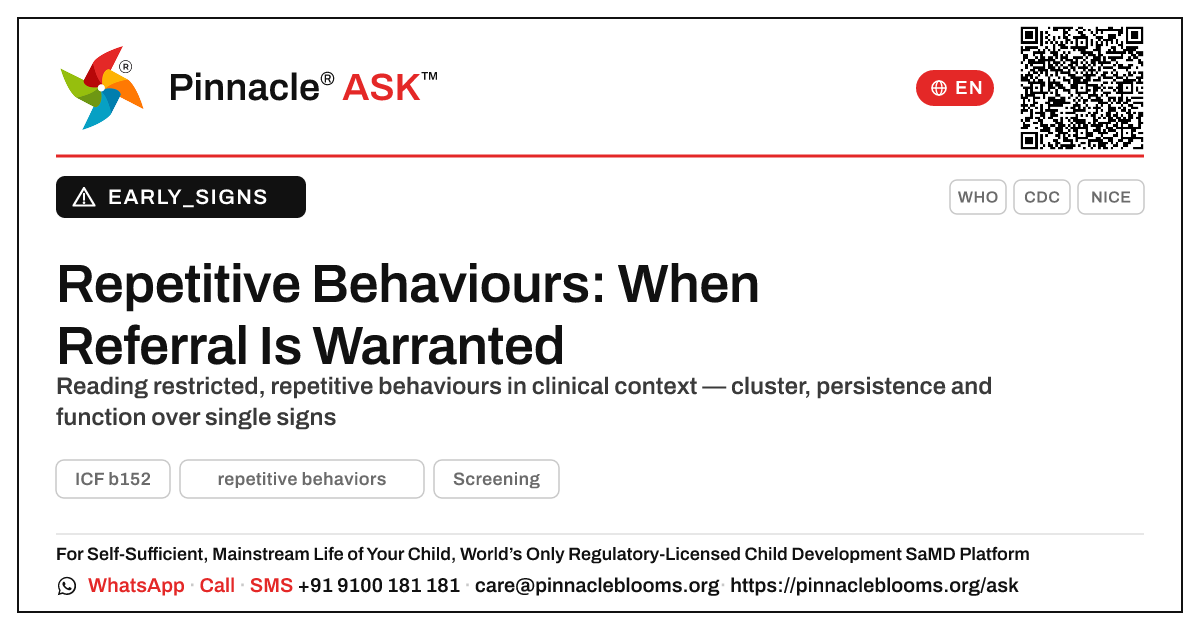
Repetitive Behaviours: When to Refer for Developmental Assessment
Repetitive behaviours are patterns, not a skill a child fails to learn. Isolated, transient repetitive behaviours are developmentally common under 3. They warrant a developmental referral when persistent, rigid, distress-driven on interruption, co-occurring with social-communication differences, or causing functional impairment — read in ICF context (b152). A single behaviour is reassuring; a widening cluster across domains is the actionable signal. Screen, do not label.
In this answer 5 sections
Repetitive behaviours sit at the crossroads of typical self-regulation and emerging neurodevelopmental signal — the clinical art is reading them in context.
In short
The premise needs a gentle correction: repetitive behaviours are not a skill a child fails to learn — they are behavioural patterns. The clinically meaningful question is whether restricted, repetitive behaviours and interests (RRBs) are present, intensifying, or interfering with function. In isolation, transient repetitive behaviours (lining up toys, hand-flapping with excitement, rocking) are developmentally common, especially under 3. They warrant a developmental referral when they are persistent, inflexible, distress-driven when interrupted, co-occur with social-communication differences, or cause functional impairment — consistent with ICF mental-function context (b152, emotional functions).
Red flags that warrant referral
Refer for structured developmental assessment when RRBs show:
- Persistence and rigidity — fixed routines or rituals where disruption triggers marked distress, beyond age-typical preference
- Sensory-linked patterns — intense, sustained sensory seeking or aversion, or self-stimulatory behaviour that displaces play and learning
- Co-occurring social-communication signal — reduced joint attention, limited gesture or response to name alongside the repetitive behaviour
- Functional interference — behaviour that limits engagement, peer play, sleep, feeding or daily participation
- Trajectory — emergence with regression, or escalation rather than the expected fading after age 3
A single behaviour in an otherwise well-progressing child is reassuring; a cluster across domains, persisting or widening, is the actionable pattern.
The science
RRBs are a recognised core domain in autism spectrum frameworks, but they are non-specific — also seen in anxiety, sensory processing differences, stereotypic movement disorder, and typical development. Context, co-occurrence and functional impact determine clinical weight. Screen, don't label.
The Pinnacle way
At Pinnacle Blooms Network, we read repetitive behaviours within the whole developmental picture — strengths first. Explore repetitive behaviours and our behavioural therapy pathway. A clinical AbilityScore® and any diagnosis are formed only at a Pinnacle Blooms Network centre under qualified clinician care; nothing here is a diagnosis. Across 70+ centres, 700+ therapists and 4.95 lakh+ families served, our approach stays strengths-led.
Trusted sources
Aligned with WHO ICF function classification, AAP and CDC developmental-surveillance guidance, and NICE recognition-and-referral principles for autism.
Next step — if a child's repetitive behaviours show this clustering pattern, refer for a structured developmental screen via our clinical team on WhatsApp at +91 91001 81181.
This is general information, not a diagnosis — individual assessment and diagnosis require an appropriately qualified healthcare professional.
CONNECT THE ANSWER TO YOUR CHILD’S DAY
Something to notice. Something to discuss.
What to notice
Persistent, inflexible routines with marked distress on interruption; intense sustained sensory seeking/aversion displacing play; co-occurring reduced joint attention, gesture or response to name; functional interference with play, sleep or feeding; escalation or emergence with regression rather than fading after age 3.
In everyday life
Note whether a repetitive behaviour is flexible and fades when redirected, or fixed and distress-driven when interrupted — and whether it co-occurs with social-communication differences. That context, not the behaviour alone, guides referral.
Bring your observations and questions to your child’s professional. Choose activities that suit your child’s comfort, abilities and agreed plan.
Bring your questions to a first visitQuestions families ask
Is a single repetitive behaviour a reason to refer?
Usually not. Isolated, transient repetitive behaviours — lining up toys, brief hand-flapping with excitement, rocking — are developmentally common, especially under age 3. Referral is indicated when behaviours are persistent, rigid, distress-driven on interruption, or co-occur with social-communication differences and functional impairment.
How do repetitive behaviours differ from age-typical preferences?
Age-typical preferences are flexible and redirect easily; clinically significant restricted, repetitive behaviours are inflexible, ritualised, trigger marked distress when disrupted, and increasingly displace play, learning and participation.
Are repetitive behaviours specific to autism?
No. They are a recognised core autism domain but are non-specific — also seen in anxiety, sensory processing differences, stereotypic movement disorder and typical development. Co-occurrence and functional impact determine clinical weight, so the recommendation is to screen, not label.
FOLLOW THE SOURCE
References behind this answer.
- Organisation website · further readingWHO ICF — function classification context
- Source referenceCDC — Developmental monitoring and surveillance
- Source referenceNICE — Autism recognition and referral principles
References are supplied with this answer. An organisation homepage offers further reading; it does not establish an independent review of this page.
Content attribution: SETU Consortium · Pinnacle Blooms Network.
PEOPLE, TOPICS & DEVELOPMENT
See the connections.
Browse the wider question collections connected with this answer’s audience, developmental area and stage.
FROM UNDERSTANDING TO PURPOSEFUL SUPPORT
One question. Your child’s whole life.
Your child’s self-sufficient, mainstream-included life is the purpose from the beginning. At Pinnacle, that purpose shapes what we understand, the goals we choose, the people we bring together, everyday practice and review.
Connect this question with the right support.
Explore how the relevant service contributes to everyday abilities, then speak with us about your child.
Make the next conversation useful.
Bring the situations you notice at home or school. We’ll explain a suitable service, centre and first visit, including availability and fees, before you decide.
How PinnacleAI® connects the journeyExplore the seven stages
- 1Understand abilities
A starting picture of your child’s capabilities.
- 2Choose meaningful goals
Readiness and a plan shaped around the child.
- 3Bring the right support together
Suitable therapies and people for those goals.
- 4Carry practice into everyday life
Guidance for family, home and school.
- 5Track and correct
Use observations to adjust the plan.
- 6Reassess and review
Decide what to continue, change or do next.
- 7Grow independence and participation
The child’s life gives each step its purpose.
Explore the whole PinnacleAI® system → · Participation at school and in the community →
PINNACLE’S EVIDENCE, OPEN TO YOU
Look at the evidence behind our work.
Read our research, inspect the original regulatory documents and check what each institutional measure means.
General information supports a conversation with an appropriately qualified professional. Advice, goals and support depend on the individual child.