
YOUR QUESTION. A CLEARER NEXT STEP.
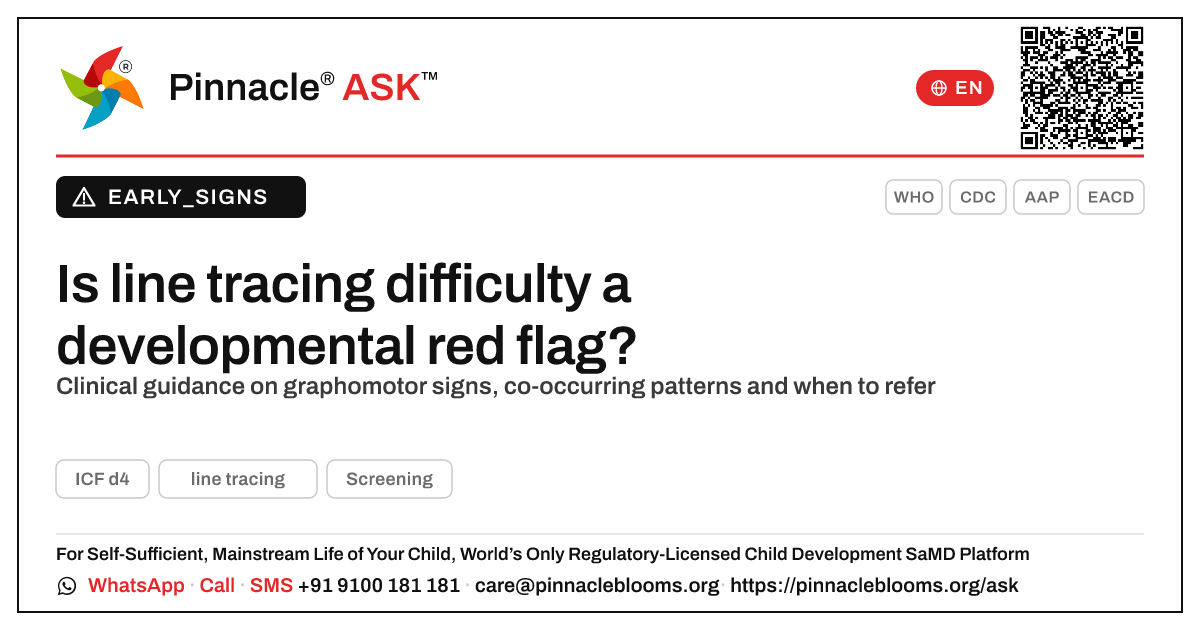
Is difficulty with line tracing a developmental red flag?
Isolated difficulty learning line tracing is rarely a stand-alone red flag — it is a late-emerging graphomotor skill that consolidates between roughly 3 and 5 years. Referral is warranted when the difficulty forms part of a broader pattern: immature grasp beyond 4–5 years, poor postural or bilateral coordination, visual-perceptual difficulty, regression, or a marked persistent gap versus peers despite adequate exposure. A multi-domain pattern, not the tracing skill alone, shifts this from monitoring to formal assessment. Pair any concern with hearing and vision screening.
In this answer 4 sections
A child who struggles to trace a line is telling us something about the visual-motor system — but is it signal or simply maturation?
In short
Isolated difficulty acquiring line tracing is rarely a stand-alone red flag — it is a developmentally late-emerging graphomotor skill, typically consolidating between 3 and 5 years. It warrants developmental referral when the difficulty is part of a broader pattern: co-occurring delays in grasp maturation, bilateral coordination, postural control, or visual-perceptual function — or when the gap is marked, persistent, and out of step with peers despite adequate exposure and instruction.
The science and what to watch
Line tracing (ICF d4, mobility/fine hand use) integrates pencil grasp, proximal stability, eye-hand coordination, motor planning and visual-perceptual processing. A single immature skill in an otherwise well-developing child usually reflects practice opportunity, not pathology.
Consider referral when you observe:
- Persistent immature or atypical grasp beyond ~4–5 years, or inability to stabilise the page with the non-dominant hand
- Excessive pressure, tremor, or fatigue disproportionate to effort
- Co-occurring gross-motor or postural signs — low tone, poor sitting balance, clumsiness, frequent falls (screen for DCD)
- Visual-perceptual difficulty — losing the line, crossing midline poorly, directional confusion
- Regression, or a widening gap versus same-age peers despite consistent exposure
- Associated speech, attention or social-communication concerns suggesting a broader neurodevelopmental profile
A clear, persistent, multi-domain pattern — rather than the tracing skill alone — is what shifts this from watchful monitoring to formal assessment. Always pair with hearing and vision screening, as undetected refractive or oculomotor issues commonly masquerade as graphomotor delay.
The Pinnacle way
We profile the underlying components — grasp, stability, visual-motor integration — rather than the surface skill, and build strengths-first through play-based occupational therapy. You can read more on line tracing and how structured profiling works via the AbilityScore®. Developmental measurement supports care planning; diagnosis requires an appropriately qualified healthcare professional. under qualified clinician care; nothing here is a diagnosis.
Trusted sources
Aligned with WHO ICF activity domains, AAP and CDC developmental-monitoring guidance, and ASHA/EACD consensus on early identification.
Next step — if the tracing difficulty sits within a broader motor or developmental pattern, refer for a developmental screen via WhatsApp +91 91001 81181, and we'll profile the child together.
This is general information, not a diagnosis — individual assessment and diagnosis require an appropriately qualified healthcare professional.
CONNECT THE ANSWER TO YOUR CHILD’S DAY
Something to notice. Something to discuss.
What to notice
Persistent immature or atypical grasp beyond 4–5 years, poor page stabilisation, excessive pressure or tremor, co-occurring low tone or clumsiness, visual-perceptual difficulty, regression, or a widening gap versus peers despite adequate exposure — plus any associated speech, attention or social-communication concerns.
In everyday life
Before flagging tracing alone, screen the whole motor profile — grasp, posture, bilateral use and vision — and confirm the child has had consistent, age-appropriate exposure to pencil tasks.
Bring your observations and questions to your child’s professional. Choose activities that suit your child’s comfort, abilities and agreed plan.
Bring your questions to a first visitQuestions families ask
At what age should line tracing typically be acquired?
Line tracing usually consolidates between roughly 3 and 5 years, building on grasp maturation, postural stability and visual-motor integration. Variation is wide, so a single immature skill in an otherwise well-developing child rarely indicates pathology.
When does tracing difficulty justify a developmental referral?
Refer when the difficulty is part of a broader pattern — immature grasp beyond 4–5 years, poor postural or bilateral coordination, visual-perceptual difficulty, regression, or a marked persistent gap versus peers despite adequate exposure and instruction.
Should vision be checked first?
Yes. Undetected refractive or oculomotor problems commonly present as graphomotor delay, so pair any concern with hearing and vision screening before attributing difficulty to motor or developmental causes.
FOLLOW THE SOURCE
References behind this answer.
- Organisation website · further readingWHO ICF activity and participation domains (d4)
- Source referenceCDC developmental milestone monitoring
- Organisation website · further readingAAP developmental surveillance and screening guidance
- Organisation website · further readingEACD guidance on developmental coordination
References are supplied with this answer. An organisation homepage offers further reading; it does not establish an independent review of this page.
Content attribution: SETU Consortium · Pinnacle Blooms Network.
PEOPLE, TOPICS & DEVELOPMENT
See the connections.
Browse the wider question collections connected with this answer’s audience, developmental area and stage.
FROM UNDERSTANDING TO PURPOSEFUL SUPPORT
One question. Your child’s whole life.
Your child’s self-sufficient, mainstream-included life is the purpose from the beginning. At Pinnacle, that purpose shapes what we understand, the goals we choose, the people we bring together, everyday practice and review.
Connect this question with the right support.
Explore how the relevant service contributes to everyday abilities, then speak with us about your child.
Make the next conversation useful.
Bring the situations you notice at home or school. We’ll explain a suitable service, centre and first visit, including availability and fees, before you decide.
How PinnacleAI® connects the journeyExplore the seven stages
- 1Understand abilities
A starting picture of your child’s capabilities.
- 2Choose meaningful goals
Readiness and a plan shaped around the child.
- 3Bring the right support together
Suitable therapies and people for those goals.
- 4Carry practice into everyday life
Guidance for family, home and school.
- 5Track and correct
Use observations to adjust the plan.
- 6Reassess and review
Decide what to continue, change or do next.
- 7Grow independence and participation
The child’s life gives each step its purpose.
Explore the whole PinnacleAI® system → · Participation at school and in the community →
PINNACLE’S EVIDENCE, OPEN TO YOU
Look at the evidence behind our work.
Read our research, inspect the original regulatory documents and check what each institutional measure means.
General information supports a conversation with an appropriately qualified professional. Advice, goals and support depend on the individual child.