
YOUR QUESTION. A CLEARER NEXT STEP.
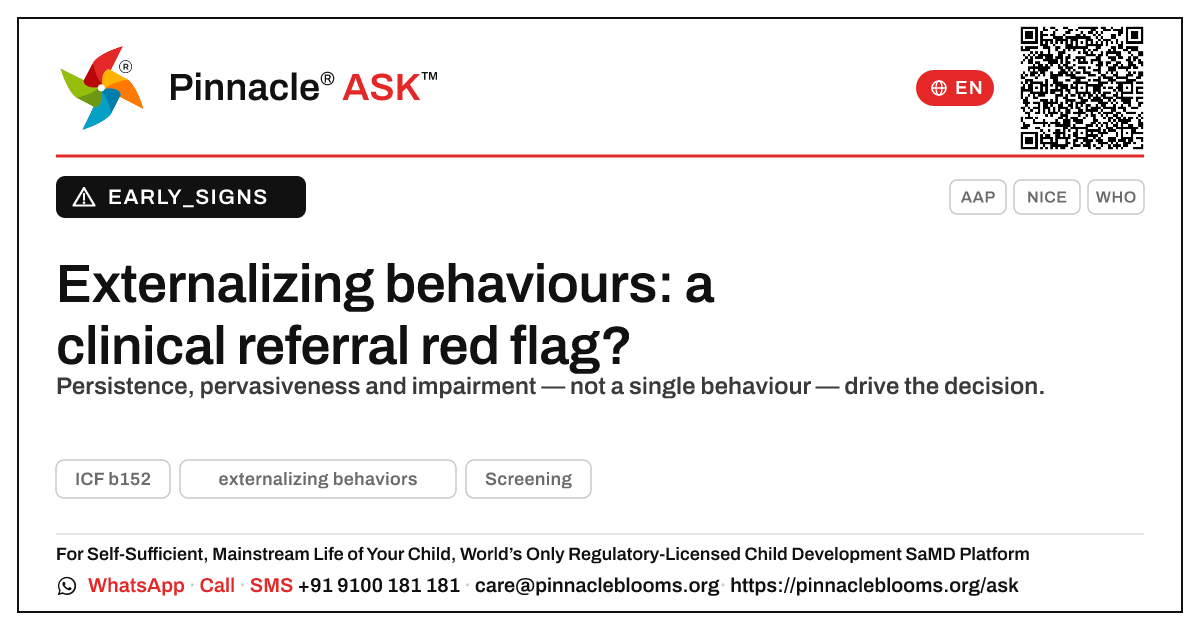
Externalizing behaviours: when do they warrant a developmental referral?
Externalizing behaviours (ICF b152) are outward dysregulation, not a skill to be learned. A developmental referral is warranted when the pattern is persistent, pervasive across settings and functionally impairing — particularly when co-occurring with language delay or limited self-regulation — rather than isolated, age-typical defiance. Age grades the decision: below ~3 years, monitor and support; persistence, pervasiveness and impairment drive referral.
In this answer 5 sections
When a child's distress shows up as defiance, aggression or impulsivity rather than words, the clinical question becomes: pattern, or passing phase?
In short
The phrasing "difficulty learning to externalizing behaviors" likely conflates two constructs. Externalizing behaviours (ICF b152, emotional functions) are not a skill to be learned — they are outward-directed dysregulation. What warrants a developmental referral is a persistent, pervasive and impairing pattern of externalizing behaviour that exceeds developmental expectation for the child's age, especially when coupled with delays in language, emotional regulation or social communication. Isolated, situational defiance in a typically developing toddler usually does not.
Red flags that warrant referral
Consider developmental/behavioural referral when externalizing presentations are frequent, cross-setting (home and childcare/school), and functionally impairing:
- Aggression, severe tantrums or destructiveness disproportionate to age and persisting beyond expected developmental windows (e.g. well past the typical 2–3 year peak)
- Impulsivity, hyperactivity or inattention out of keeping with developmental level
- Externalizing behaviour co-occurring with expressive/receptive language delay — dysregulation is often the visible surface of an unmet communication need
- Limited emergence of self-regulation, joint attention or social reciprocity
- Behaviour that disrupts learning, peer relationships or family functioning, or raises safety concerns
- Regression, or sudden behavioural change (screen for medical, sensory, hearing or psychosocial drivers first)
Age matters: externalizing behaviour is age-graded. Below ~3 years, frame as monitoring and parent-mediated support; persistence, pervasiveness and impairment — not a single behaviour — drive the referral decision.
The science
Externalizing behaviour frequently signals an underlying regulatory, communicative or environmental load rather than a discrete diagnosis. A structured developmental and behavioural screen distinguishes transient phases from emerging neurodevelopmental or behavioural conditions, and identifies modifiable contributors (sleep, language access, sensory profile, caregiving context).
The Pinnacle way
We assess behaviour through a strengths-first, function-led lens — mapping what drives the behaviour before naming it. A clinical AbilityScore® and any diagnosis are formed only at a Pinnacle Blooms Network centre under qualified clinician care; this guidance does not diagnose. Explore externalizing behaviors and our behavioural therapy pathway. Across 70+ centres in 4 states, 700+ therapists and 4.95 lakh+ families served, our approach is consistent and evidence-led.
Trusted sources
Aligned with AAP and HealthyChildren.org guidance on behavioural concerns and developmental surveillance, NICE guidance on behavioural disorders in children, and the WHO ICF framework for emotional functions (b152).
Next step — refer or co-manage by connecting your patient's family with our clinical team on WhatsApp at +91 91001 81181 for a structured developmental and behavioural screen.
This is general information, not a diagnosis — individual assessment and diagnosis require an appropriately qualified healthcare professional.
CONNECT THE ANSWER TO YOUR CHILD’S DAY
Something to notice. Something to discuss.
What to notice
Frequent, cross-setting, impairing aggression, severe tantrums, impulsivity or hyperactivity beyond developmental expectation; externalizing behaviour co-occurring with language delay or poor self-regulation; behaviour disrupting learning, peer or family function, or raising safety concerns.
In everyday life
Before labelling behaviour, screen the function — language access, sleep, sensory load and caregiving context often explain externalizing presentations and are modifiable.
Bring your observations and questions to your child’s professional. Choose activities that suit your child’s comfort, abilities and agreed plan.
Bring your questions to a first visitQuestions families ask
Is externalizing behaviour a skill a child learns?
No. Externalizing behaviour (ICF b152, emotional functions) is outward-directed dysregulation — aggression, defiance, impulsivity — not a skill. The clinical question is whether the pattern is persistent, pervasive and impairing enough to warrant assessment, not whether a skill is delayed.
At what age should externalizing behaviour prompt referral rather than monitoring?
Externalizing behaviour is age-graded and peaks around 2–3 years. Below this, frame as monitoring with parent-mediated support. Persistence beyond expected windows, pervasiveness across home and childcare/school, and functional impairment — not a single behaviour or age threshold — drive the referral decision.
What commonly underlies externalizing behaviour in young children?
It is frequently the visible surface of an unmet need — expressive/receptive language delay, regulatory or sensory load, sleep disruption, or psychosocial factors. A structured screen identifies modifiable drivers and distinguishes transient phases from emerging neurodevelopmental conditions.
FOLLOW THE SOURCE
References behind this answer.
- Organisation website · further readingAAP HealthyChildren.org — behavioural concerns and developmental surveillance
- Organisation website · further readingNICE — guidance on behavioural disorders in children
- Organisation website · further readingWHO ICF — emotional functions
References are supplied with this answer. An organisation homepage offers further reading; it does not establish an independent review of this page.
Content attribution: SETU Consortium · Pinnacle Blooms Network.
PEOPLE, TOPICS & DEVELOPMENT
See the connections.
Browse the wider question collections connected with this answer’s audience, developmental area and stage.
FROM UNDERSTANDING TO PURPOSEFUL SUPPORT
One question. Your child’s whole life.
Your child’s self-sufficient, mainstream-included life is the purpose from the beginning. At Pinnacle, that purpose shapes what we understand, the goals we choose, the people we bring together, everyday practice and review.
Connect this question with the right support.
Explore how the relevant service contributes to everyday abilities, then speak with us about your child.
Make the next conversation useful.
Bring the situations you notice at home or school. We’ll explain a suitable service, centre and first visit, including availability and fees, before you decide.
How PinnacleAI® connects the journeyExplore the seven stages
- 1Understand abilities
A starting picture of your child’s capabilities.
- 2Choose meaningful goals
Readiness and a plan shaped around the child.
- 3Bring the right support together
Suitable therapies and people for those goals.
- 4Carry practice into everyday life
Guidance for family, home and school.
- 5Track and correct
Use observations to adjust the plan.
- 6Reassess and review
Decide what to continue, change or do next.
- 7Grow independence and participation
The child’s life gives each step its purpose.
Explore the whole PinnacleAI® system → · Participation at school and in the community →
PINNACLE’S EVIDENCE, OPEN TO YOU
Look at the evidence behind our work.
Read our research, inspect the original regulatory documents and check what each institutional measure means.
General information supports a conversation with an appropriately qualified professional. Advice, goals and support depend on the individual child.