
YOUR QUESTION. A CLEARER NEXT STEP.
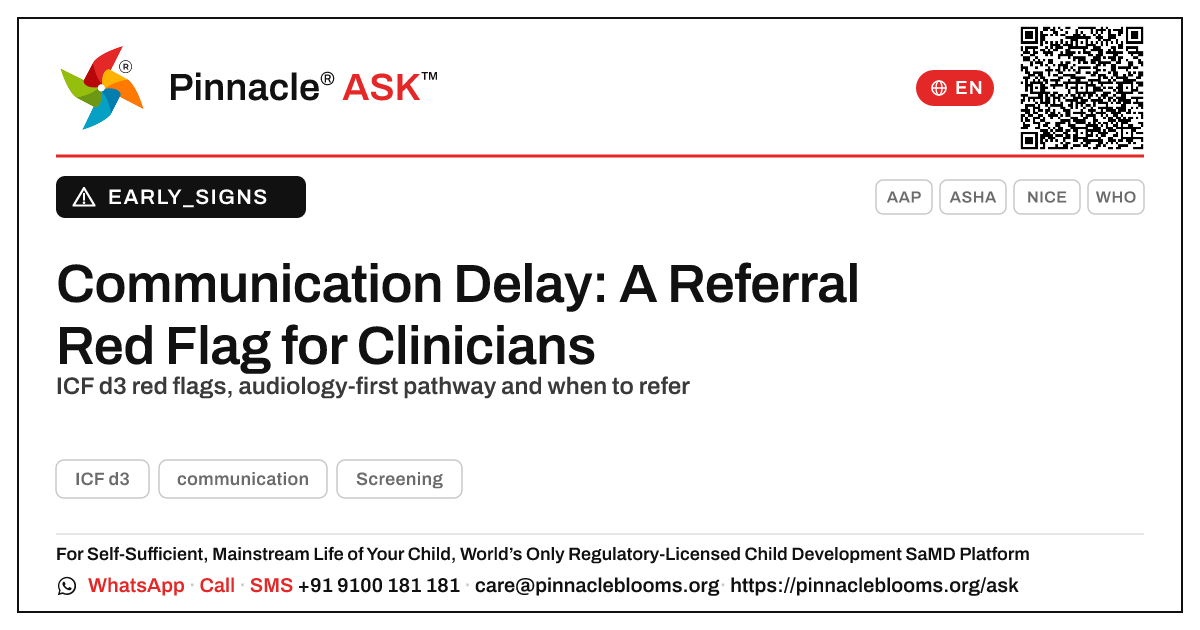
Communication delay: a red flag for developmental referral?
Yes — persistent difficulty acquiring communication (ICF d3) is a clinical red flag warranting developmental referral. Watch for no babble by 9–12 months, no words by 16 months, no two-word phrases by 24 months, any regression, weak joint attention or gesture, and apparent non-response to sound. Audiology precedes language work. Guideline consensus (AAP, NICE, ASHA) supports referral on screen failure or persistent concern rather than watchful waiting.
In this answer 5 sections
A child who is slow to find words or gestures is telling us something — the question is whether it warrants a closer, structured look.
In short
Yes. Persistent difficulty acquiring communication skills — receptive, expressive or social-pragmatic — is a recognised developmental red flag warranting referral, not watchful waiting alone. ICF domain d3 (Communication) delays that fail to close, regress, or present with associated motor/social atypia justify prompt developmental and audiological evaluation. The yield of early referral outweighs the low risk of over-referral.
Red flags warranting referral (by lens)
Expressive
- No babbling by 9–12 months; no single words by 16 months
- Fewer than 50 words or no two-word combinations by 24 months
- Any loss of previously acquired words or babble (regression — refer urgently)
Receptive
- Inconsistent response to name or familiar requests by 12–15 months
- Apparent not-hearing or poor sound localisation (mandates audiology first)
Social-pragmatic
- Limited gesture (pointing, showing, waving) by 12–18 months
- Reduced joint attention, eye contact or gaze-following
- Communication used for needs only, not for sharing
Cross-cutting amplifiers — a gap that widens across months, more than one domain affected, a positive family history, or regression — each raises priority.
The science
Audiological assessment precedes language work in every case, since otitis media and sensorineural loss are common, treatable contributors. Communication delay is non-specific: it may be isolated (language disorder), or an early marker of autism, global developmental delay or hearing impairment — which is precisely why structured evaluation, not labelling, is the correct response. Guideline consensus (AAP surveillance/screening, NICE, ASHA) supports referral on any validated screen failure or persistent parental/clinician concern, without awaiting spontaneous resolution.
The Pinnacle way
Refer for a structured developmental evaluation; a clinical AbilityScore® and any diagnosis are formed only at a Pinnacle Blooms Network centre under qualified clinician care. We map communication across receptive, expressive and pragmatic lenses and coordinate audiology and play-based speech therapy. Across 70+ centres in 4 states, 700+ therapists and 4.95 lakh+ families served, we work peer-to-peer with referring clinicians.
Trusted sources
Aligned with AAP developmental surveillance and screening guidance, ASHA resources on early communication milestones, NICE guidance on recognising developmental concerns, and the WHO ICF framework for communication (d3).
Next step — refer a child with communication concerns for a developmental screen via WhatsApp +91 91001 81181, or co-ordinate a clinician-to-clinician referral pathway.
This is general information, not a diagnosis — individual assessment and diagnosis require an appropriately qualified healthcare professional.
CONNECT THE ANSWER TO YOUR CHILD’S DAY
Something to notice. Something to discuss.
What to notice
No babbling by 9–12 months, no single words by 16 months, no two-word combinations by 24 months, any loss of words or babble (regression), limited pointing/showing/waving by 12–18 months, reduced joint attention, and apparent non-response to sound. A widening gap, multiple domains affected, family history or regression each raise referral priority.
In everyday life
On any positive screen or persistent parental concern, refer and arrange audiology first — communication delay is non-specific and hearing loss is common and treatable.
Bring your observations and questions to your child’s professional. Choose activities that suit your child’s comfort, abilities and agreed plan.
Bring your questions to a first visitQuestions families ask
At what age should I refer a child with a communication delay?
Refer on any validated screen failure or persistent concern: no babble by 9–12 months, no words by 16 months, no two-word phrases by 24 months, or any regression at any age. Earlier referral improves outcomes and the over-referral risk is low.
Should audiology come before speech-language assessment?
Yes. Audiological assessment precedes language intervention in every case, as otitis media and sensorineural hearing loss are common, treatable contributors to communication delay.
Does a communication delay mean autism?
Not necessarily. Communication delay is non-specific — it may be an isolated language disorder, or an early marker of autism, global developmental delay or hearing impairment. Structured evaluation, not home labelling, distinguishes these.
Is regression of acquired words urgent?
Yes. Any loss of previously acquired words or babble warrants prompt referral rather than watchful waiting.
FOLLOW THE SOURCE
References behind this answer.
- Organisation website · further readingAAP — developmental surveillance and screening
- Organisation website · further readingASHA — early communication milestones
- Organisation website · further readingNICE — recognising developmental concerns
- Organisation website · further readingWHO ICF — communication domain (d3)
References are supplied with this answer. An organisation homepage offers further reading; it does not establish an independent review of this page.
Content attribution: SETU Consortium · Pinnacle Blooms Network.
PEOPLE, TOPICS & DEVELOPMENT
See the connections.
Browse the wider question collections connected with this answer’s audience, developmental area and stage.
FROM UNDERSTANDING TO PURPOSEFUL SUPPORT
One question. Your child’s whole life.
Your child’s self-sufficient, mainstream-included life is the purpose from the beginning. At Pinnacle, that purpose shapes what we understand, the goals we choose, the people we bring together, everyday practice and review.
Connect this question with the right support.
Explore how the relevant service contributes to everyday abilities, then speak with us about your child.
Make the next conversation useful.
Bring the situations you notice at home or school. We’ll explain a suitable service, centre and first visit, including availability and fees, before you decide.
How PinnacleAI® connects the journeyExplore the seven stages
- 1Understand abilities
A starting picture of your child’s capabilities.
- 2Choose meaningful goals
Readiness and a plan shaped around the child.
- 3Bring the right support together
Suitable therapies and people for those goals.
- 4Carry practice into everyday life
Guidance for family, home and school.
- 5Track and correct
Use observations to adjust the plan.
- 6Reassess and review
Decide what to continue, change or do next.
- 7Grow independence and participation
The child’s life gives each step its purpose.
Explore the whole PinnacleAI® system → · Participation at school and in the community →
PINNACLE’S EVIDENCE, OPEN TO YOU
Look at the evidence behind our work.
Read our research, inspect the original regulatory documents and check what each institutional measure means.
General information supports a conversation with an appropriately qualified professional. Advice, goals and support depend on the individual child.