
YOUR QUESTION. A CLEARER NEXT STEP.
Is balance difficulty a developmental red flag warranting referral?
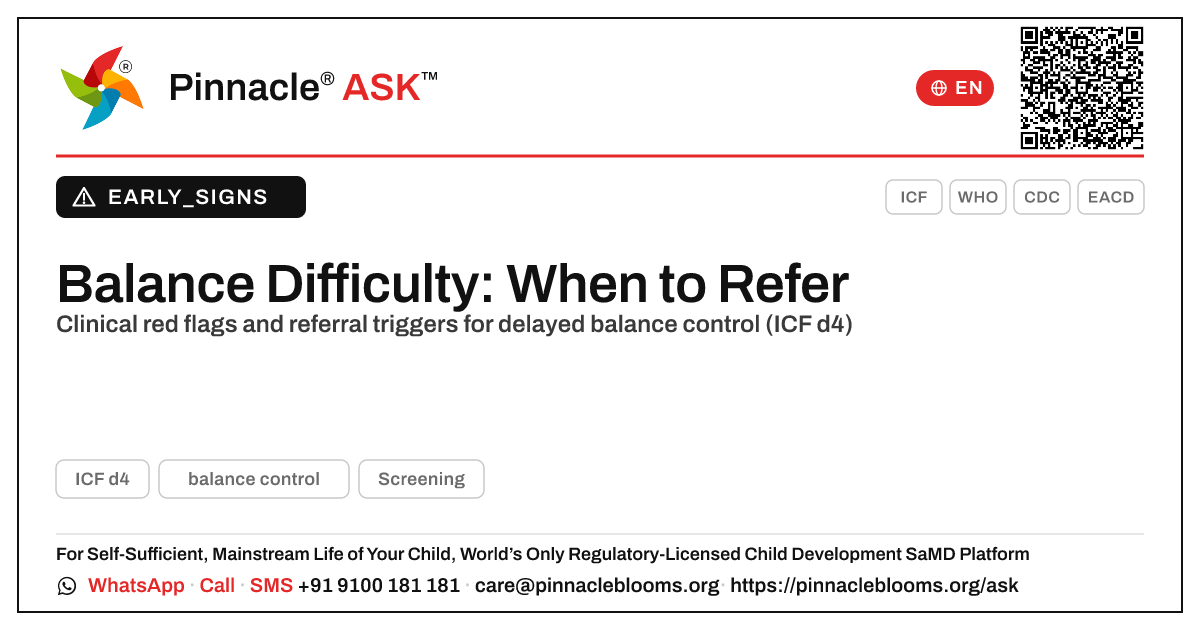
Isolated variability in balance acquisition is usually not a red flag, but balance control (ICF d4) that is persistently delayed, regressing, asymmetric, or paired with abnormal tone, ataxia or coexisting communication/motor delay warrants developmental referral. Acute or regressive loss should be expedited for neurological evaluation. Treat balance difficulty as a screening trigger judged by trajectory and context, not a diagnosis.
In this answer 5 sections
A child wobbling longer than peers can be ordinary maturation — or an early signal worth a structured look.
In short
Isolated, age-appropriate variability in balance acquisition is usually not a red flag. However, balance control (ICF d4 — Mobility) that is persistently delayed, regressing, asymmetric, or accompanied by abnormal tone, ataxia or coexisting communication/motor delay does warrant developmental referral. Treat balance difficulty as a screening trigger, not a diagnosis — context and trajectory determine urgency.
Red flags warranting referral
Refer when balance difficulty shows any of the following:
Pattern and trajectory
- Loss of previously acquired postural skills (regression — refer urgently)
- Delay persisting or widening across review intervals rather than narrowing
- Marked discrepancy between balance and other domains, or a single domain dragging
Neuromotor signs
- Clear asymmetry, hand preference before 12 months, or unilateral neglect
- Hypertonia, hypotonia, scissoring, or persistent primitive reflexes
- Truncal ataxia, intention tremor, nystagmus, or wide-based unsteady gait
- Frequent unexplained falls, toe-walking, or apparent fatigability
Co-occurring concern
- Associated speech, social-communication or fine-motor delay
- Headache, vomiting, visual change (consider posterior-fossa pathology — expedite)
- Family history of neuromuscular or genetic conditions
The science
Postural control integrates vestibular, visual, proprioceptive and cerebellar inputs with emerging musculoskeletal strength. Normal acquisition is heterogeneous, so single time-point judgement is unreliable; serial surveillance against validated milestones is the standard. The clinical value lies in distinguishing benign maturational lag from emerging cerebral palsy, developmental coordination disorder, ataxia, neuromuscular disease, or sensory (vestibular/visual) deficit. Where balance loss is acute or regressive, prioritise medical/neurological evaluation over a therapy-first pathway.
The Pinnacle way
We assess balance control within whole-child motor profiling and offer targeted occupational therapy where indicated, coaching parents as partners. A clinical AbilityScore® and any diagnosis are formed only at a Pinnacle Blooms Network centre under qualified clinician care — nothing here is a diagnosis. Across 70+ centres and 4.95 lakh+ families served, our stance is strengths-first and surveillance-led.
Trusted sources
Aligned with WHO/ICF mobility framing, AAP and CDC developmental surveillance guidance, and EACD recommendations on motor coordination assessment.
Next step — refer a child with persistent or regressive balance concern to our clinical team via WhatsApp at +91 91001 81181 for structured developmental assessment.
CONNECT THE ANSWER TO YOUR CHILD’S DAY
Something to notice. Something to discuss.
What to notice
Regression of postural skills, persistent or widening delay, asymmetry or early hand preference, hypertonia/hypotonia, truncal ataxia, nystagmus, frequent unexplained falls, toe-walking, and co-occurring speech or fine-motor delay or red-flag medical signs (headache, vomiting, visual change).
In everyday life
Judge balance against serial milestones, not a single visit — a delay that narrows over review intervals reassures; one that persists, widens or regresses warrants referral.
Bring your observations and questions to your child’s professional. Choose activities that suit your child’s comfort, abilities and agreed plan.
Bring your questions to a first visitQuestions families ask
Is delayed balance always a red flag?
No. Acquisition of postural control is heterogeneous, so isolated, narrowing variability against milestones is usually benign. Referral is warranted when delay persists or widens, regresses, is asymmetric, or co-occurs with abnormal tone, ataxia or other domain delay.
Which balance findings need urgent escalation?
Loss of previously acquired skills, acute-onset ataxia, nystagmus, or balance change with headache, vomiting or visual disturbance should be expedited for neurological evaluation rather than a therapy-first pathway.
What conditions should differential consideration cover?
Cerebral palsy, developmental coordination disorder, cerebellar ataxia, neuromuscular disease, and vestibular or visual sensory deficits — distinguished through serial surveillance and structured clinical assessment.
FOLLOW THE SOURCE
References behind this answer.
- Source referenceICF d4
- Source referenceWHO ICF — Mobility (d4) framework
- Source referenceCDC — Developmental monitoring and screening
- Organisation website · further readingEACD — Motor coordination assessment recommendations
References are supplied with this answer. An organisation homepage offers further reading; it does not establish an independent review of this page.
Content attribution: SETU Consortium · Pinnacle Blooms Network.
PEOPLE, TOPICS & DEVELOPMENT
See the connections.
Browse the wider question collections connected with this answer’s audience, developmental area and stage.
FROM UNDERSTANDING TO PURPOSEFUL SUPPORT
One question. Your child’s whole life.
Your child’s self-sufficient, mainstream-included life is the purpose from the beginning. At Pinnacle, that purpose shapes what we understand, the goals we choose, the people we bring together, everyday practice and review.
Connect this question with the right support.
Start with your child’s strengths, your observations and what you want everyday life to become.
Make the next conversation useful.
Bring the situations you notice at home or school. We’ll explain a suitable service, centre and first visit, including availability and fees, before you decide.
How PinnacleAI® connects the journeyExplore the seven stages
- 1Understand abilities
A starting picture of your child’s capabilities.
- 2Choose meaningful goals
Readiness and a plan shaped around the child.
- 3Bring the right support together
Suitable therapies and people for those goals.
- 4Carry practice into everyday life
Guidance for family, home and school.
- 5Track and correct
Use observations to adjust the plan.
- 6Reassess and review
Decide what to continue, change or do next.
- 7Grow independence and participation
The child’s life gives each step its purpose.
Explore the whole PinnacleAI® system → · Participation at school and in the community →
PINNACLE’S EVIDENCE, OPEN TO YOU
Look at the evidence behind our work.
Read our research, inspect the original regulatory documents and check what each institutional measure means.
General information supports a conversation with an appropriately qualified professional. Advice, goals and support depend on the individual child.