
YOUR QUESTION. A CLEARER NEXT STEP.
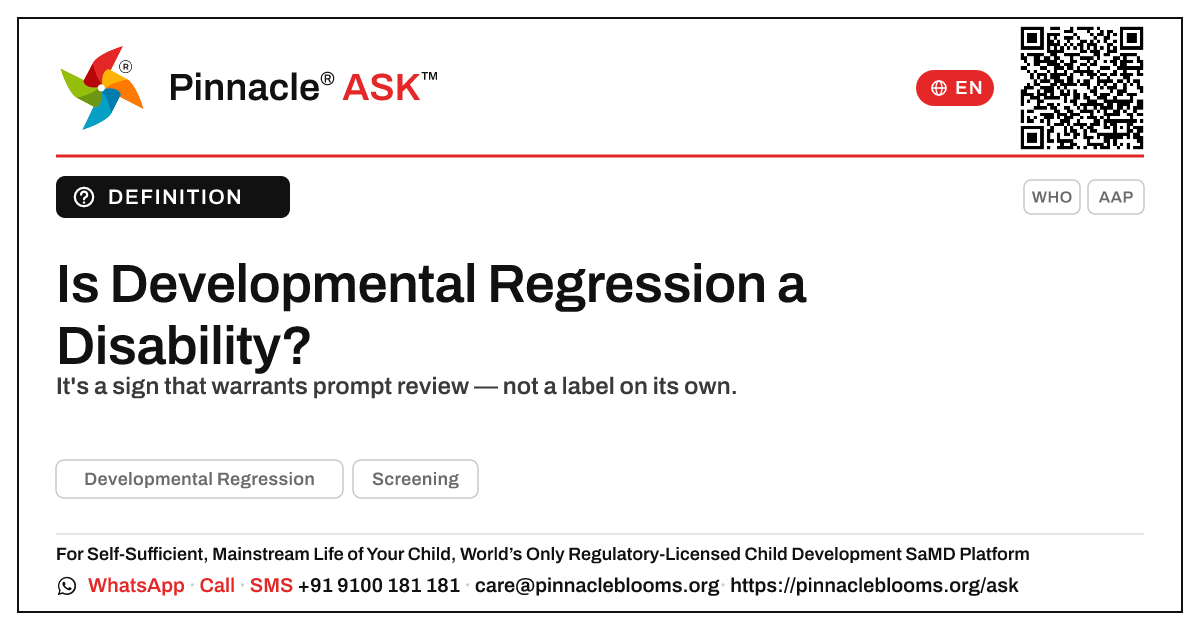
Is Developmental Regression considered a disability?
Developmental regression is not itself a disability — it is a sign that a child is losing previously gained skills. Whether it points to a longer-term condition depends on the underlying cause, which only prompt clinical assessment can reveal. Any genuine loss of skills should be reviewed by a clinician soon.
In this answer 4 sections
When a child loses skills they once had, the first question many parents ask is whether this is a "disability" — and the honest answer is gentler than the word feels.
In short
Developmental regression is not itself a disability — it is a sign, a description of what is happening: a child losing skills they had previously gained, in speech, movement, social connection or self-care. It is a signal that the body and brain need a careful look, not a label on its own. Whether it points to a condition that meets the definition of a disability depends entirely on the underlying cause, and that can only be understood through prompt assessment. The most important thing to know is that regression always warrants a timely clinical review.
How to think about it
Under the WHO's framework, a disability describes a lasting difference in functioning — how a child participates in everyday life — whereas regression is the change you are observing right now. Some causes of regression are temporary or treatable; others are linked to neurodevelopmental or medical conditions that may bring longer-term support needs. Because the causes range widely — and because some need prompt medical attention rather than a wait-and-watch approach — any genuine loss of previously acquired skills should be reviewed by a clinician soon, not monitored at home. Early understanding opens the door to early support, and that is where outcomes are shaped.
The Pinnacle way
AbilityScore® is part of Pinnacle’s developmental assessment. Diagnosis, where needed, requires an appropriately qualified healthcare professional — never from an online form or this page. If you have noticed your child losing skills, that is reason enough to seek a developmental check now. Learn more about developmental regression and how early intervention can support your child's journey.
Trusted sources
WHO International Classification of Functioning, Disability and Health (ICF), which frames disability as a difference in functioning rather than a single symptom; the American Academy of Pediatrics guidance that loss of skills warrants prompt evaluation.
Next step — Have you seen your child lose a skill they once had? Book a developmental check with a Pinnacle clinician — sooner is always better.
This is general information, not a diagnosis — individual assessment and diagnosis require an appropriately qualified healthcare professional.
CONNECT THE ANSWER TO YOUR CHILD’S DAY
Something to notice. Something to discuss.
What to notice
Any genuine loss of skills your child once had — fewer words than before, stopping eye contact or social smiles, no longer walking or sitting as steadily, or withdrawing from play they used to enjoy. Loss of previously acquired skills, at any age, always warrants a prompt clinical review.
In everyday life
Keep a short, dated note of what your child could do recently versus now — a few words, a wave, climbing the stairs. This simple timeline helps a clinician see the change clearly and act faster.
Bring your observations and questions to your child’s professional. Choose activities that suit your child’s comfort, abilities and agreed plan.
Bring your questions to a first visitQuestions families ask
Is developmental regression the same as a disability?
No. Regression describes a child losing skills they had previously gained — it is a sign, not a diagnosis or a label. Whether it leads to a condition that meets the definition of a disability depends on the underlying cause, which a clinician can assess.
Should I wait to see if my child catches up again?
No — any genuine loss of previously acquired skills should be reviewed by a clinician promptly rather than monitored at home. Some causes need timely medical attention, and early understanding opens the door to early support.
Can a child recover from developmental regression?
It depends entirely on the cause. Some causes are temporary or treatable; others may bring longer-term support needs. Only a clinical assessment can clarify what is happening and what support will help most.
FOLLOW THE SOURCE
References behind this answer.
- Organisation website · further readingAAP HealthyChildren — when loss of skills warrants evaluation
References are supplied with this answer. An organisation homepage offers further reading; it does not establish an independent review of this page.
Content attribution: SETU Consortium · Pinnacle Blooms Network.
PEOPLE, TOPICS & DEVELOPMENT
See the connections.
Browse the wider question collections connected with this answer’s audience, developmental area and stage.
FROM UNDERSTANDING TO PURPOSEFUL SUPPORT
One question. Your child’s whole life.
Your child’s self-sufficient, mainstream-included life is the purpose from the beginning. At Pinnacle, that purpose shapes what we understand, the goals we choose, the people we bring together, everyday practice and review.
Connect this question with the right support.
Explore how the relevant service contributes to everyday abilities, then speak with us about your child.
Make the next conversation useful.
Bring the situations you notice at home or school. We’ll explain a suitable service, centre and first visit, including availability and fees, before you decide.
How PinnacleAI® connects the journeyExplore the seven stages
- 1Understand abilities
A starting picture of your child’s capabilities.
- 2Choose meaningful goals
Readiness and a plan shaped around the child.
- 3Bring the right support together
Suitable therapies and people for those goals.
- 4Carry practice into everyday life
Guidance for family, home and school.
- 5Track and correct
Use observations to adjust the plan.
- 6Reassess and review
Decide what to continue, change or do next.
- 7Grow independence and participation
The child’s life gives each step its purpose.
Explore the whole PinnacleAI® system → · Participation at school and in the community →
PINNACLE’S EVIDENCE, OPEN TO YOU
Look at the evidence behind our work.
Read our research, inspect the original regulatory documents and check what each institutional measure means.
General information supports a conversation with an appropriately qualified professional. Advice, goals and support depend on the individual child.