
YOUR QUESTION. A CLEARER NEXT STEP.
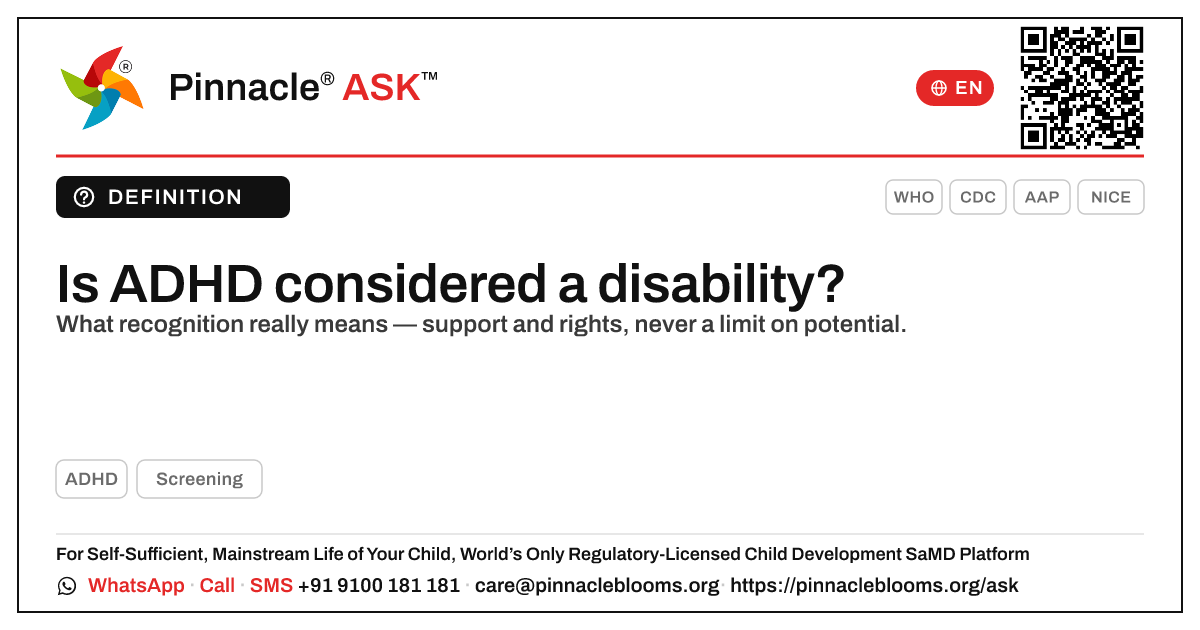
Is ADHD considered a disability?
Yes — ADHD is recognised as a neurodevelopmental condition (WHO ICD-11 6A05) and qualifies as a disability for the purposes of support, accommodations and rights. The label unlocks help; it does not limit your child's potential. Developmental measurement supports care planning; diagnosis requires an appropriately qualified healthcare professional. under qualified clinician care.
In this answer 5 sections
When a parent hears the word "disability" attached to ADHD, it can feel heavy — but in practice it is a doorway to understanding and support, not a label that limits your child.
In short
Yes — ADHD (attention deficit hyperactivity disorder) is recognised as a neurodevelopmental condition, and in many contexts it qualifies as a disability for the purposes of support, accommodations and rights. The WHO classifies it under ICD-11 (6A05), and in India it can attract protections and educational adjustments under disability and rights frameworks. But "disability" here means support is owed — it does not mean your child cannot thrive, learn or lead a full, capable life. With the right understanding, structure and therapy, children with ADHD flourish.
What the label actually means
Calling ADHD a disability is a functional and legal description, not a verdict on your child's potential. It signals that the way your child's attention, activity and impulse-control develop can create real barriers — in classrooms designed for a different pace, or in routines that demand sustained stillness. Recognising it as a disability is precisely what unlocks:
- Reasonable accommodations at school — extra time, seating, broken-down instructions.
- Access to therapy and support rather than being labelled "naughty" or "lazy".
- Rights and dignity under frameworks that protect children who learn and focus differently.
ADHD is best understood as a difference in how attention and self-regulation are wired, not a deficit in intelligence, character or love of learning. Many children with ADHD are creative, energetic and deeply capable — they simply need an environment and skills that fit them.
When to seek a structured look
If you notice persistent difficulty sustaining attention, high restlessness or impulsivity that shows up across settings — home, school, play — and that is affecting learning or relationships, it is worth a structured developmental review. ADHD is reliably assessed from around school age, when expectations for sitting, focusing and following multi-step tasks naturally rise.
The Pinnacle way
AbilityScore® is part of Pinnacle’s developmental assessment. Diagnosis, where needed, requires an appropriately qualified healthcare professional — never from an online form or an app. Our approach builds on your child's strengths, mapping where focus, regulation and learning support will help most. Explore understanding ADHD, how behavioural therapy builds everyday skills, and what the AbilityScore is and how it is established.
Trusted sources
WHO ICD-11 classifies ADHD as a neurodevelopmental disorder (6A05). The CDC and the American Academy of Pediatrics describe ADHD as a recognised condition warranting support and accommodation, and NICE guidance (NG87) sets out diagnosis and management pathways.
Next step — Curious where your child stands and what support fits? Book a developmental check with a Pinnacle clinician.
This is general information, not a diagnosis — individual assessment and diagnosis require an appropriately qualified healthcare professional.
CONNECT THE ANSWER TO YOUR CHILD’S DAY
Something to notice. Something to discuss.
What to notice
Persistent difficulty sustaining attention, high restlessness or impulsivity that appears across settings — home, school and play — and that affects learning, friendships or daily routines.
In everyday life
Break tasks into small, clear steps and praise the effort, not just the result. Short, predictable routines and movement breaks help a child with ADHD succeed without feeling told off.
Bring your observations and questions to your child’s professional. Choose activities that suit your child’s comfort, abilities and agreed plan.
Bring your questions to a first visitQuestions families ask
Does ADHD being a disability mean my child can't do well in school?
Not at all. The disability recognition exists so your child gets the right accommodations — extra time, clearer instructions, supportive seating. Many children with ADHD do very well academically once their learning environment fits how they focus.
At what age can ADHD be assessed?
ADHD is reliably assessed from around school age, when expectations for sustained attention and following multi-step tasks naturally rise. If you have concerns earlier, a general developmental check is the right first step.
Will an ADHD label follow my child forever?
Recognition opens access to support, not a permanent restriction. Many children develop strong self-regulation and coping skills over time. The goal is always growing independence, built on your child's strengths.
FOLLOW THE SOURCE
References behind this answer.
- Source referenceWHO ICD-11 — Attention deficit hyperactivity disorder
- Source referenceCDC — Learn the Signs. Act Early.
- Organisation website · further readingAmerican Academy of Pediatrics — HealthyChildren.org
- Source referenceNICE NG87 — ADHD diagnosis & management
References are supplied with this answer. An organisation homepage offers further reading; it does not establish an independent review of this page.
Content attribution: SETU Consortium · Pinnacle Blooms Network.
PEOPLE, TOPICS & DEVELOPMENT
See the connections.
Browse the wider question collections connected with this answer’s audience, developmental area and stage.
FROM UNDERSTANDING TO PURPOSEFUL SUPPORT
One question. Your child’s whole life.
Your child’s self-sufficient, mainstream-included life is the purpose from the beginning. At Pinnacle, that purpose shapes what we understand, the goals we choose, the people we bring together, everyday practice and review.
Connect this question with the right support.
Start with your child’s strengths, your observations and what you want everyday life to become.
Make the next conversation useful.
Bring the situations you notice at home or school. We’ll explain a suitable service, centre and first visit, including availability and fees, before you decide.
How PinnacleAI® connects the journeyExplore the seven stages
- 1Understand abilities
A starting picture of your child’s capabilities.
- 2Choose meaningful goals
Readiness and a plan shaped around the child.
- 3Bring the right support together
Suitable therapies and people for those goals.
- 4Carry practice into everyday life
Guidance for family, home and school.
- 5Track and correct
Use observations to adjust the plan.
- 6Reassess and review
Decide what to continue, change or do next.
- 7Grow independence and participation
The child’s life gives each step its purpose.
Explore the whole PinnacleAI® system → · Participation at school and in the community →
PINNACLE’S EVIDENCE, OPEN TO YOU
Look at the evidence behind our work.
Read our research, inspect the original regulatory documents and check what each institutional measure means.
General information supports a conversation with an appropriately qualified professional. Advice, goals and support depend on the individual child.