
YOUR QUESTION. A CLEARER NEXT STEP.
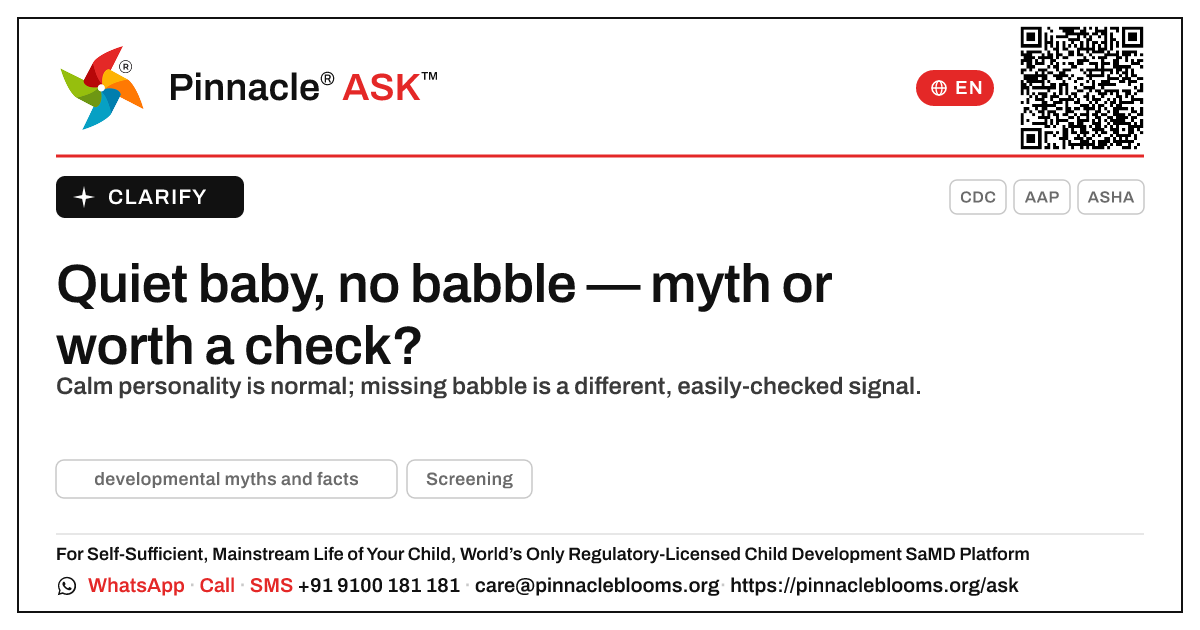
Is a quiet baby who doesn't babble nothing to worry about?
A quiet temperament is normal, but absent babble is a separate signal. Most babies coo by 3 months and babble repeated syllables by around 12 months. No babble by 12 months, no response to your voice, or any loss of sounds is worth a calm check — starting with hearing — rather than waiting.
In this answer 5 sections
Some babies are simply gentle and watchful — but babble is communication practising itself, and it is worth knowing what to expect.
In short
A naturally calm temperament is not the same thing as missing babble. Many quiet babies coo, gurgle and babble plenty — they are just unhurried in other ways. What matters is whether sound and back-and-forth communication are present and growing: most babies coo by around 3 months, laugh and make sounds back to you by 4–6 months, and babble with repeated syllables like ba-ba or da-da by around 9–12 months. A baby who makes little sound, does not respond to your voice, or has no babble by 12 months deserves a gentle check — starting with hearing — rather than 'wait and see'.
Myth vs fact
The myth: "He's just a quiet baby — quiet babies talk late, it's nothing to worry about."
The fact: Quiet personality is normal and lovely. But absence of babble is a different signal. Babble is how a baby rehearses the muscles, sounds and turn-taking that become words. A baby can be calm and still babble warmly. When the sounds themselves are missing, the most common and easily-treated cause to rule out first is hearing — even mild or fluctuating hearing loss quietens babble.
Gently watch for:
- No cooing or vowel sounds by around 3–4 months
- Not turning to your voice or to sounds
- No back-and-forth 'sound games' (you make a sound, baby answers) by 6 months
- No babbling — repeated syllables like ba-ba, ma-ma — by 12 months
- Any loss of sounds the baby once made
When to check
None of this means something is wrong — it means it is worth looking. A hearing screen and a general developmental check are the right, calm first steps. They are quick, reassuring far more often than not, and when something does need support, earlier is always gentler. Persistent parental instinct that "something is quiet about my baby's communication" is itself worth listening to.
The Pinnacle way
Developmental measurement supports care planning; diagnosis requires an appropriately qualified healthcare professional. under qualified clinician care — never from an online list. Our team can map your baby's communication and hearing gently and clearly. Learn how we work at Pinnacle Blooms Network, explore speech therapy, and understand our structured developmental profiling at the AbilityScore®.
Trusted sources
Guided by CDC developmental milestones ("Learn the Signs. Act Early."), the American Academy of Pediatrics via HealthyChildren, and ASHA guidance on early communication and hearing — all of which treat absent babble by 12 months and any concern about hearing as reasons for a prompt, calm check.
Next step — book a gentle developmental and hearing check, or message the Pinnacle team on WhatsApp at +91 91001 81181 for reassurance and guidance.
This is general information, not a diagnosis — individual assessment and diagnosis require an appropriately qualified healthcare professional.
CONNECT THE ANSWER TO YOUR CHILD’S DAY
Something to notice. Something to discuss.
What to notice
Seek a prompt check if there is no cooing by 3–4 months, no response to your voice, no back-and-forth sound games by 6 months, no babble by 12 months, or any loss of sounds the baby once made.
In everyday life
Play 'sound tennis' daily: when your baby makes any sound, copy it back warmly and pause — these turn-taking games invite babble and let you notice if responses are growing.
Bring your observations and questions to your child’s professional. Choose activities that suit your child’s comfort, abilities and agreed plan.
Bring your questions to a first visitQuestions families ask
My baby is calm and content but doesn't babble much — is that just personality?
A calm personality is normal, but it is separate from babble. Many quiet babies still coo and babble warmly. If the sounds themselves are largely missing by around 12 months, it is worth a gentle check rather than assuming it is only temperament.
By what age should a baby be babbling?
Most babies coo by around 3 months, swap sounds with you by 4–6 months, and babble repeated syllables like ba-ba or da-da by around 9–12 months. No babble by 12 months is a reason for a calm check, starting with hearing.
What is usually the first thing to check if a baby isn't making sounds?
Hearing. Even mild or fluctuating hearing loss can quieten babble, and a hearing screen is quick and reassuring. A general developmental check alongside it gives the full picture.
Does no babble mean autism?
No. Absent babble has many possible reasons — hearing being the most common to rule out first. It is simply a signal to assess, not a diagnosis. Any concern is best mapped by a qualified clinician.
FOLLOW THE SOURCE
References behind this answer.
- Source referenceCDC — Learn the Signs. Act Early. (milestones)
- Organisation website · further readingAAP — HealthyChildren on early communication
- Organisation website · further readingASHA — early speech, language and hearing
References are supplied with this answer. An organisation homepage offers further reading; it does not establish an independent review of this page.
Content attribution: SETU Consortium · Pinnacle Blooms Network.
PEOPLE, TOPICS & DEVELOPMENT
See the connections.
Browse the wider question collections connected with this answer’s audience, developmental area and stage.
FROM UNDERSTANDING TO PURPOSEFUL SUPPORT
One question. Your child’s whole life.
Your child’s self-sufficient, mainstream-included life is the purpose from the beginning. At Pinnacle, that purpose shapes what we understand, the goals we choose, the people we bring together, everyday practice and review.
Connect this question with the right support.
Explore how the relevant service contributes to everyday abilities, then speak with us about your child.
Make the next conversation useful.
Bring the situations you notice at home or school. We’ll explain a suitable service, centre and first visit, including availability and fees, before you decide.
How PinnacleAI® connects the journeyExplore the seven stages
- 1Understand abilities
A starting picture of your child’s capabilities.
- 2Choose meaningful goals
Readiness and a plan shaped around the child.
- 3Bring the right support together
Suitable therapies and people for those goals.
- 4Carry practice into everyday life
Guidance for family, home and school.
- 5Track and correct
Use observations to adjust the plan.
- 6Reassess and review
Decide what to continue, change or do next.
- 7Grow independence and participation
The child’s life gives each step its purpose.
Explore the whole PinnacleAI® system → · Participation at school and in the community →
PINNACLE’S EVIDENCE, OPEN TO YOU
Look at the evidence behind our work.
Read our research, inspect the original regulatory documents and check what each institutional measure means.
General information supports a conversation with an appropriately qualified professional. Advice, goals and support depend on the individual child.