
YOUR QUESTION. A CLEARER NEXT STEP.
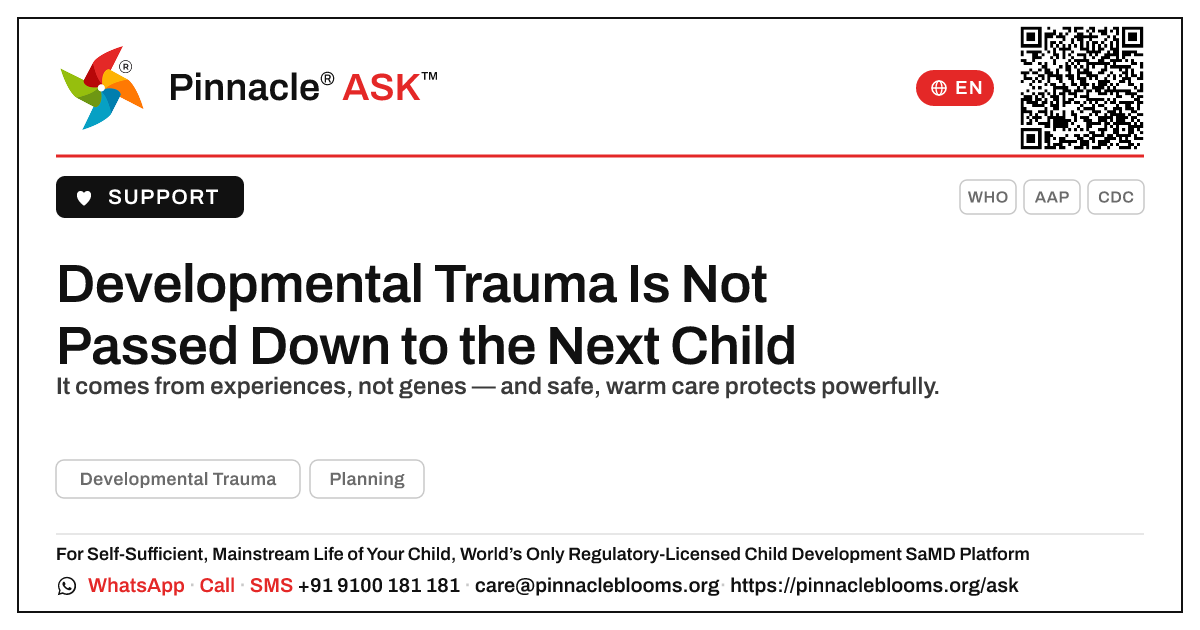
Can my next child also have Developmental Trauma?
Developmental Trauma is not genetic or inherited, so it does not pass automatically from one child to the next — it arises from a young child's early experiences and circumstances, not DNA. If difficult family conditions persist they could affect a younger sibling, but warm, responsive, predictable caregiving is powerfully protective. AbilityScore® is part of Pinnacle’s developmental assessment. Diagnosis, where needed, requires an appropriately qualified healthcare professional.
In this answer 5 sections
If one child carries the weight of early adversity, it is natural to wonder whether your next baby is destined for the same — and the reassuring truth is that this is not something passed down like an inherited gene.
In short
Developmental Trauma is not a genetic or inherited condition, so it does not pass automatically from one child to the next. It arises from a young child's lived experiences — early adversity, disrupted caregiving, neglect, loss or repeated overwhelming stress — rather than from DNA. That means each child's story is their own, and a safe, nurturing, predictable environment is the single most protective thing you can offer your next baby.
Understanding why it happens
Developmental Trauma describes how a very young child's developing brain and stress system adapt to early, overwhelming or unpredictable experiences — not something written into their genes at conception. So the honest answer to your worry is: no, your next child does not "inherit" it from a sibling.
A few things are worth understanding gently:
- It is experience-shaped, not gene-determined. Two children in the same family can have very different early stories — different pregnancies, different caregiving moments, different events — and so very different paths.
- Shared circumstances, not shared genes, are what matter. If the difficult conditions that affected your first child (for example illness, separation, household stress or instability) are still present, they could affect a younger sibling too. The good news is these are things that can be changed and supported.
- Protective care is powerfully effective. Warm, responsive, predictable caregiving — being a "safe base" your baby can return to — actively buffers a child's stress system and builds resilience.
So rather than asking "will it be passed on?", the more helpful question is "what can I put in place so my next child feels safe and secure?" — and that is something well within reach.
When to seek a check
If you are pregnant or planning, and your family has lived through significant stress, it is wise to talk with a paediatrician or developmental clinician early — so support is in place from the start. For your next child, watch over the first years for how they settle, soothe, connect, play and respond to comfort. If any little one seems persistently distressed, withdrawn, or hard to console, a gentle developmental check brings clarity and peace of mind — never to label, but to support.
The Pinnacle way
AbilityScore® is part of Pinnacle’s developmental assessment. Diagnosis, where needed, requires an appropriately qualified healthcare professional — never from an app, a checklist or worry alone. Our clinician-administered structured assessment looks at how your child connects, regulates and grows, and shapes warm, family-centred support around them. Explore how we walk alongside families , understand how the AbilityScore® is calculated, and learn how gentle, relationship-based behavioural and emotional therapy builds a child's sense of safety.
Trusted sources
WHO and the Nurturing Care Framework on the protective power of responsive caregiving in early childhood; American Academy of Pediatrics (HealthyChildren.org) guidance on early childhood adversity, toxic stress and building resilience; CDC resources on early relationships and healthy child development.
Next step — Worried about your next baby's start? Book a reassuring developmental conversation with a Pinnacle clinician and put protective support in place from day one.
This is general information, not a diagnosis — individual assessment and diagnosis require an appropriately qualified healthcare professional.
CONNECT THE ANSWER TO YOUR CHILD’S DAY
Something to notice. Something to discuss.
What to notice
In your next child's early years, watch how they settle, soothe, connect, play and respond to comfort. Seek a gentle developmental check if a little one seems persistently distressed, withdrawn or very hard to console — for clarity and support, never to label.
In everyday life
Be your baby's predictable safe base — respond warmly and consistently to their cues. This responsive, comforting care actively buffers a young child's stress system and builds lasting resilience.
Bring your observations and questions to your child’s professional. Choose activities that suit your child’s comfort, abilities and agreed plan.
Bring your questions to a first visitQuestions families ask
Is Developmental Trauma inherited or genetic?
No. Developmental Trauma is not a genetic or inherited condition. It arises from a young child's early lived experiences — adversity, disrupted caregiving, loss or overwhelming stress — rather than from DNA passed between siblings.
Could my next child still be affected?
Not by inheritance. But if the difficult circumstances that affected your first child — such as household stress, separation or instability — are still present, they could affect a younger sibling too. These are things that can be changed and supported.
What is the best way to protect my next baby?
Warm, responsive, predictable caregiving is the single most protective thing you can offer. Being a reliable 'safe base' actively buffers your baby's stress system and builds resilience from the very start.
When should I seek a developmental check?
If your family has lived through significant stress, speak with a paediatrician or developmental clinician early. For your next child, seek a gentle check if they seem persistently distressed, withdrawn or hard to console.
FOLLOW THE SOURCE
References behind this answer.
- Organisation website · further readingWHO Nurturing Care Framework — responsive caregiving in early childhood
- Organisation website · further readingAAP HealthyChildren.org — early childhood adversity and resilience
- Organisation website · further readingCDC — early relationships and healthy child development
References are supplied with this answer. An organisation homepage offers further reading; it does not establish an independent review of this page.
Content attribution: SETU Consortium · Pinnacle Blooms Network.
PEOPLE, TOPICS & DEVELOPMENT
See the connections.
Browse the wider question collections connected with this answer’s audience, developmental area and stage.
FROM UNDERSTANDING TO PURPOSEFUL SUPPORT
One question. Your child’s whole life.
Your child’s self-sufficient, mainstream-included life is the purpose from the beginning. At Pinnacle, that purpose shapes what we understand, the goals we choose, the people we bring together, everyday practice and review.
Connect this question with the right support.
Explore how the relevant service contributes to everyday abilities, then speak with us about your child.
Make the next conversation useful.
Bring the situations you notice at home or school. We’ll explain a suitable service, centre and first visit, including availability and fees, before you decide.
How PinnacleAI® connects the journeyExplore the seven stages
- 1Understand abilities
A starting picture of your child’s capabilities.
- 2Choose meaningful goals
Readiness and a plan shaped around the child.
- 3Bring the right support together
Suitable therapies and people for those goals.
- 4Carry practice into everyday life
Guidance for family, home and school.
- 5Track and correct
Use observations to adjust the plan.
- 6Reassess and review
Decide what to continue, change or do next.
- 7Grow independence and participation
The child’s life gives each step its purpose.
Explore the whole PinnacleAI® system → · Participation at school and in the community →
PINNACLE’S EVIDENCE, OPEN TO YOU
Look at the evidence behind our work.
Read our research, inspect the original regulatory documents and check what each institutional measure means.
General information supports a conversation with an appropriately qualified professional. Advice, goals and support depend on the individual child.