
YOUR QUESTION. A CLEARER NEXT STEP.
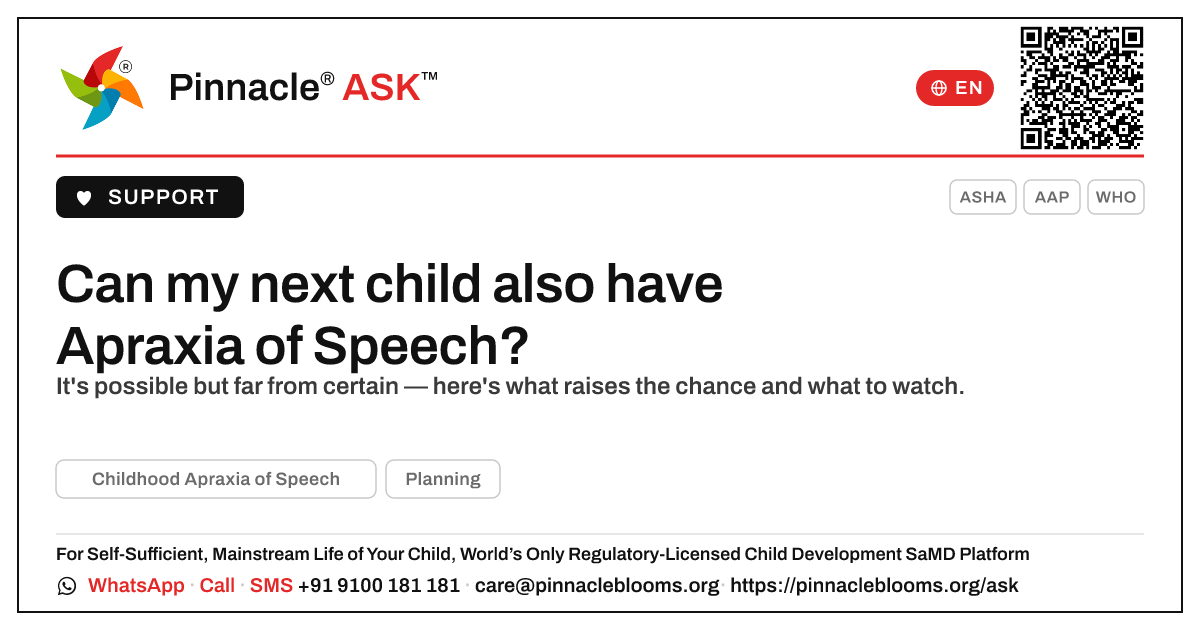
If one child has Childhood Apraxia of Speech, can my next child have it too?
Childhood Apraxia of Speech can run in families, so a younger sibling may have a somewhat raised chance — but most siblings of a child with CAS do not develop it, and one child having CAS does not mean the next will. The best step is to watch early speech milestones and seek a check early if anything seems different. AbilityScore® is part of Pinnacle’s developmental assessment. Diagnosis, where needed, requires an appropriately qualified healthcare professional.
In this answer 5 sections
If one of your children has Childhood Apraxia of Speech, it is natural to wonder about the next — and the honest answer is reassuring: it is possible, but far from certain.
In short
Childhood Apraxia of Speech (CAS) does seem to run in some families, so a younger sibling can carry a somewhat higher chance than the general population — but most younger siblings of a child with CAS do not develop it. Having one child with CAS does not mean your next child will have it. The most helpful thing you can do is simply keep an eye on your next child's early speech milestones and seek a check early if anything feels different.
Understanding the family link
CAS is a motor-speech difference — the brain finds it hard to plan and coordinate the precise movements of the lips, tongue and jaw needed for clear speech. Research suggests that genetics play a role in a portion of cases, which is why CAS sometimes appears in more than one family member and is more common in boys.
What this means for you:
- Higher does not mean inevitable. A raised chance is still, for most families, a small chance — the majority of younger siblings develop typical speech.
- Each child is their own story. Genes are only part of the picture; many children with no family history have CAS, and many siblings of a child with CAS speak typically.
- Early support changes outcomes. If a younger child does show signs, starting the right speech therapy early makes a real difference.
What to watch in your next child
There is no need to anxiously test a baby. Instead, gently notice the usual milestones — cooing and babbling in the first year, first words around the first birthday, and a steadily growing, increasingly clear vocabulary in the toddler years. Reasons to seek a speech check include very limited babbling, few or no words well past the first birthday, speech that is hard for family to understand, or a child who clearly wants to talk but struggles to make the sounds come out consistently.
The Pinnacle way
AbilityScore® is part of Pinnacle’s developmental assessment. Diagnosis, where needed, requires an appropriately qualified healthcare professional — never from an app, a checklist or an online form. If you would like peace of mind, our clinicians can review your next child's speech development and, where helpful, build a tailored plan through speech therapy. You can learn how a clinician-administered structured assessment works, and explore more support across our network.
Trusted sources
American Speech-Language-Hearing Association guidance on Childhood Apraxia of Speech and its possible genetic links; American Academy of Pediatrics (HealthyChildren.org) on early speech and language milestones; WHO guidance on healthy early childhood development.
Next step — Want reassurance about your next child's speech? Book a developmental speech check with a Pinnacle clinician.
This is general information, not a diagnosis — individual assessment and diagnosis require an appropriately qualified healthcare professional.
CONNECT THE ANSWER TO YOUR CHILD’S DAY
Something to notice. Something to discuss.
What to notice
In your next child, gently watch early milestones — babbling in the first year, first words near the first birthday, and growing clarity in the toddler years. Seek a speech check if there is very little babbling, few or no words well past the first birthday, speech hard for family to understand, or a child who wants to talk but struggles to make sounds come out consistently.
In everyday life
Talk, sing and play face-to-face with your baby every day so they can watch your mouth and copy sounds — rich, unhurried back-and-forth chatter is the best support for any child's early speech.
Bring your observations and questions to your child’s professional. Choose activities that suit your child’s comfort, abilities and agreed plan.
Bring your questions to a first visitQuestions families ask
Is Childhood Apraxia of Speech inherited?
Genetics appear to play a role in some cases, which is why CAS can run in families and is more common in boys. However, it is not a simple inherited condition — many children with CAS have no family history, and most siblings of a child with CAS speak typically.
What are the chances my next child will also have CAS?
A younger sibling may carry a somewhat higher chance than the general population, but for most families this is still a small chance. Having one child with CAS does not mean your next child will have it.
Should I have my next child tested early just in case?
There is no need to test a baby anxiously. Simply watch the usual speech milestones and seek a clinician's review if babbling is very limited, words are slow to arrive after the first birthday, or your toddler struggles to make sounds clearly. Early help makes a real difference if support is needed.
Can early speech therapy help if my next child does have CAS?
Yes. CAS responds well to specialised, frequent speech therapy, and starting early tends to improve outcomes. A Pinnacle clinician can assess your child and design a tailored plan.
FOLLOW THE SOURCE
References behind this answer.
- Source referenceASHA — Childhood Apraxia of Speech
- Source referenceAAP HealthyChildren — early language development
- Source referenceWHO — Early childhood development
References are supplied with this answer. An organisation homepage offers further reading; it does not establish an independent review of this page.
Content attribution: SETU Consortium · Pinnacle Blooms Network.
PEOPLE, TOPICS & DEVELOPMENT
See the connections.
Browse the wider question collections connected with this answer’s audience, developmental area and stage.
FROM UNDERSTANDING TO PURPOSEFUL SUPPORT
One question. Your child’s whole life.
Your child’s self-sufficient, mainstream-included life is the purpose from the beginning. At Pinnacle, that purpose shapes what we understand, the goals we choose, the people we bring together, everyday practice and review.
Connect this question with the right support.
Explore how the relevant service contributes to everyday abilities, then speak with us about your child.
Make the next conversation useful.
Bring the situations you notice at home or school. We’ll explain a suitable service, centre and first visit, including availability and fees, before you decide.
How PinnacleAI® connects the journeyExplore the seven stages
- 1Understand abilities
A starting picture of your child’s capabilities.
- 2Choose meaningful goals
Readiness and a plan shaped around the child.
- 3Bring the right support together
Suitable therapies and people for those goals.
- 4Carry practice into everyday life
Guidance for family, home and school.
- 5Track and correct
Use observations to adjust the plan.
- 6Reassess and review
Decide what to continue, change or do next.
- 7Grow independence and participation
The child’s life gives each step its purpose.
Explore the whole PinnacleAI® system → · Participation at school and in the community →
PINNACLE’S EVIDENCE, OPEN TO YOU
Look at the evidence behind our work.
Read our research, inspect the original regulatory documents and check what each institutional measure means.
General information supports a conversation with an appropriately qualified professional. Advice, goals and support depend on the individual child.