
YOUR QUESTION. A CLEARER NEXT STEP.
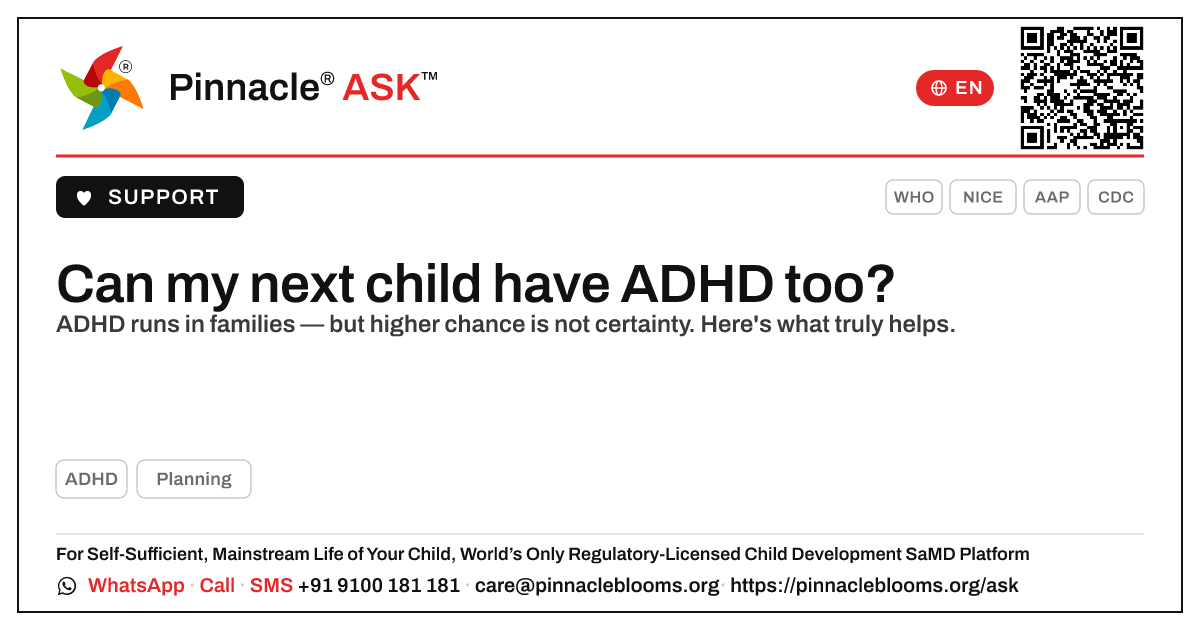
If one child has ADHD, can my next child have it too?
ADHD does run in families, so a younger sibling has a somewhat higher chance of also having it — but higher chance is not certainty, and many siblings never develop it. With a younger child the right stance is gentle watch-and-monitor, as ADHD is reliably recognised from around school age. AbilityScore® is part of Pinnacle’s developmental assessment. Diagnosis, where needed, requires an appropriately qualified healthcare professional.
In this answer 5 sections
Hearing that ADHD can run in families is natural to worry about — but a family tendency is not a verdict, and knowing early is a strength, not a fear.
In short
Yes — ADHD does tend to run in families, so a younger sibling has a somewhat higher chance of also being attentive-and-active in the ADHD way than a child with no family history. But higher chance is not certainty: many siblings of children with ADHD never develop it, and genes are only part of the story. The most useful thing you can do is simply watch your next child's development with gentle, informed eyes — not anxious ones — and seek a check if real concerns appear at the right age.
Understanding the family link
- ADHD is strongly heritable. Research consistently shows a meaningful genetic component, so siblings and children of someone with ADHD are more likely to share the trait. This is about inherited tendencies in attention, activity and impulse regulation — not something a parent caused.
- "More likely" is not "will." Each child is their own person. Many siblings show no ADHD traits at all, and even those who do can present very differently — one child restless and impulsive, another quietly inattentive.
- Genes set the stage, environment shapes the play. Sleep, routine, early language-rich interaction, and a calm predictable home all influence how any tendency unfolds.
- ADHD is reliably recognised from around school-going age (commonly 5–6 years and beyond), when sustained attention and impulse control are genuinely expected. Lively, distractible, energetic behaviour in toddlers and preschoolers is usually typical development — not an early diagnosis. So with a younger child, the right stance is watch-and-monitor, not alarm.
When to seek a check
For your younger child, seek a developmental check if — once they are around school age — you notice persistent difficulty sustaining attention, marked restlessness or impulsivity that shows up across more than one setting (home and school), and that genuinely affects learning, friendships or daily life. Trust the patterns over time, not a single hard day. There is no need to test a calm, thriving toddler simply because an older sibling has ADHD.
The Pinnacle way
AbilityScore® is part of Pinnacle’s developmental assessment. Diagnosis, where needed, requires an appropriately qualified healthcare professional — never from a family history alone, an app or an online form. If you ever have concerns, a clinician-administered structured developmental assessment gives you clarity and, where helpful, a plan through tailored behavioural and attention support. You can also explore how we walk alongside families like yours from the very first question.
Trusted sources
WHO ICD-11 (6A05, Attention deficit hyperactivity disorder); NICE guideline NG87 on ADHD diagnosis and management; the American Academy of Pediatrics via HealthyChildren.org; CDC "Learn the Signs. Act Early." milestone guidance; and the Indian Academy of Pediatrics.
Next step — Worried, or simply want reassurance about your younger child's development? Book a developmental check with a Pinnacle clinician.
This is general information, not a diagnosis — individual assessment and diagnosis require an appropriately qualified healthcare professional.
CONNECT THE ANSWER TO YOUR CHILD’S DAY
Something to notice. Something to discuss.
What to notice
Once your younger child is around school age, watch for persistent inattention, marked restlessness or impulsivity showing up in more than one setting (home and school) and affecting learning, friendships or daily life — trust patterns over time, not a single hard day.
In everyday life
Give your younger child the gift of a calm, predictable rhythm — steady sleep, simple routines and plenty of warm, language-rich play. This supports every child's attention and self-regulation, whatever their family history.
Bring your observations and questions to your child’s professional. Choose activities that suit your child’s comfort, abilities and agreed plan.
Bring your questions to a first visitQuestions families ask
Is ADHD inherited from parents?
ADHD has a strong genetic component, so it does tend to run in families. A child whose parent or sibling has ADHD is more likely to share the tendency — but this is about inherited traits in attention and activity, never something a parent caused, and many family members are unaffected.
Does a higher chance mean my next child definitely will have ADHD?
No. A family link raises the likelihood but does not make it certain. Many siblings of children with ADHD never develop it, and each child is their own person who may present very differently or not at all.
Can I tell if my baby or toddler has ADHD?
ADHD is reliably recognised from around school-going age (commonly 5–6 years and beyond), when sustained attention and impulse control are genuinely expected. Lively, distractible energy in babies and preschoolers is usually typical development, so the right approach with a young child is gentle watch-and-monitor.
Should I get my younger child tested just because an older sibling has ADHD?
There is no need to test a calm, thriving young child simply because of family history. Watch their development with informed, relaxed eyes, and seek a check if genuine concerns appear at school age across more than one setting.
FOLLOW THE SOURCE
References behind this answer.
- Source referenceWHO ICD-11 · Attention deficit hyperactivity disorder
- Source referenceNICE NG87 — ADHD diagnosis & management
- Organisation website · further readingAmerican Academy of Pediatrics — HealthyChildren.org
- Source referenceCDC — Learn the Signs. Act Early.
References are supplied with this answer. An organisation homepage offers further reading; it does not establish an independent review of this page.
Content attribution: SETU Consortium · Pinnacle Blooms Network.
PEOPLE, TOPICS & DEVELOPMENT
See the connections.
Browse the wider question collections connected with this answer’s audience, developmental area and stage.
FROM UNDERSTANDING TO PURPOSEFUL SUPPORT
One question. Your child’s whole life.
Your child’s self-sufficient, mainstream-included life is the purpose from the beginning. At Pinnacle, that purpose shapes what we understand, the goals we choose, the people we bring together, everyday practice and review.
Connect this question with the right support.
Start with your child’s strengths, your observations and what you want everyday life to become.
Make the next conversation useful.
Bring the situations you notice at home or school. We’ll explain a suitable service, centre and first visit, including availability and fees, before you decide.
How PinnacleAI® connects the journeyExplore the seven stages
- 1Understand abilities
A starting picture of your child’s capabilities.
- 2Choose meaningful goals
Readiness and a plan shaped around the child.
- 3Bring the right support together
Suitable therapies and people for those goals.
- 4Carry practice into everyday life
Guidance for family, home and school.
- 5Track and correct
Use observations to adjust the plan.
- 6Reassess and review
Decide what to continue, change or do next.
- 7Grow independence and participation
The child’s life gives each step its purpose.
Explore the whole PinnacleAI® system → · Participation at school and in the community →
PINNACLE’S EVIDENCE, OPEN TO YOU
Look at the evidence behind our work.
Read our research, inspect the original regulatory documents and check what each institutional measure means.
General information supports a conversation with an appropriately qualified professional. Advice, goals and support depend on the individual child.