
YOUR QUESTION. A CLEARER NEXT STEP.
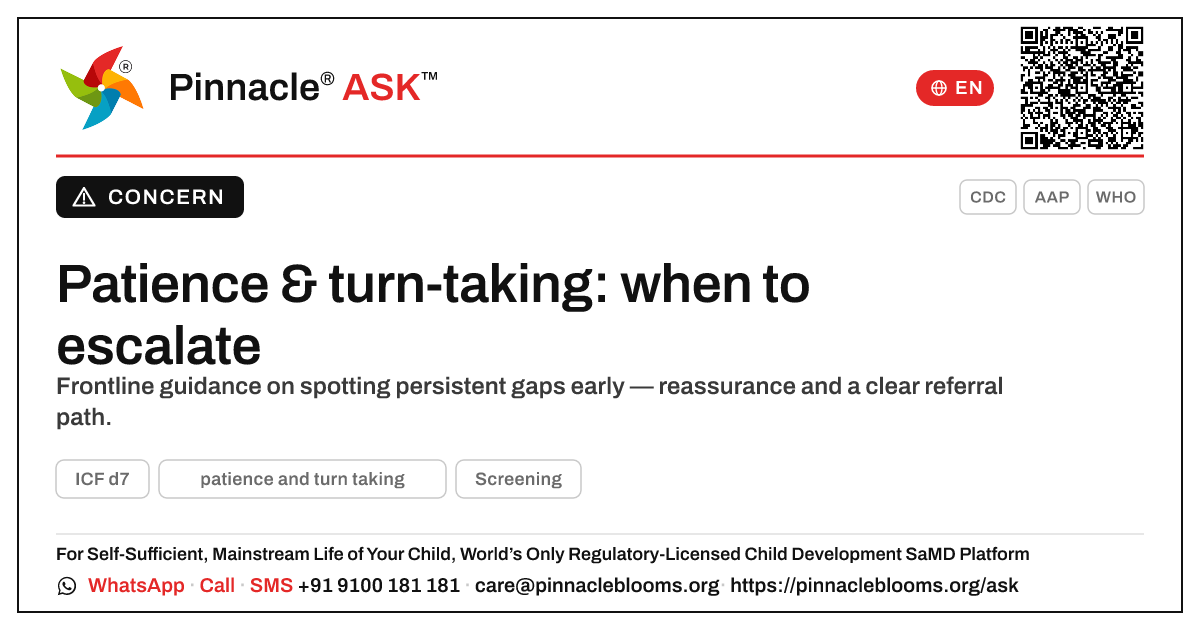
When to escalate concerns about patience and turn-taking
Patience and turn-taking develop gradually, with simple turn-taking by around age 3 and self-control maturing into the school years. A frontline health worker should escalate to a developmental check when the difficulty is clearly behind same-age peers, is not improving over a few months, disrupts play and daily life, or comes alongside delays in language, social connection or play. Escalation means a structured developmental review — not a diagnosis.
In this answer 5 sections
Patience and turn-taking grow slowly through play — and the frontline worker who notices the pattern early is doing vital, protective work.
In short
Patience and turn-taking (ICF d7, interpersonal interactions) develop gradually — most children manage simple back-and-forth and short waits by around 3 years, with self-control still maturing well into the school years. A frontline health worker should escalate to a developmental check when difficulty waiting or sharing is well behind same-age peers, is not improving over a few months, disrupts play, group activities or family life, or travels alongside delays in talking, listening, social connection or play. This is a reason to assess early — never a diagnosis.
What to watch
Most young children find waiting hard; that alone is not a flag. Escalate when you see:
- A clear age gap — by ~3–4 years the child cannot take simple turns in a game even with adult help, or shows no improvement over 2–3 months of gentle practice.
- Distress that disrupts — meltdowns at every wait that get in the way of nursery, play groups or daily routines.
- Travelling with other delays — few words, not responding to name, little eye contact or shared play, or trouble following simple instructions.
- A loss of skill — turn-taking or social play that was present and then faded.
Use your local screening tool, log a short example, and refer to a developmental review rather than waiting and watching alone.
The science
Turn-taking depends on emerging self-regulation, joint attention and language — skills that mature on a wide-but-real timeline. Spotting persistent gaps early matters because support works best when started young. Escalation here means a structured developmental review, not therapy-first or alarm.
The Pinnacle way
A clinical AbilityScore® and any diagnosis are formed only at a Pinnacle Blooms Network centre, under qualified clinician care — never from a screening list. Our clinicians look at how patience and turn-taking sit within the whole picture of communication and play, and our speech therapy team supports the language and social foundations beneath them.
Trusted sources
WHO ICF framework (chapter d7, interpersonal interactions); CDC developmental milestones and "Learn the Signs, Act Early" guidance; American Academy of Pediatrics (healthychildren.org) on social-emotional development and developmental monitoring.
Next step — Trust the pattern you've observed. Book a developmental assessment with a Pinnacle clinician for a calm, structured review.
This is general information, not a diagnosis — individual assessment and diagnosis require an appropriately qualified healthcare professional.
CONNECT THE ANSWER TO YOUR CHILD’S DAY
Something to notice. Something to discuss.
What to notice
Escalate if by ~3–4 years a child cannot take simple turns even with help, shows no improvement over 2–3 months, has meltdowns at every wait that disrupt nursery or routines, or shows other delays — few words, no response to name, little eye contact or shared play, or loss of a skill once present.
In everyday life
Log one short, dated example of how the child handles waiting or sharing in a game — what triggered the difficulty and whether they could be gently brought back. This concrete note gives the developmental reviewer a clear, useful picture.
Bring your observations and questions to your child’s professional. Choose activities that suit your child’s comfort, abilities and agreed plan.
Bring your questions to a first visitQuestions families ask
At what age should turn-taking be established?
Most children manage simple back-and-forth turns in a game by around age 3, often with adult help, while patience and self-control keep maturing into the early school years. Wide variation is normal — a persistent gap over a few months matters more than a single age cut-off.
Is difficulty waiting always a developmental concern?
No. Almost all young children find waiting hard. It becomes a reason for a developmental check only when the difficulty is clearly behind peers, isn't improving, disrupts daily life, or travels with other delays in language, social connection or play.
What does escalation involve?
It means referring the child for a structured developmental review, not starting therapy or making a diagnosis. A frontline worker logs an example, uses the local screening tool and routes the family to a developmental check.
FOLLOW THE SOURCE
References behind this answer.
- Source referenceCDC developmental milestones & Learn the Signs, Act Early
- Organisation website · further readingAAP healthychildren.org — social-emotional development
- Organisation website · further readingWHO ICF — interpersonal interactions (d7)
References are supplied with this answer. An organisation homepage offers further reading; it does not establish an independent review of this page.
Content attribution: SETU Consortium · Pinnacle Blooms Network.
PEOPLE, TOPICS & DEVELOPMENT
See the connections.
Browse the wider question collections connected with this answer’s audience, developmental area and stage.
FROM UNDERSTANDING TO PURPOSEFUL SUPPORT
One question. Your child’s whole life.
Your child’s self-sufficient, mainstream-included life is the purpose from the beginning. At Pinnacle, that purpose shapes what we understand, the goals we choose, the people we bring together, everyday practice and review.
Connect this question with the right support.
Start with your child’s strengths, your observations and what you want everyday life to become.
Make the next conversation useful.
Bring the situations you notice at home or school. We’ll explain a suitable service, centre and first visit, including availability and fees, before you decide.
How PinnacleAI® connects the journeyExplore the seven stages
- 1Understand abilities
A starting picture of your child’s capabilities.
- 2Choose meaningful goals
Readiness and a plan shaped around the child.
- 3Bring the right support together
Suitable therapies and people for those goals.
- 4Carry practice into everyday life
Guidance for family, home and school.
- 5Track and correct
Use observations to adjust the plan.
- 6Reassess and review
Decide what to continue, change or do next.
- 7Grow independence and participation
The child’s life gives each step its purpose.
Explore the whole PinnacleAI® system → · Participation at school and in the community →
PINNACLE’S EVIDENCE, OPEN TO YOU
Look at the evidence behind our work.
Read our research, inspect the original regulatory documents and check what each institutional measure means.
General information supports a conversation with an appropriately qualified professional. Advice, goals and support depend on the individual child.