
YOUR QUESTION. A CLEARER NEXT STEP.
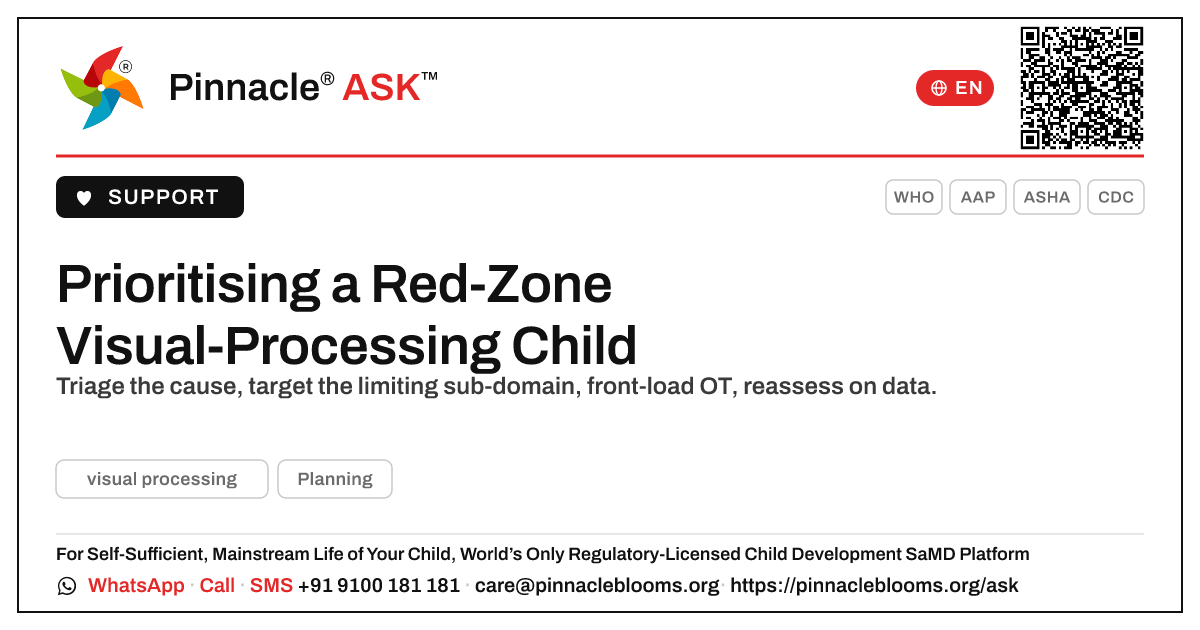
Prioritising a red-zone visual-processing child
A red-zone visual-processing flag warrants priority scheduling: rule out an ocular or neurological cause in parallel, identify the limiting sub-domain, weight by functional impact, and front-load occupational therapy with short-cycle goals and tight reassessment. The banding is a clinician-administered structured assessment, not a diagnosis. AbilityScore® is part of Pinnacle’s developmental assessment. Diagnosis, where needed, requires an appropriately qualified healthcare professional.
In this answer 5 sections
When a child's visual processing scores in the red zone, the priority is not just sharper eyes — it is a swift, structured plan that protects every skill resting on it.
In short
A red-zone visual-processing result signals high need and warrants priority scheduling — but "red" is a clinician-administered structured-assessment flag, not a diagnosis. Prioritise by first ruling out an unaddressed ocular or neurological cause (refer for an eye/medical review in parallel), then front-loading occupational therapy that targets the specific visual-processing components most blocking daily function and learning. Frequency and intensity should match functional impact, with clear short-term goals and tight reassessment.
How to prioritise the red-zone child
- Triage the cause first. A red flag in visual processing can sit on top of an uncorrected refractive error, oculomotor problem or neurological concern. Refer concurrently for a vision/medical examination so therapy is not working against an untreated substrate.
- Identify the limiting sub-domain. Visual processing spans discrimination, spatial relations, visual memory, figure-ground, visual-motor integration and visual attention. Prioritise the component with the greatest functional cost — handwriting, reading readiness, safe navigation, self-care.
- Weight by functional impact, not score alone. A child whose visual-processing difficulty is derailing classroom participation, safety or feeding self-direction moves ahead of one with an isolated, well-compensated finding.
- Front-load intensity, then taper. Red zone typically justifies higher initial OT frequency with environmental and curricular accommodations layered in immediately, reviewed at short intervals.
- Coordinate, don't silo. Align with speech-language, special education and the family so visual-processing supports reinforce communication and learning goals rather than competing for the child's stamina.
- Set measurable short-cycle goals. Define 4–6 week functional targets and re-screen to confirm the child is shifting out of the red zone, escalating or de-escalating intensity on the data.
When to escalate beyond therapy
Escalate promptly for any new or rapid visual decline, asymmetry, suspected field loss, or visual changes alongside neurological signs — these are medical-referral matters, not therapy-first ones. Therapy proceeds best once a treatable medical or ocular cause has been examined.
The Pinnacle way
AbilityScore® is part of Pinnacle’s developmental assessment. Diagnosis, where needed, requires an appropriately qualified healthcare professional — the red/amber/green banding is a clinician-administered structured assessment, never a self-scored or app-generated label. Drawing on 2.5 billion+ data points and 25 million+ therapy sessions, our team builds a precise, prioritised plan. Explore our network, our occupational therapy pathway, and how the AbilityScore® is determined.
Trusted sources
WHO ICD-11 framework for functioning; American Academy of Pediatrics (HealthyChildren.org) guidance on vision and development; American Speech-Language-Hearing Association on visual-supported learning interactions; CDC developmental milestone resources.
Next step — Refer a red-zone child for a clinician-led visual-processing assessment and prioritised OT plan — partner with a Pinnacle Blooms Network centre.
This is general clinical information, not a diagnosis — individual assessment and diagnosis require an appropriately qualified healthcare professional.
CONNECT THE ANSWER TO YOUR CHILD’S DAY
Something to notice. Something to discuss.
What to notice
Watch for difficulty with figure-ground, spatial relations, visual memory or visual-motor integration that derails reading, handwriting, safe navigation or self-care; and any rapid visual change or asymmetry that needs medical review.
In everyday life
Reduce visual clutter in the child's work area and break visual-motor tasks into short, high-success steps — early wins build the stamina the harder targets need.
Bring your observations and questions to your child’s professional. Choose activities that suit your child’s comfort, abilities and agreed plan.
Bring your questions to a first visitQuestions families ask
Does a red-zone visual-processing result mean the child has a diagnosis?
No. The red/amber/green banding is a clinician-administered structured assessment flag indicating level of need, not a diagnosis. Any diagnosis is formed only at a Pinnacle Blooms Network centre under qualified clinician care.
Why refer for an eye or medical check before intensive therapy?
A visual-processing red flag can sit on top of an uncorrected refractive error, oculomotor issue or neurological cause. A parallel vision/medical review ensures therapy is not working against an untreated underlying substrate.
How is therapy intensity decided for a red-zone child?
Intensity is weighted by functional impact on learning, safety and daily living — not by the score alone. Red zone typically justifies front-loaded occupational therapy with accommodations, then tapering guided by short-cycle reassessment.
FOLLOW THE SOURCE
References behind this answer.
- Organisation website · further readingWHO ICD-11 framework for functioning
- Organisation website · further readingAAP HealthyChildren.org — vision and child development
- Organisation website · further readingASHA — visual supports in communication and learning
- Organisation website · further readingCDC — developmental milestone resources
References are supplied with this answer. An organisation homepage offers further reading; it does not establish an independent review of this page.
Content attribution: SETU Consortium · Pinnacle Blooms Network.
PEOPLE, TOPICS & DEVELOPMENT
See the connections.
Browse the wider question collections connected with this answer’s audience, developmental area and stage.
FROM UNDERSTANDING TO PURPOSEFUL SUPPORT
One question. Your child’s whole life.
Your child’s self-sufficient, mainstream-included life is the purpose from the beginning. At Pinnacle, that purpose shapes what we understand, the goals we choose, the people we bring together, everyday practice and review.
Connect this question with the right support.
Start with your child’s strengths, your observations and what you want everyday life to become.
Make the next conversation useful.
Bring the situations you notice at home or school. We’ll explain a suitable service, centre and first visit, including availability and fees, before you decide.
How PinnacleAI® connects the journeyExplore the seven stages
- 1Understand abilities
A starting picture of your child’s capabilities.
- 2Choose meaningful goals
Readiness and a plan shaped around the child.
- 3Bring the right support together
Suitable therapies and people for those goals.
- 4Carry practice into everyday life
Guidance for family, home and school.
- 5Track and correct
Use observations to adjust the plan.
- 6Reassess and review
Decide what to continue, change or do next.
- 7Grow independence and participation
The child’s life gives each step its purpose.
Explore the whole PinnacleAI® system → · Participation at school and in the community →
PINNACLE’S EVIDENCE, OPEN TO YOU
Look at the evidence behind our work.
Read our research, inspect the original regulatory documents and check what each institutional measure means.
General information supports a conversation with an appropriately qualified professional. Advice, goals and support depend on the individual child.