
YOUR QUESTION. A CLEARER NEXT STEP.
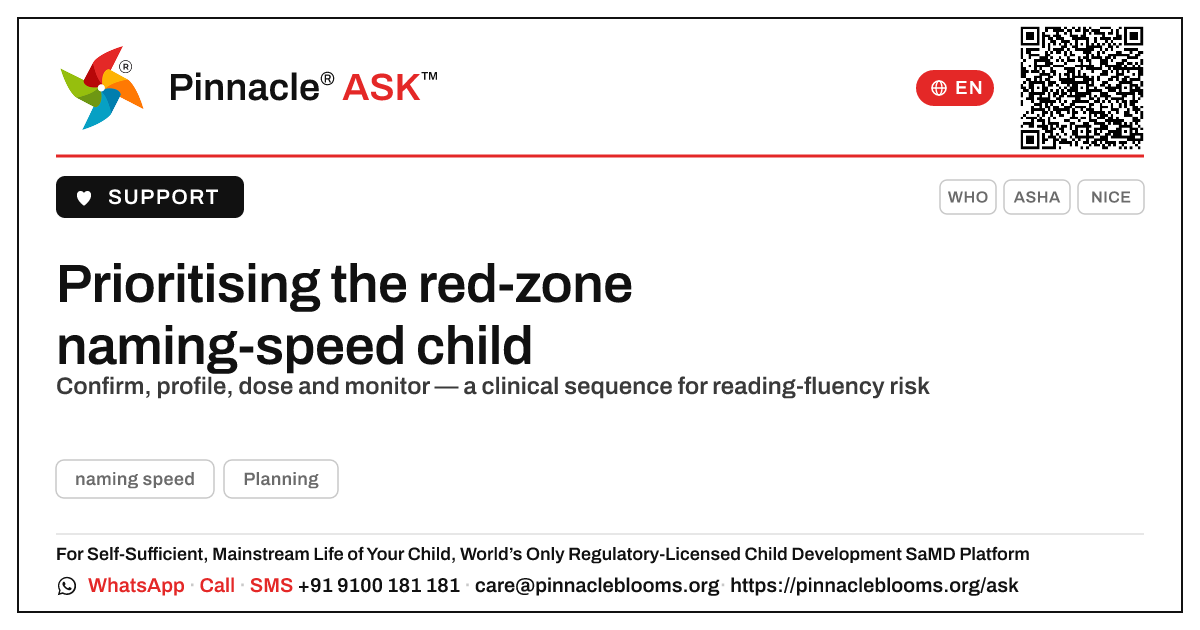
Prioritising a child in the red zone for naming speed
A red-zone rapid automatised naming result is a high-priority flag for reading-fluency risk, not a diagnosis. Prioritise by confirming the finding, ruling out sensory and word-retrieval confounds, profiling RAN against phonological awareness and decoding, then setting automaticity-focused goals with frequent progress monitoring and earlier, more intensive cycles. AbilityScore® is part of Pinnacle’s developmental assessment. Diagnosis, where needed, requires an appropriately qualified healthcare professional.
In this answer 5 sections
A red-zone naming-speed result is a signal to act early — rapid automaticity is the engine beneath fluent reading, and timely support changes trajectories.
In short
Treat a red-zone rapid automatised naming (RAN) result as a high-priority flag for emerging reading-fluency risk, not as a diagnosis in itself. Prioritise this child within your caseload by triangulating RAN against phonological awareness, letter-sound knowledge and oral language, ruling out vision, hearing and word-retrieval confounds, then setting tightly-targeted automaticity and fluency goals with frequent progress monitoring. Earlier, more intensive cycles tend to yield the strongest gains, so a red zone warrants prompt scheduling rather than watchful waiting.
Prioritising the red-zone child — a clinical sequence
- Confirm before you escalate. Re-check that the slow naming is genuine automaticity weakness, not a transient state (fatigue, attention, anxiety) or a sensory confound. Screen vision and hearing status and review whether expressive word-finding difficulty is contributing.
- Profile, don't isolate. RAN sits within the double-deficit model: a child slow on RAN and weak in phonological awareness typically carries higher risk and merits earlier, more intensive intervention than a single-deficit profile. Map RAN against PA, decoding and oral language to set the priority tier.
- Set automaticity-focused goals. Build sub-lexical and lexical retrieval speed through structured, high-repetition practice — rapid letter/digit naming drills, timed sight-word and high-frequency word sets, and repeated reading for fluency — layered with continued phonics where decoding is weak.
- Dose for impact. Red zone implies shorter goal-review cycles, higher session frequency and tighter progress monitoring (curve-based, e.g. words-correct-per-minute and RAN re-checks) so you can adjust dosage early.
- Coordinate the team. Share the profile with the educational team and family so classroom accommodations (extra processing time, reduced copying load) reinforce therapy gains.
When to refer onward
If red-zone naming speed co-occurs with persistent decoding failure beyond expected age, or with broader language or attention concerns, route to multidisciplinary review. A specific learning disability label is appropriately considered only from around 6–8 years; before that, frame findings as a monitored risk profile and intervene on the underlying skills rather than diagnosing.
The Pinnacle way
AbilityScore® is part of Pinnacle’s developmental assessment. Diagnosis, where needed, requires an appropriately qualified healthcare professional — the AbilityScore® is a clinician-administered structured assessment, never an app score, and it situates a single red-zone measure within the child's whole communication profile. Begin with the home page for the network's approach, shape the literacy-and-language plan through speech therapy, and see how the profile is built at what the AbilityScore® is and how it is calculated.
Trusted sources
WHO ICD-11 framing of developmental learning disorders; American Speech-Language-Hearing Association guidance on literacy and the role of the SLP; NICE guidance on supporting children with reading and language difficulties.
Next step — Have a child flagged red for naming speed? Partner with a Pinnacle clinician to build a structured literacy-and-language plan.
This is general information, not a diagnosis — individual assessment and diagnosis require an appropriately qualified healthcare professional.
CONNECT THE ANSWER TO YOUR CHILD’S DAY
Something to notice. Something to discuss.
What to notice
Watch for red-zone naming speed co-occurring with weak phonological awareness or persistent decoding failure — a double-deficit profile carries higher reading-fluency risk and warrants earlier, more intensive intervention.
In everyday life
Build short, daily timed naming and repeated-reading bursts — automaticity grows with frequent low-stakes repetition, not long pressured sessions.
Bring your observations and questions to your child’s professional. Choose activities that suit your child’s comfort, abilities and agreed plan.
Bring your questions to a first visitQuestions families ask
Does a red-zone naming-speed score mean the child has dyslexia?
No. Naming speed is one risk marker, not a diagnosis. It must be interpreted within a full profile alongside phonological awareness, decoding and oral language, and after ruling out sensory and attention confounds. A specific learning disability is appropriately considered only from around 6–8 years.
Why does the double-deficit model matter for prioritisation?
A child slow on rapid automatised naming and also weak in phonological awareness typically carries higher reading-fluency risk than a child with a single deficit, and so warrants earlier, more intensive intervention and tighter progress monitoring.
What goals best target slow naming speed?
Automaticity-focused work: structured high-repetition rapid naming drills, timed high-frequency and sight-word sets, and repeated reading for fluency, layered with continued phonics where decoding remains weak.
FOLLOW THE SOURCE
References behind this answer.
- Organisation website · further readingWHO ICD-11: developmental learning disorders
- Organisation website · further readingASHA: SLP role in literacy and reading difficulties
- Organisation website · further readingNICE guidance on language and reading support
References are supplied with this answer. An organisation homepage offers further reading; it does not establish an independent review of this page.
Content attribution: SETU Consortium · Pinnacle Blooms Network.
PEOPLE, TOPICS & DEVELOPMENT
See the connections.
Browse the wider question collections connected with this answer’s audience, developmental area and stage.
FROM UNDERSTANDING TO PURPOSEFUL SUPPORT
One question. Your child’s whole life.
Your child’s self-sufficient, mainstream-included life is the purpose from the beginning. At Pinnacle, that purpose shapes what we understand, the goals we choose, the people we bring together, everyday practice and review.
Connect this question with the right support.
Start with your child’s strengths, your observations and what you want everyday life to become.
Make the next conversation useful.
Bring the situations you notice at home or school. We’ll explain a suitable service, centre and first visit, including availability and fees, before you decide.
How PinnacleAI® connects the journeyExplore the seven stages
- 1Understand abilities
A starting picture of your child’s capabilities.
- 2Choose meaningful goals
Readiness and a plan shaped around the child.
- 3Bring the right support together
Suitable therapies and people for those goals.
- 4Carry practice into everyday life
Guidance for family, home and school.
- 5Track and correct
Use observations to adjust the plan.
- 6Reassess and review
Decide what to continue, change or do next.
- 7Grow independence and participation
The child’s life gives each step its purpose.
Explore the whole PinnacleAI® system → · Participation at school and in the community →
PINNACLE’S EVIDENCE, OPEN TO YOU
Look at the evidence behind our work.
Read our research, inspect the original regulatory documents and check what each institutional measure means.
General information supports a conversation with an appropriately qualified professional. Advice, goals and support depend on the individual child.