
YOUR QUESTION. A CLEARER NEXT STEP.
Prioritising a green-zone pronunciation result in therapy
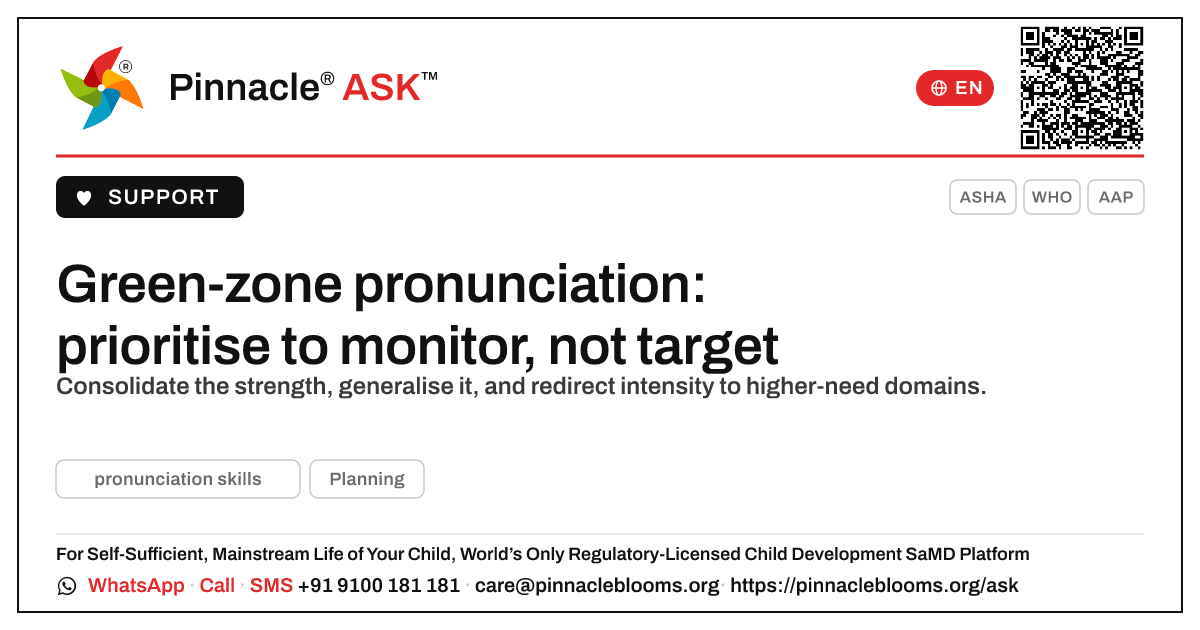
A child in the green zone for pronunciation skills is at or above age expectation, so the therapist should monitor rather than actively target this domain, set light-touch maintenance and generalisation goals, use the strength to scaffold weaker areas, and redirect intensity to amber and red domains while re-screening at review. AbilityScore® is part of Pinnacle’s developmental assessment. Diagnosis, where needed, requires an appropriately qualified healthcare professional.
In this answer 5 sections
A green-zone result is not a finish line — it is a green light to consolidate, generalise and redeploy your time where the need is greatest.
In short
A child in the green zone for pronunciation (speech sound) skills is performing at or above age expectation, so this domain should be monitored, not actively targeted. Prioritise it low for direct intervention, fold any maintenance work into broader functional communication goals, and redirect your therapeutic intensity towards amber and red domains. Green means consolidate and watch — it does not mean discharge from observation.
How to prioritise within the plan
- De-prioritise for direct articulation drills. Reserve high-frequency phonological or motor-speech blocks for domains showing functional impact. A green score signals adequate intelligibility and age-appropriate phonetic inventory.
- Set a light-touch maintenance goal. Embed pronunciation incidentally within expressive-language, narrative or social-communication tasks so the skill generalises across contexts and stays robust without dedicated sessions.
- Use it as a strength to scaffold weaker domains. Strong speech-sound production can anchor work on phonological awareness, emergent literacy, or fluency where those areas score lower.
- Schedule periodic re-screening. Confirm stability at the next review cycle — green status can shift with new phoneme demands, multilingual load, or as utterance complexity increases.
- Document the rationale. Record that pronunciation is a relative strength so the wider team and family understand why intensity sits elsewhere.
When to re-prioritise upward
Move pronunciation back into active targeting if intelligibility drops in connected speech despite an adequate inventory, if a family or educator reports new listener-breakdown, if regression appears at review, or if emerging literacy reveals phonological-awareness gaps that a sound-system focus would resolve. RAG zoning is dynamic — reassess at each structured review.
The Pinnacle way
AbilityScore® is part of Pinnacle’s developmental assessment. Diagnosis, where needed, requires an appropriately qualified healthcare professional — the RAG zone is a clinician-administered structured snapshot, not an app output, and never a standalone diagnosis. Understand how zoning is derived in how the AbilityScore® is calculated, align maintenance and generalisation goals through speech therapy planning, and explore the wider engine at Pinnacle Blooms Network.
Trusted sources
American Speech-Language-Hearing Association guidance on speech sound disorders and intervention prioritisation; WHO ICD-11 framing of speech sound development; American Academy of Pediatrics developmental surveillance principles.
Next step — Reviewing a child's domain profile? Plan a strengths-led therapy programme with a Pinnacle clinician.
This is general information, not a diagnosis — individual assessment and diagnosis require an appropriately qualified healthcare professional.
CONNECT THE ANSWER TO YOUR CHILD’S DAY
Something to notice. Something to discuss.
What to notice
Watch for drops in connected-speech intelligibility despite an adequate sound inventory, new listener-breakdown reports from family or school, regression at review, or phonological-awareness gaps emerging with early literacy — any of which warrant moving pronunciation back into active targeting.
In everyday life
Keep pronunciation work incidental — embed it inside richer language and narrative play so the skill generalises and stays robust without dedicated drill sessions.
Bring your observations and questions to your child’s professional. Choose activities that suit your child’s comfort, abilities and agreed plan.
Bring your questions to a first visitQuestions families ask
Does a green zone mean I can discharge the child from speech support?
Not necessarily. Green indicates age-appropriate pronunciation that needs monitoring rather than active targeting; the child may still need support in other communication or developmental domains, and pronunciation should be re-screened at each review to confirm stability.
Should I set any pronunciation goal at all for a green-zone child?
A light-touch maintenance goal embedded within broader expressive-language, narrative or social-communication tasks is usually sufficient — it keeps the skill generalising across contexts without consuming dedicated session time better spent on higher-need domains.
Can a green-zone domain shift back into amber or red?
Yes. RAG zoning is dynamic. As utterance complexity, multilingual load or literacy demands increase, intelligibility can change, so periodic re-screening and clear documentation of the strength are important.
FOLLOW THE SOURCE
References behind this answer.
- Source referenceASHA — Speech Sound Disorders (clinical guidance)
- Organisation website · further readingWHO ICD-11 — developmental speech sound classification
- Organisation website · further readingAmerican Academy of Pediatrics — developmental surveillance
References are supplied with this answer. An organisation homepage offers further reading; it does not establish an independent review of this page.
Content attribution: SETU Consortium · Pinnacle Blooms Network.
PEOPLE, TOPICS & DEVELOPMENT
See the connections.
Browse the wider question collections connected with this answer’s audience, developmental area and stage.
FROM UNDERSTANDING TO PURPOSEFUL SUPPORT
One question. Your child’s whole life.
Your child’s self-sufficient, mainstream-included life is the purpose from the beginning. At Pinnacle, that purpose shapes what we understand, the goals we choose, the people we bring together, everyday practice and review.
Connect this question with the right support.
Start with your child’s strengths, your observations and what you want everyday life to become.
Make the next conversation useful.
Bring the situations you notice at home or school. We’ll explain a suitable service, centre and first visit, including availability and fees, before you decide.
How PinnacleAI® connects the journeyExplore the seven stages
- 1Understand abilities
A starting picture of your child’s capabilities.
- 2Choose meaningful goals
Readiness and a plan shaped around the child.
- 3Bring the right support together
Suitable therapies and people for those goals.
- 4Carry practice into everyday life
Guidance for family, home and school.
- 5Track and correct
Use observations to adjust the plan.
- 6Reassess and review
Decide what to continue, change or do next.
- 7Grow independence and participation
The child’s life gives each step its purpose.
Explore the whole PinnacleAI® system → · Participation at school and in the community →
PINNACLE’S EVIDENCE, OPEN TO YOU
Look at the evidence behind our work.
Read our research, inspect the original regulatory documents and check what each institutional measure means.
General information supports a conversation with an appropriately qualified professional. Advice, goals and support depend on the individual child.