
YOUR QUESTION. A CLEARER NEXT STEP.
Prioritising a child in the green zone for imagination
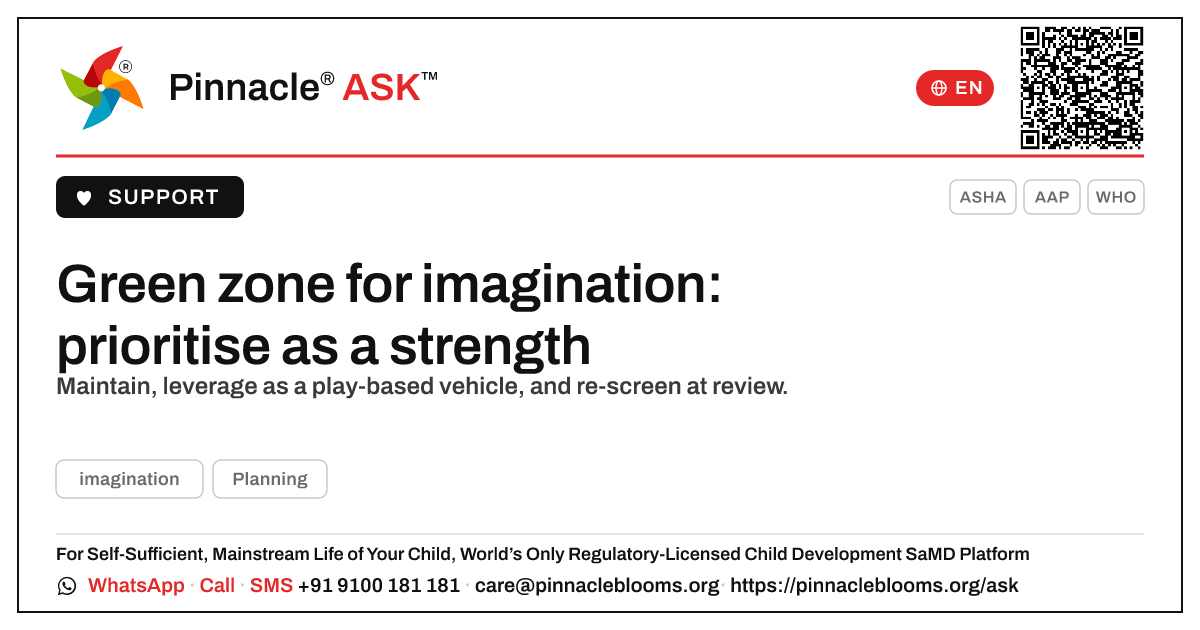
A green-zone score for imagination signals a strength to maintain and leverage, not remediate. The therapist prioritises direct time toward amber and red domains while using imaginative play as a vehicle for language, social and regulation goals, stretching the skill with richer narratives and re-screening at review. AbilityScore® is part of Pinnacle’s developmental assessment. Diagnosis, where needed, requires an appropriately qualified healthcare professional.
In this answer 5 sections
When a child sits comfortably in the green zone for imagination, the therapist's job shifts from remediation to protecting and stretching a genuine strength.
In short
A green-zone result for imagination means the child's pretend play, narrative and symbolic thinking are tracking at or above expectation — so this skill is a strength to leverage, not a target to remediate. Prioritise it low for direct intervention, but high as a therapeutic vehicle: route imaginative play into goals for language, social reciprocity, regulation and motor planning where those domains need more support. Re-screen periodically and document the strength explicitly in the plan so it is not lost when attention turns to amber and red domains.
How to prioritise in practice
- Triage by relative need. Green = monitor and maintain. Allocate direct session time to amber and red domains first; imagination becomes the medium through which those goals are delivered.
- Use it as a scaffold. A robust imaginative repertoire is a high-yield channel for expressive language expansion, theory-of-mind and joint-attention work, sequencing and narrative skills, and graded emotional regulation through role-play.
- Stretch, don't stall. Even a strength benefits from enrichment — introduce more complex narratives, multi-step pretend sequences, and peer-mediated symbolic play to keep the trajectory rising and generalise into social contexts.
- Watch for masking. Strong solitary imaginative play can occasionally co-exist with social-communication or rigidity concerns; confirm that green imagination is paired with shared, flexible play, not only scripted solo narratives.
- Coach the parent. Brief carers on following the child's imaginative lead at home so the strength continues to drive incidental learning between sessions.
When to re-evaluate
Re-screen the domain at planned review points or sooner if play becomes notably repetitive, loses flexibility, or regresses. A drop from green warrants closer profiling rather than an assumption that a one-time strength is permanent. Equally, if imagination outpaces language or social use, flag for inter-domain review.
The Pinnacle way
AbilityScore® is part of Pinnacle’s developmental assessment. Diagnosis, where needed, requires an appropriately qualified healthcare professional — never from an app or single screen. The structured AbilityScore® profile shows where imagination sits relative to other domains so you can build a plan that leverages strengths while targeting need. Where imaginative play is the chosen vehicle, our occupational therapy and speech therapy teams co-plan goals so a green-zone strength does real work. Explore more developmental support at Pinnacle Blooms Network.
Trusted sources
WHO ICD-11 developmental framework; American Speech-Language-Hearing Association guidance on play-based and symbolic-play approaches; AAP / HealthyChildren.org on play as a driver of development.
Next step — Want to turn a child's imaginative strength into measurable cross-domain progress? Partner with a Pinnacle clinician to build the plan.
This is general information, not a diagnosis — individual assessment and diagnosis require an appropriately qualified healthcare professional.
CONNECT THE ANSWER TO YOUR CHILD’S DAY
Something to notice. Something to discuss.
What to notice
Watch that green imagination is paired with shared, flexible play rather than only scripted solo narratives, and re-evaluate if play becomes repetitive, rigid or regresses, or if imagination outpaces language and social use.
In everyday life
Coach carers to follow the child's imaginative lead at home and gently add a new twist or extra step to pretend scenarios, so the strength keeps driving language and social learning between sessions.
Bring your observations and questions to your child’s professional. Choose activities that suit your child’s comfort, abilities and agreed plan.
Bring your questions to a first visitQuestions families ask
Does a green-zone imagination score mean no intervention is needed?
Not necessarily. It means imagination is a relative strength requiring maintenance rather than direct remediation. Direct session time is best allocated to amber and red domains, while imagination is used as a high-yield vehicle for language, social and regulation goals.
Can a strong imagination still hide a concern?
Yes. Robust solitary or scripted pretend play can co-exist with social-communication or rigidity concerns. Confirm that imaginative play is shared, flexible and reciprocal — not only complex solo narratives — and flag for inter-domain review if play is rigid.
How often should a green-zone domain be re-screened?
Re-screen at planned plan-review points, or sooner if play loses flexibility, becomes repetitive or regresses. A green result is a snapshot, not a permanent state, so periodic confirmation keeps the plan accurate.
FOLLOW THE SOURCE
References behind this answer.
- Organisation website · further readingASHA — play-based and symbolic-play approaches
- Organisation website · further readingAAP HealthyChildren.org — the importance of play in development
- Organisation website · further readingWHO ICD-11 developmental framework
References are supplied with this answer. An organisation homepage offers further reading; it does not establish an independent review of this page.
Content attribution: SETU Consortium · Pinnacle Blooms Network.
PEOPLE, TOPICS & DEVELOPMENT
See the connections.
Browse the wider question collections connected with this answer’s audience, developmental area and stage.
FROM UNDERSTANDING TO PURPOSEFUL SUPPORT
One question. Your child’s whole life.
Your child’s self-sufficient, mainstream-included life is the purpose from the beginning. At Pinnacle, that purpose shapes what we understand, the goals we choose, the people we bring together, everyday practice and review.
Connect this question with the right support.
Start with your child’s strengths, your observations and what you want everyday life to become.
Make the next conversation useful.
Bring the situations you notice at home or school. We’ll explain a suitable service, centre and first visit, including availability and fees, before you decide.
How PinnacleAI® connects the journeyExplore the seven stages
- 1Understand abilities
A starting picture of your child’s capabilities.
- 2Choose meaningful goals
Readiness and a plan shaped around the child.
- 3Bring the right support together
Suitable therapies and people for those goals.
- 4Carry practice into everyday life
Guidance for family, home and school.
- 5Track and correct
Use observations to adjust the plan.
- 6Reassess and review
Decide what to continue, change or do next.
- 7Grow independence and participation
The child’s life gives each step its purpose.
Explore the whole PinnacleAI® system → · Participation at school and in the community →
PINNACLE’S EVIDENCE, OPEN TO YOU
Look at the evidence behind our work.
Read our research, inspect the original regulatory documents and check what each institutional measure means.
General information supports a conversation with an appropriately qualified professional. Advice, goals and support depend on the individual child.